
5G Financing in Pakistan: A Policy Everyone Supports but Nobody Can Complete

Samsung Galaxy A26 5G
The Promise and the Pause
On paper, Pakistan’s 5G rollout looks complete. The March 2025 spectrum auction laid the groundwork, Jazz and Zong already operate 5G networks, and the merged Telenor-Ufone entity commands the largest 5G portfolio in the country. In every measurable sense, next-generation connectivity has arrived.
Yet one critical initiative that could unlock mass adoption remains stalled—not by disagreement, but by paperwork. Despite universal public backing from telecom operators and government bodies, a proposed instalment scheme to make 5G phones affordable to middle-income Pakistanis has failed to advance past the formal submission stage. The Ministry of IT and Telecommunication and the PTA are waiting for the signed commitments that would let the program move forward—commitments that, officially at least, no one is opposing.
What the Instalment Scheme Actually Proposes
The core idea is not complicated. Entry-level 5G smartphones in Pakistan currently start at roughly Rs 60,000 to Rs 75,000 for the most affordable options, with mid-range 5G devices sitting between Rs 80,000 and Rs 150,000. Flagship 5G handsets from Samsung, Apple, and other brands run from Rs 200,000 upward. For a buyer in a smaller city earning a median household income, paying that amount upfront is simply not possible.
The proposed policy would allow telecom operators, working in partnership with banks or licensed financing companies, to offer 5G handsets on structured monthly payment plans. A buyer could walk into a Jazz or Zong franchise, choose a PTA-approved 5G device, and pay for it in equal monthly instalments spread over 12 to 24 months, much the way car financing or home appliance schemes already work in Pakistan.
Jazz President Kazim Mujtaba has been the loudest voice pushing this forward. His argument is broader than just low-income access. Many middle-income consumers who could technically afford a 5G phone are simply unwilling to make a large one-time payment for a device they will replace in two or three years. An instalment option changes the psychological barrier, not just the financial one.
Who Is On Board, and Who Has Not Formally Responded
On paper, all three major operators are aligned. Jazz has advocated for the policy the longest. Ufone signed on early. Zong joined publicly last month, with Sajid Munir, head of marketing at Zong, stating at a recent media workshop that handset financing will help cater to rising demand for high-end 5G devices once rollout accelerates.
The problem is that public statements and formal regulatory submissions are not the same thing. Reports citing sources at the IT Ministry and PTA indicate that at least one major operator’s official written response has still not reached the government, despite the positive public language. When asked directly, a Zong spokesperson said the company fully supports the industry-wide initiative and is working closely with the regulator and stakeholders to finalise a framework that benefits customers and the broader industry. That language describes a process still ongoing, not one that has been completed.
The result is a policy that is functionally blocked, not by opposition, but by the gap between intent and paperwork.
Why Every Month of Delay Has a Real Cost
The window for driving early 5G adoption is open right now. Consumers are aware that 5G has launched. Curiosity is at its highest point. This is exactly when an affordability policy would have the greatest impact on subscriber numbers, which in turn strengthens the business case for operators to build more 5G towers.
Without the instalment scheme, 5G in Pakistan remains a technology for buyers who can already afford to pay Rs 80,000 or more upfront. That is, by definition, a small share of the population. The government’s stated goal is digital inclusion. Limiting 5G access to premium buyers is the opposite of that goal.
There is also a load shedding angle that rarely gets mentioned in policy discussions. In cities and towns where power cuts still run several hours a day, buyers are increasingly prioritising phones with large batteries. Many of the most affordable 5G handsets, which would be the primary target of an instalment scheme, carry 5,000 mAh or larger batteries that hold up well through outages. Making these devices affordable through financing would serve both the 5G adoption goal and the practical daily reality of Pakistani buyers.
Beyond urban centres, stakeholders have noted that a successful 5G rollout will push improved 4G coverage into currently underserved areas. That coverage expansion will create new demand for smartphones in regions that have never had reliable data access. That demand surge needs an affordability answer, not just a network one.
The USF Motorway Suggestion
Alongside the instalment scheme discussion, Jazz President Kazim Mujtaba raised a separate connectivity gap that financing alone cannot solve. He suggested that once 5G rollout matures, the government should commission projects under the Universal Service Fund (USF) to ensure connectivity along Pakistan’s motorway network.
His reasoning is straightforward: no single operator has a viable business case to build towers along motorways, because the subscriber density does not justify the infrastructure cost. But motorway connectivity matters for road safety, emergency response, long-haul freight, and millions of daily travellers. USF financing, which exists specifically to fund connectivity in commercially unviable areas, is the right mechanism for this. It is a practical suggestion, and it deserves its own policy track separate from the handset instalment debate.
Current 5G Phone Prices in Pakistan: What Buyers Are Actually Facing
To understand why the instalment policy matters, it helps to look at what 5G phones actually cost at Hafeez Centre in Lahore or on Daraz right now. PTA-approved prices for the most commonly discussed 5G handsets are listed below. Note that grey market units are cheaper but carry PTA compliance risk and may face SIM blocking.
| Phone | Price (PKR, PTA Approved) | RAM | Storage | Battery | Display | Main Camera |
|---|---|---|---|---|---|---|
| Samsung Galaxy A36 5G | Rs 74,999 | 8 GB | 128 GB | 5,000 mAh | 6.7-inch Super AMOLED | 50 MP |
| Samsung Galaxy A56 5G | Rs 109,999 | 8 GB | 256 GB | 5,000 mAh | 6.7-inch Super AMOLED | 50 MP |
| Xiaomi Redmi Note 14 Pro 5G | Rs 89,999 | 8 GB | 256 GB | 5,110 mAh | 6.67-inch AMOLED | 50 MP |
| OnePlus Nord CE 4 5G | Rs 84,999 | 8 GB | 256 GB | 5,500 mAh | 6.7-inch AMOLED | 50 MP |
| Samsung Galaxy S25 | Rs 249,999 | 12 GB | 256 GB | 4,000 mAh | 6.2-inch Dynamic AMOLED | 50 MP |
| iPhone 16 | Rs 289,999 | 8 GB | 128 GB | 3,561 mAh | 6.1-inch Super Retina XDR | 48 MP |
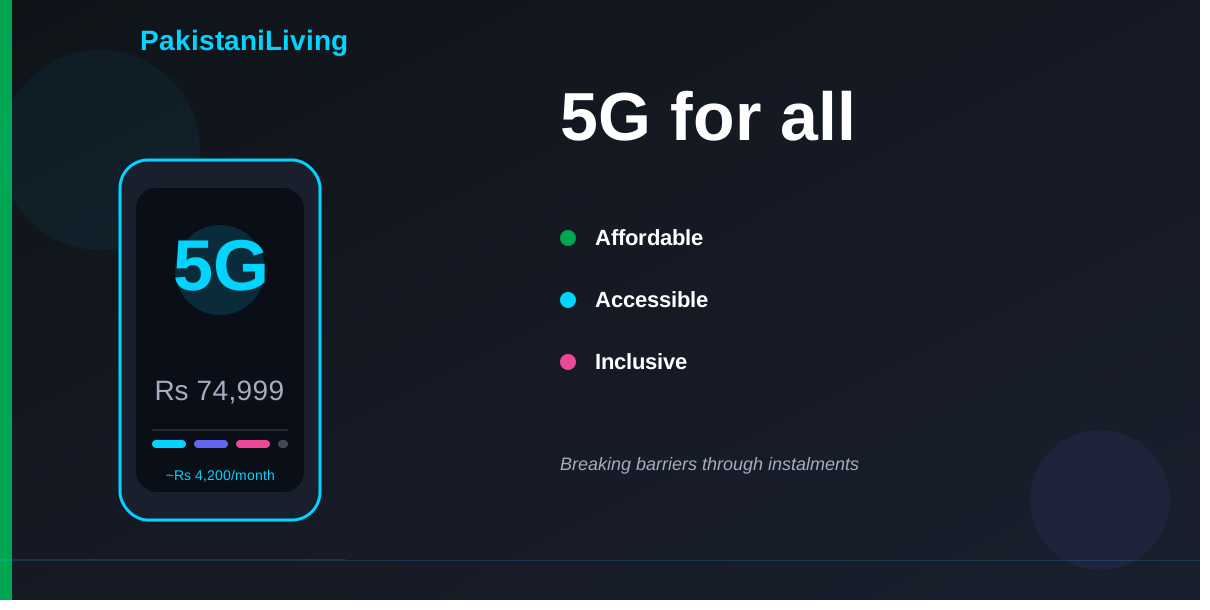
As the table shows, even the most affordable PTA-approved 5G option sits at roughly Rs 75,000. An instalment plan spreading that over 18 months would bring the monthly payment to around Rs 4,200 before any financing charges, a figure that is genuinely accessible to a much wider pool of Pakistani buyers.
Best For Pakistani Buyers: Quick Recommendations
- Samsung Galaxy A36 5G (Rs 74,999): Best for first-time 5G buyers in smaller cities who want a PTA-approved device at the lowest available entry point.
- Xiaomi Redmi Note 14 Pro 5G (Rs 89,999): Best for buyers who want strong camera performance and a large battery to manage load shedding without spending over Rs 90,000.
- OnePlus Nord CE 4 5G (Rs 84,999): Best for users who prioritise fast charging and a clean software experience in the under-Rs 90,000 5G bracket.
- Samsung Galaxy A56 5G (Rs 109,999): Best for mid-range buyers in Lahore or Karachi who want a premium AMOLED display and a reliable after-sales service network.
- Samsung Galaxy S25 (Rs 249,999): Best for power users who want flagship-grade performance and are willing to pay full price upfront or wait for an official financing option.
Pakistan Context: What Buyers Should Know Right Now
- PTA Approval
Any 5G phone you buy must be PTA-approved or registered through the DIRBS system to work with a Pakistani SIM card. Grey-market imports are common at Hafeez Centre in Lahore and similar markets in Karachi, but these units carry the risk of SIM blocking after registration deadlines. Always verify PTA status before purchasing, particularly for imported units sold below the prices listed above.
- Daraz vs. Hafeez Centre
Daraz often runs official brand sales with warranty coverage and easier return policies, but delivery times to smaller cities can run several days. Hafeez Centre and similar physical markets in Karachi allow you to inspect the device and negotiate, but warranty support varies by vendor. For a 5G phone that will be a multi-year investment, buying from a brand-authorised retailer or an official Daraz brand store is the safer option.
- Load Shedding and Battery Life
In cities outside Karachi and Islamabad, power cuts can still run four to eight hours daily in summer. A 5G phone with a 5,000 mAh or larger battery is not a luxury in this context, it is a functional necessity. The good news is that most affordable 5G handsets in the Rs 75,000 to Rs 90,000 range carry large batteries as a standard feature. Flagship 5G phones like the iPhone 16 and Galaxy S25 have smaller batteries by comparison, which matters if you are frequently off the grid.
- Carrier Band Support
Pakistan’s 5G networks are operating on spectrum bands that not all imported phones support. Jazz and Zong are deploying on specific mid-band and sub-6 GHz bands. Before buying a 5G phone through any grey channel, confirm that the device supports the exact bands your preferred operator is using in your city. Officially sold, PTA-approved units are typically band-compatible by default for the Pakistani market.
- Bottom Line
The 5G instalment scheme is a genuinely good idea that is being delayed by a procedural gap, not by any fundamental disagreement. Every operator says they want it. The government says it wants it. The buyers who would benefit from it are waiting. What is missing is the formal paperwork that converts public support into an operational framework.
For buyers in Lahore, Karachi, or Islamabad who are considering a 5G phone right now, the practical advice is this: if you can manage the upfront cost, the Samsung Galaxy A36 5G at Rs 74,999 or the Xiaomi Redmi Note 14 Pro 5G at Rs 89,999 are the strongest value options available today, both PTA-approved and both suited to Pakistan’s daily usage conditions. If you are waiting for an official instalment plan, check back with your preferred operator’s franchise in the coming months, as the scheme is more likely than not to eventually launch, but there is no confirmed date yet.
The government’s digital inclusion ambitions will remain exactly that, ambitions, until the gap between a public press statement and a signed formal submission gets closed. That is not a technology problem. It is an administrative one, and it has an easy fix.
Frequently Asked Questions
- When will Pakistan’s 5G phone instalment scheme launch?
There is no confirmed launch date as of May 2026. The IT Ministry and PTA have indicated they are still awaiting formal responses from some industry stakeholders. Jazz and Ufone have been the most committed advocates, while Zong has publicly supported the scheme but has not yet submitted its formal response according to available reports.
- Which Pakistani network has 5G right now?
Jazz and Zong both have active 5G sites running as of mid-2025. Ufone has confirmed a commercial 5G launch following the spectrum auction held on March 10, 2025. The merged Telenor-Ufone entity holds the largest 5G spectrum portfolio in Pakistan. Coverage is currently concentrated in major cities including Lahore, Karachi, and Islamabad.
- What is the cheapest PTA-approved 5G phone available in Pakistan?
As of mid-2026, the Samsung Galaxy A36 5G is among the most affordable PTA-approved 5G options, available at around Rs 74,999. Prices fluctuate based on exchange rates and import duties, so checking current listings at official brand stores or authorised Daraz storefronts is recommended before purchasing.
- Will the 5G instalment plan cover all phones or only specific brands?
The policy framework has not been finalised, so the exact list of eligible devices has not been announced. Based on how similar schemes work in other markets, the expectation is that the scheme would cover a range of PTA-approved 5G handsets offered by participating operators, likely starting with mid-range devices priced between Rs 70,000 and Rs 150,000 where the financing benefit is most significant for buyers.

Samsung Galaxy A57 5G

About Luqman
A passionate technology writer and digital researcher,Luqman specializes in simplifying complex tech trends into practical, user-focused insights. With a strong interest in smartphones, emerging gadgets, and digital ecosystems, Luqman delivers well-researched, unbiased content tailored for everyday users. From product deep-dives to buying guides, the goal is simple: help readers make smarter, more informed decisions in a fast-changing tech landscape.