AI Built the App in One Night — And Accidentally Exposed Everyone’s Data

Samsung Galaxy S23 Ultra
The internet is entering a dangerous new phase.
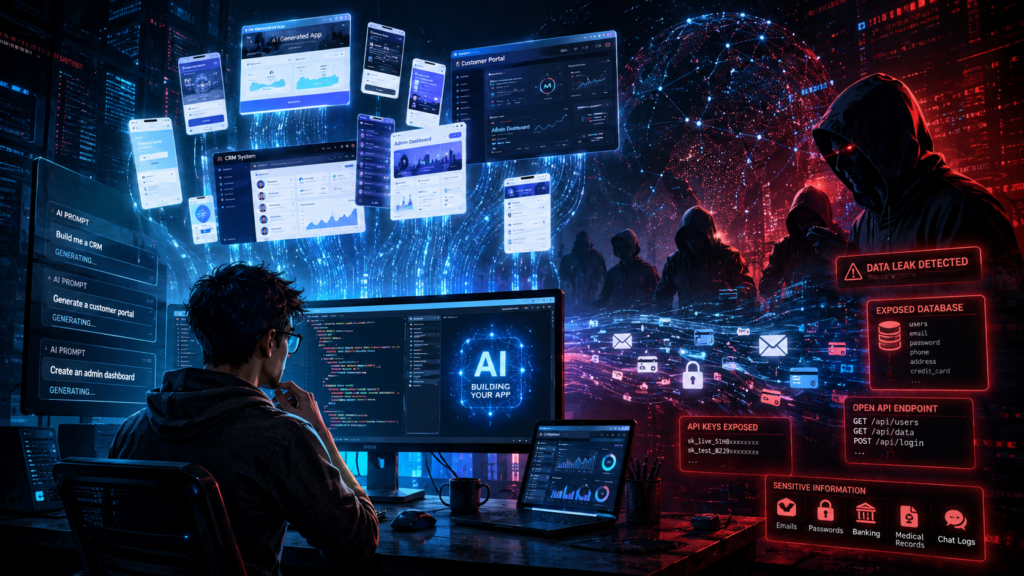
A few years ago, building a mobile app or SaaS platform required software engineers, backend developers, security teams, QA testers, and months of development effort. Today, AI coding tools can generate complete applications in minutes using simple prompts.
Someone can now type: “Build me a CRM with login, dashboard, and analytics” and receive a working app almost instantly.
While this sounds revolutionary, cybersecurity researchers are now discovering a disturbing reality behind the AI app boom: thousands of AI-generated applications are exposing private user data directly to the public internet.
The Rise of AI-Generated Apps
Platforms like Replit, Lovable, Cursor, Bolt, Firebase Studio, and other AI development tools are changing software creation completely. Users no longer need advanced programming knowledge to launch applications.
This new trend is often called “vibe coding,” where users describe ideas in natural language while AI generates the backend, APIs, UI, and hosting configuration automatically.
The problem is that many users deploying these applications do not understand cybersecurity fundamentals.
Researchers recently found exposed AI-generated apps leaking:
- Customer information
- Medical records
- Email addresses
- Authentication tokens
- Private chats
- Admin dashboards
- API credentials
- Internal business documents
In many cases, these systems were not hacked at all. They were simply left publicly accessible due to poor configuration.
Why AI Apps Are Becoming a Security Risk
AI coding assistants prioritize functionality and speed. Their goal is usually to create applications that work visually and operationally. Security often becomes secondary.
This creates applications that may look professional on the surface while containing major vulnerabilities underneath.
Many beginner developers trust AI-generated code completely without reviewing:
- Authentication systems
- Access permissions
- API protection
- Database rules
- Environment variables
- Role-based access control
As a result, dangerous applications are reaching production environments rapidly.
The Firebase Misconfiguration Problem
A major percentage of AI-generated applications rely on Firebase because it is fast, scalable, and easy to integrate. However, Firebase has also become one of the biggest sources of accidental data leaks.
Many developers unknowingly enable public database access during setup and forget to lock it down later.
Security researchers found incidents where:
- User chat histories were exposed
- GPS records became public
- Profile images leaked online
- Authentication tokens were accessible
- Private AI chatbot conversations became searchable
This issue becomes even more dangerous because AI tools frequently generate Firebase-based architectures automatically.
The Illusion of Professional Software
One of the most dangerous aspects of AI-generated software is appearance.
Modern AI development tools can instantly generate:
- Responsive dashboards
- Animated login pages
- Enterprise-style admin panels
- Premium-looking user interfaces
- Mobile-friendly layouts
To ordinary users, these applications appear trustworthy and enterprise-grade.
But internally, many contain serious vulnerabilities such as:
- Missing authorization checks
- Public APIs
- Broken authentication
- Exposed databases
- Hardcoded secrets
The internet is increasingly filling with software that looks polished but behaves like unfinished prototypes.
How AI Is Changing Startup Culture
AI development tools are creating a new category of founders who can launch software products before understanding software engineering principles.
Some startups now generate MVPs within days and immediately onboard real users without conducting proper security reviews.
This creates a dangerous pattern:
Faster development → faster launch → larger security exposure
Because AI dramatically lowers technical barriers, similar insecure apps are appearing across the internet at massive scale.
Why This Matters for Pakistan
Pakistan’s startup and freelance ecosystem is rapidly embracing AI-assisted development. Students, freelancers, agencies, and entrepreneurs are increasingly using AI coding tools to build products and services.
However, cybersecurity awareness is not growing at the same pace.
This creates several major local risks.
Potential Pakistani Scenarios
A local ecommerce business may deploy an AI-generated CRM system that accidentally exposes customer phone numbers and addresses.
A telemedicine startup may launch an AI-generated healthcare platform with weak API protection, risking patient privacy.
A freelancer may upload environment variables or API keys publicly while using AI-generated deployment workflows.
These risks are no longer theoretical. Similar incidents are already happening globally.
AI Is Also Empowering Cybercriminals
The same tools helping developers are also helping attackers.
Cybercriminals can now rapidly create:
- Fake banking portals
- Phishing dashboards
- Scam ecommerce stores
- Fake courier tracking pages
- Impersonation websites
Previously, building convincing phishing systems required technical expertise. AI dramatically reduces that barrier.
Security researchers fear this could lead to industrial-scale phishing attacks.
The Core Problem: Blind Trust in AI
The issue is not AI itself.
The real danger comes from treating AI-generated code as production-ready engineering.
AI tools are extremely useful for accelerating development, reducing repetitive tasks, and enabling innovation. But they still generate insecure patterns, outdated practices, and vulnerable implementations.
AI should be treated like a fast junior developer — not an unsupervised senior engineer.
What Developers Should Do
Organizations using AI-assisted development should establish proper security practices immediately.
- Review all AI-generated code manually
- Run penetration testing before launch
- Secure Firebase and databases properly
- Use strict authentication everywhere
- Protect APIs with authorization checks
- Separate prototypes from production systems
- Train teams on cybersecurity fundamentals
Even small applications handling user data should undergo basic security validation before deployment.
The Future of AI Software Development
AI-assisted development is not slowing down. In fact, it is accelerating rapidly.
More startups, freelancers, and businesses are now relying heavily on AI-generated codebases to move faster and reduce costs.
But speed without security creates enormous risk.
The next major internet crisis may not come from sophisticated hackers alone. It may come from millions of insecure AI-generated apps deployed without proper review.
PakistaniLiving Verdict
AI-powered software development is one of the biggest technology opportunities of this decade. It allows Pakistani freelancers, startups, and businesses to innovate faster than ever before.
But there is a dangerous misconception spreading online: if AI generated the app, it must already be secure.
That assumption is becoming one of the largest cybersecurity risks of the modern internet.
The future belongs to teams that combine AI speed with human engineering discipline.
Because in the AI era, trust and security may become more valuable than software itself.

Moto G37

About Quraat ul Ain
Editor - Research & Academic Technology Contributor Quraat ul Ain brings an academic and research-driven perspective to PakistaniLiving (PL), specializing in emerging technologies, digital ecosystems, AI trends, mobile platforms, and consumer technology behavior. With a background in higher education and technology research, she contributes analytical articles that simplify complex innovations into accessible insights for everyday readers. Her writing bridges academia and the fast-moving gadget industry, offering balanced, evidence-based coverage tailored for Pakistan’s growing tech audience.