PakistaniLiving – Pakistan Heat Edition
How to Extend Your Phone Battery Life – Pakistan Heat Edition
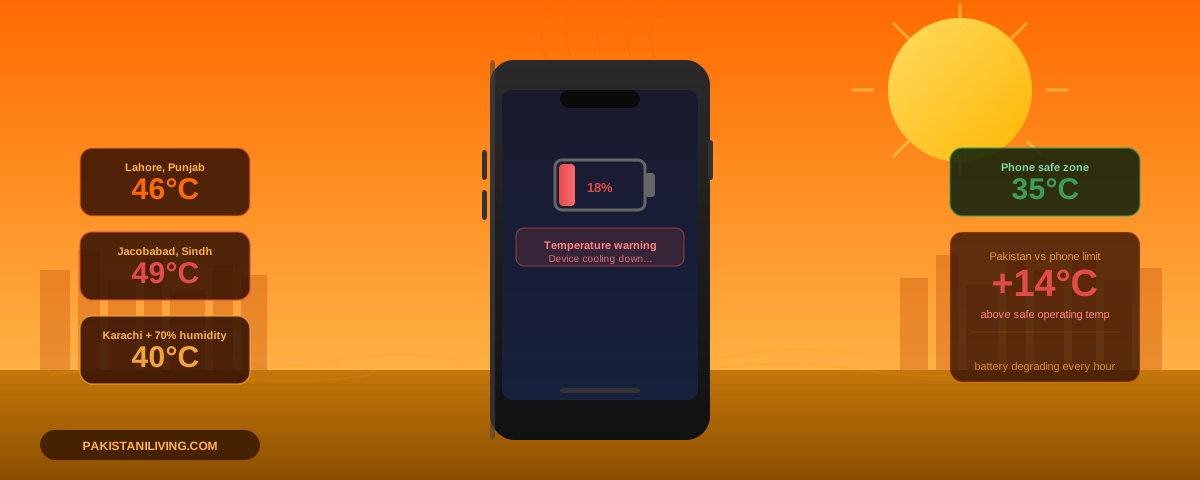
Pakistani summers push well past 45°C across Punjab and Sindh. Your phone’s battery was designed for 35°C. Here’s what that gap is costing you – and exactly what to do about it.
Lahore
46°C
Peak May–Jun
Jacobabad
49°C
Hottest city
Karachi
40°C
+70% humidity
Peshawar
45°C
KP plains
Phone safe
35°C
Max operating
Updated May 2026
All Android brands + iPhone
Pakistan’s summer is officially too hot for your phone. Apple recommends a maximum operating temperature of 35°C. Samsung follows the same guideline. During a Lahore June at 46°C, your phone is already 11 degrees above its safe limit – before you’ve even turned on the screen. This isn’t a minor inconvenience. Repeated heat exposure permanently degrades your battery’s capacity, and no software fix can reverse that damage.
Why heat destroys batteries – the short version
What’s actually happening inside your phone
Your phone’s lithium-ion battery works through chemical reactions between electrodes. Heat accelerates those reactions beyond their designed limits, causing two types of damage: immediate (throttling, shutdown, fast drain) and cumulative (permanent loss of charge capacity that worsens with every overheating event).
Think of your battery like a sponge. New, it holds a full litre of water. Every time it overheats severely, the sponge shrinks a little – maybe to 95% capacity, then 88%, then 79%. You cannot restore the lost capacity. A replacement is the only fix, and in Pakistan that means spending Rs.1,500 to Rs.4,000 on a battery – assuming you get a genuine one. [1]
“Heat is the number one cause of shortened battery life in smartphones. Once the damage is done, no app, no setting, no trick will restore your battery’s lost capacity.” – Technology experts via WILX, June 2025 [2]
There are also secondary effects: screen discolouration (yellow patches, ghost touch), processor throttling (your phone slowing itself down to reduce heat), and in severe cases battery swelling – which can physically crack your screen from the inside. None of these are hypothetical. They are common repair complaints at Pakistani mobile shops every June and July.
Temperature danger zones for your phone
What happens to your phone at each temperature range
Apple and Samsung both recommend max 35°C for active use. Pakistan regularly exceeds this by 10–15°C in direct conditions. [3][4]
0°C – 15°C
Battery drains fast in cold but no permanent damage
16°C – 35°C
Safe operating zone. Peak performance. No damage.
36°C – 45°C
Lahore / Jacobabad range. Throttling begins. Cumulative battery damage.
46°C +
Pakistan record highs. Emergency shutdown risk. Swelling and leakage possible.
The 3 stages of phone overheating – know the signs
Stage 1 – Warm (36°C–42°C internal)
Running hot but manageable
Your phone feels warm to the touch. Battery drains faster than usual. Screen may dim slightly. Charging slows down. This is the stage where most Pakistanis are during a normal summer day outdoors – and most people ignore it. Don’t. Every hour at this stage chips away at your battery’s permanent capacity.
Stage 2 – Hot (43°C–50°C internal)
Thermal throttling kicks in
The phone is uncomfortable to hold. Performance drops noticeably – apps lag, camera quality falls, calls may drop. iPhone shows “iPhone needs to cool down.” Android may show a temperature warning or automatically kill background apps. This is your phone begging you to act. Stop using it immediately and move it to shade. Remove the case.
Stage 3 – Critical (50°C+ internal)
Emergency shutdown – hardware at risk
The phone shuts itself down completely to prevent permanent damage. This is the correct response – do not try to restart it immediately. Let it cool in shade for at least 30 minutes. A parked car in Pakistani summer sun can reach 70°C inside. Leaving your phone on a car dashboard for 20 minutes can push it into Stage 3 in under 10 minutes. Battery swelling and leakage are real risks at this stage. [1][6]
Pakistan-specific situations that accelerate the damage
The parked car dashboard
Lahore summer + closed car + dashboard = 70°C+ in under 30 minutes. This is the single most destructive thing most Pakistanis do to their phones. Never leave your phone on a dashboard or car seat.
Load shedding + heat
During load shedding, phones work harder to find weak 4G signal. Signal searching burns battery and generates internal heat – especially brutal when ambient temperature is already 42°C+ in a room without AC or fans.
Charging during peak heat
Charging generates its own internal heat. Charging at full speed in a hot room – or under a pillow, or with a thick cover on – stacks heat sources on top of each other. This is one of the most common causes of battery failure in Pakistan.
Jeans pocket in full sun
Your body heat + fabric insulation + direct sun = a pocket that easily reaches 40°C+. This is especially a problem for people working outdoors – rickshaw drivers, vendors, construction workers – whose phones are pocketed in direct sun all day.
4K video + outdoor shooting
Recording 4K video is one of the most processor-intensive tasks a phone can do. Doing it outdoors in Karachi summer heat generates internal temperatures that can hit Stage 2 in under 5 minutes of continuous recording.
Cheap charger from repair shop
Non-original chargers sold at Pakistani repair shops and markets often lack proper voltage regulation, causing irregular current that generates excess heat during charging – accelerating battery degradation faster than climate alone. [2]
What to do and what to stop doing right now
Do these things
Keep it in shade always. In a car, in a pocket, on a table – always shade. Even indirect sun through a window heats a phone significantly. A cloth bag in shade is better than a pocket in sun.
Remove the case when charging in heat. Cases trap heat. In summer, charge your phone case-off in a cool spot. The scratch risk is worth the battery life gain.
Charge between 20% and 80%. Lithium-ion batteries stress most at the extremes. Charging to 100% nightly in a hot room is far more damaging in Pakistani summer than in winter.
Charge overnight only if the room has AC. If you charge in a hot room overnight, your phone sits at 100% for hours in heat – the worst combination for battery lifespan.
Use the original charger only. The brand charger in the box has the correct voltage regulation for your battery’s chemistry. Any other charger is a gamble – especially in Pakistan where counterfeit chargers are common. [2]
Use a fan if no AC. A table fan pointed at your phone while charging significantly reduces ambient temperature. During load shedding, even placing the phone near a window with airflow helps.
Stop doing these
Never leave phone in a parked car. Ever. A closed car in Pakistani summer reaches 70°C. This is the number one cause of severe heat damage to Pakistani phones. There are no exceptions to this rule.
Don’t game or stream while charging outdoors. Gaming + charging + outdoor summer heat = three simultaneous heat sources. Your battery will throttle, your performance will crater, and the damage accumulates permanently. [1]
Never put a hot phone in the fridge or freezer. Rapid temperature change causes condensation inside the phone – moisture that shorts circuits. Let it cool slowly in shade, not artificially in cold. [1]
Don’t charge under pillows or blankets. This is a fire risk, not just a battery risk. Cases, pillows, and blankets trap heat during charging. Multiple fires in Pakistan every year are attributed to phones charged under bedding. [6]
Don’t restart a hot phone immediately. If your phone shuts down from heat, give it at least 20–30 minutes in shade before restarting. Restarting hot means the CPU immediately generates more heat before the battery has recovered.
Don’t leave all radios on during load shedding. Mobile data, Wi-Fi, Bluetooth and GPS simultaneously searching in weak signal conditions during 44°C heat is a battery and temperature disaster. Turn off what you’re not using.
Phone settings to change right now for summer
These are free changes you make once that reduce heat generation and extend battery life meaningfully during Pakistani summer. None of them require a new phone or a repair shop.
Enable auto-brightness
Screen brightness is the biggest single battery drain. Auto-brightness reduces it when indoors, where you spend most of your time.
Reduce background app refresh
On Android: Settings → Battery → Background usage limits. On iPhone: Settings → General → Background App Refresh → Off. Apps refreshing in heat = double damage.
Turn GPS off when unused
Location services running constantly is one of the most battery-intensive background processes. Only enable GPS for navigation apps when actively using them.
Enable battery saver at 30%
Don’t wait until 10% to turn on battery saver. Setting it to trigger at 30% reduces CPU speed and heat generation earlier, extending life meaningfully.
Use Wi-Fi instead of mobile data
Wi-Fi uses significantly less power and generates less heat than maintaining a 4G LTE connection – especially if your carrier signal is weak in your area.
Enable dark mode
On AMOLED screens (most mid-range+ phones sold in Pakistan today), dark mode turns pixels off entirely – dramatically reducing heat generated by the display.
Set screen timeout to 30 seconds
A screen staying on for 2 minutes when you set it down wastes battery and generates heat for nothing. 30 seconds is the sweet spot – quick enough to not annoy, slow enough to matter.
Use “optimised charging” if available
iPhones have this built-in. Samsung Galaxy devices have “Protect battery” under battery settings. It limits charging to 80% overnight – exactly the right call in Pakistani summer heat.
How to check if summer has already damaged your battery
Diagnosing your battery health right now
If you’ve had your phone through at least one Pakistani summer without following any of this advice, there’s a good chance your battery has already lost meaningful capacity. Here’s how to check.
On iPhone
Go to Settings → Battery → Battery Health & Charging. You’ll see a percentage. Apple considers a battery “degraded” when it falls below 80%. A phone bought two years ago and kept through two Pakistani summers without heat precautions will very often sit at 76–82% by now.
On Android (Samsung, Xiaomi, Infinix, Vivo)
Most Android phones don’t show battery health directly. The easiest method: download AccuBattery (free, available on Play Store). It measures charge cycles and estimates your battery’s remaining design capacity after a few charge cycles. For Xiaomi phones specifically, dialling *#*#6485#*#* on the dial pad shows detailed battery diagnostics including design capacity vs actual capacity.
| Battery health reading |
What it means |
Action |
| 95–100% |
Excellent – nearly new battery |
Just maintain |
| 85–94% |
Good – normal wear for 1–2 years |
Monitor closely |
| 80–84% |
Degraded – Apple flags this officially |
Plan replacement |
| 70–79% |
Significantly degraded – noticeable in daily use |
Replace soon |
| Below 70% |
Severely degraded – possible swelling risk |
Replace immediately |
The single most important thing – shade and air
All the settings in the world matter less than one physical habit: keep your phone out of direct sun and in moving air. A phone in the shade with all the wrong settings will outlast a phone in a pocket on a sunny rickshaw ride with perfect battery optimisation. The Pakistani summer problem is fundamentally environmental – the software fix comes second to the physical one.
When to replace your battery – and what to pay in Pakistan
Getting a new battery done right
If your battery health is below 80%, or your phone doesn’t make it through a full day on a single charge, a battery replacement is almost always worth doing before buying a new phone. Pakistani mid-range phones (Infinix, Tecno, Xiaomi Redmi) can get another 18–24 months of comfortable life from a new battery if the rest of the phone is in good shape.
Replacement costs in Pakistan in 2025 range from Rs.1,500 to Rs.4,000 for a decent quality battery at a reputable shop. Authorised service centers (Samsung Care, Carlcare for Infinix/Tecno, Mi Service for Xiaomi) cost more – Rs.3,000 to Rs.6,000 – but use manufacturer-certified batteries that won’t cook your phone in summer with fake capacity ratings.
One critical warning: avoid batteries advertised as “high capacity” or “3x power” at Pakistani market stalls. These are counterfeit cells with falsely printed mAh ratings. They run hot, degrade within weeks, and in worst cases swell and crack the phone. A genuine replacement at a trusted shop is worth three times the price of a market stall fake.
Sources & references
Sources cited in this article
-
[1]
Pullup Phone Repair – “How Heat Damages Your Phone (and How to Prevent It)”
Primary technical source for battery degradation mechanisms, temperature stages, swelling risk, and recovery steps after overheating.
pullupphonerepair.com
Accessed 2025.
-
[2]
WILX News – “What the Tech? Protecting Your Smartphone from the Summer Heat”
Source for expert quote on heat as the #1 cause of shortened battery life, and risks from cheap third-party chargers.
wilx.com
Published June 21, 2025.
-
[3]
Apple Inc. – iPhone Environmental Requirements
Source for Apple’s official 35°C maximum operating temperature recommendation for iPhone devices.
support.apple.com
Accessed May 2026.
-
[4]
Editorialge – “Protect Your Phone from Summer Heat: Tips to Avoid Damage”
Source for Apple and Samsung’s identical 35°C operating temperature limits and thermal protection system descriptions.
editorialge.com
Published July 17, 2025.
-
[5]
Dawn – “Extreme heat sears cities across the country”
Source for Pakistan temperature data: Lahore 46.2°C, Jacobabad 49°C, Karachi 40°C with 70% humidity, Peshawar 45–46°C, Sargodha 47.8°C.
dawn.com
Published June 12, 2025.
-
[6]
Time Magazine – “6 Easy Ways to Keep Your Phone Safe in the Summer Heat”
Source for car greenhouse temperature effect (116°F / ~47°C in one hour), battery leakage risk, and charging under insulating materials fire risk.
time.com
Accessed 2025.
-
[7]
Pakistan Today – “Extremely hot, prolonged summer feared in Pakistan”
Supporting source for regional Pakistan temperature forecasts and Met Office warnings for May–June 2025.
pakistantoday.com.pk
Published May 17, 2025.
-
[8]
Wikipedia – “List of Extreme Weather Records in Pakistan”
Source for Pakistan’s all-time temperature record of 53.8°C (Turbat, 2017) and historical heatwave data.
en.wikipedia.org
Accessed May 2026.
Note on temperature data: City temperatures cited (Lahore 46°C, Jacobabad 49°C etc.) are peak June 2025 readings reported by PDMA Punjab and Sindh meteorological stations, as published by Dawn. Phone operating temperature limits (35°C) are Apple’s official specifications, which Samsung and most Android manufacturers match. Internal phone temperature is typically 5–10°C above ambient in active use, meaning a 40°C ambient in Karachi can produce 45–50°C internal phone temperatures during normal use – firmly in the danger zone described in this article.