
Galaxy S27 Ultra

Xiaomi 13T Pro
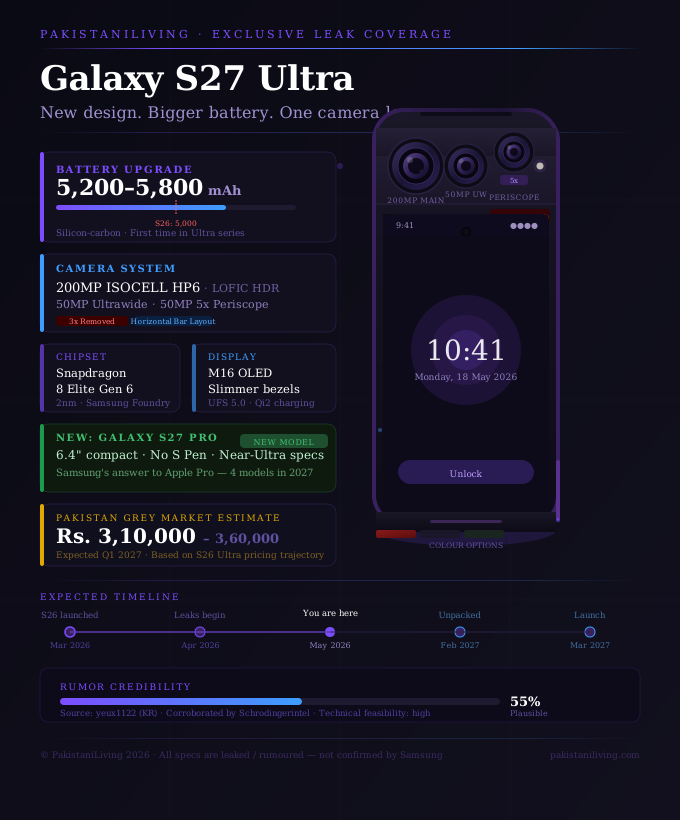
Six years. Samsung has kept the same 5,000mAh battery in its Galaxy S Ultra series for six full years while Chinese rivals ran laps around it with silicon-carbon cells hitting 10,000mAh. Now, fresh leaks out of South Korea suggest the Galaxy S27 Ultra will finally break that ceiling — and it is doing so by making a bold structural sacrifice first.
The most interesting part of this story is not the battery itself — it is what Samsung is reportedly willing to cut to get there. According to South Korean insider yeux1122, Samsung engineers are planning to remove the 3x telephoto camera module entirely from the Galaxy S27 Ultra’s rear configuration. That slot, currently occupied by a lens that critics have called the weakest link in the flagship camera system anyway, would be repurposed to create meaningful internal room for a larger battery cell.
The 3x telephoto has always been the odd one out on the Ultra’s quad-camera setup. It sits between a 5x periscope and the main wide sensor — a zoom range that most photographers skip entirely. Removing it does not gut the camera system; it simply eliminates redundancy. Samsung loses little, gains a lot of space.
The logic is clean. Less hardware inside means more room for battery cells, and as a bonus, the phone should also come out lighter. Two complaints addressed with one decision — if the leaks hold up.
The battery story goes deeper than just a capacity bump. Multiple leaks point to Samsung exploring silicon-carbon (Si-C) battery chemistry for the S27 Ultra — a fundamental shift from the lithium-ion graphite cells the company has used for years. Silicon-carbon anodes can hold significantly more energy in the same physical space, which is precisely why Chinese brands like Vivo, OPPO, and Xiaomi have already adopted the technology.
At the Galaxy S26 press briefing, Samsung EVP Jeong Seung Moon admitted on record that the company had been “a bit un-innovative” on the battery front. He confirmed Samsung is actively developing silicon-carbon cells but said none have yet cleared the company’s internal validation standards. That is the most honest admission Samsung has made about being behind, and it signals the pressure they are under.
Internal documents reportedly shared by the Schrödinger Intel blog suggest Samsung SDI — the battery division — has been testing silicon-carbon configurations under designations like SDI-DC12K-SiC-V2, with capacities ranging from 12,000mAh up to 20,000mAh in various dual-cell arrangements. One notable configuration combines a 6,800mAh cell at 4.7mm thickness with a 5,200mAh cell at 3.2mm.
| Configuration Tested | Total Capacity | Cycle Life | Status |
|---|---|---|---|
| SDI-DC12K-SiC-V2 (dual cell) | 12,000 mAh | ~960 cycles | Failed internal bar |
| SDI-TC18K-SiC | 18,000 mAh | Not confirmed | Under testing |
| Realistic S27 Ultra target | 5,200–5,800 mAh | 1,500 cycles (target) | Most likely outcome |
Here is the part the YouTube thumbnails will not show you: the massive Si-C configurations Samsung tested failed reliability requirements. Samsung’s commercial benchmark demands a battery survive 1,500 charge cycles. The tested 20,000mAh units gave out around 960 cycles — roughly two-thirds of the requirement. That gap explains why the S26 did not get this technology, and why even the S27 Ultra is not expected to jump to extreme capacities.
Samsung’s extreme caution with batteries is not stubbornness — it is institutional memory. The Galaxy Note 7 battery failures in 2016 cost the company billions and years of reputational damage. A battery-related safety issue at Samsung’s scale today would be existential. Silicon anodes naturally expand and contract during charging cycles, creating structural stress that degrades the cell over time. Until Samsung’s engineers solve the longevity problem to their satisfaction, commercial deployment stays on hold.
The most realistic near-term outcome — supported by tipster Schrödinger — is a silicon-carbon battery between 5,200mAh and 5,800mAh. Not the 12,000mAh of fevered speculation, but still a meaningful break from six years of 5,000mAh stagnation.
The structural changes do not stop at the Ultra. The same leak suggests Samsung is expanding its traditional three-model lineup into a four-model family for 2027, adding a device carrying the “Pro” moniker. This mirrors Apple’s approach and signals Samsung is reading the same market data.
Display: Compact 6.4-inch profile, smaller than the Ultra
Camera: Upgraded array similar to the Ultra, without the 3x module
Battery: Increased capacity with reduced thickness vs the current Plus models
S Pen: Not included — this is essentially an Ultra without the stylus
Price positioning: Below the Ultra, above the base S27 Plus
For Pakistani buyers who have always found the Ultra too large and too expensive, the S27 Pro could be the most interesting Samsung flagship in years. A compact body with near-Ultra internals is a combination the market has been asking for — Samsung seems to have finally listened.
The S27 Ultra is shaping up as a broader overhaul, not just a battery story. Leaks and confirmed details across multiple sources paint a fairly consistent picture:
- M16 OLED panel — a display upgrade that should improve brightness and efficiency over the current M14 panel
- UFS 5.0 storage — faster read/write speeds and better energy efficiency, restricted to Pro and Ultra models
- Qi2 wireless charging integration — improved alignment and charging efficiency, though fitting it alongside the S Pen has reportedly created engineering headaches
- Exynos 2700 in select markets — Samsung’s in-house chip with reportedly improved thermals and memory management; Snapdragon continues for other regions
- Reduced overall weight — a direct consequence of removing the 3x camera module and restructuring internals
Every flagship Samsung launch carries an uncomfortable reality for buyers in Pakistan: the import-driven premium adds 25–35% on top of global retail pricing by the time the phone reaches Grey market shelves in Hafeez Centre or similar. The Galaxy S26 Ultra currently sits in Pakistan’s grey market between Rs. 290,000 and Rs. 330,000 depending on storage variant and seller.
For most Pakistani consumers, the honest advice remains the same: wait three to four months post-launch. Grey market prices on Samsung Ultras reliably drop 15–20% within that window as supply stabilizes. The S27 Pro, if priced like Apple’s non-Pro Max models, could land Rs. 60,000–80,000 cheaper than the Ultra — and may honestly be the smarter buy for most people who do not need an S Pen.
None of this exists in a vacuum. While Samsung debates internally whether to cross its own battery safety thresholds, brands like Vivo X200 Ultra, OPPO Find X9 Ultra, and Xiaomi 15 Ultra have already shipped phones with silicon-carbon batteries exceeding 6,000mAh — some approaching 7,000mAh. These are not experimental prototypes. They are available now, they work, and they are reaching Pakistani grey markets too.
If Samsung ships the S27 Ultra with a 5,500mAh battery and calls it a revolution, Chinese brands will have already moved to 8,000mAh cells by then. The goalposts keep shifting. Samsung’s caution is understandable and probably responsible — but the optics of being two to three product cycles behind on something as fundamental as battery capacity do real damage to the premium argument Samsung makes.
The Galaxy S27 Ultra is genuinely shaping up as the most structurally interesting Samsung flagship in years — removing a camera, rethinking internal layout, adding a new model tier, and actually taking silicon-carbon chemistry seriously for the first time. Whether all of this survives the journey from prototype to production is an entirely different question, and Q1 2027 is still a long time away in the smartphone industry. But the direction is right. For Samsung, after six years of battery inertia, even right direction deserves acknowledgment — even if getting there took embarrassingly long.

Infinix Zero 30 5G

About Luqman
A passionate technology writer and digital researcher,Luqman specializes in simplifying complex tech trends into practical, user-focused insights. With a strong interest in smartphones, emerging gadgets, and digital ecosystems, Luqman delivers well-researched, unbiased content tailored for everyday users. From product deep-dives to buying guides, the goal is simple: help readers make smarter, more informed decisions in a fast-changing tech landscape.