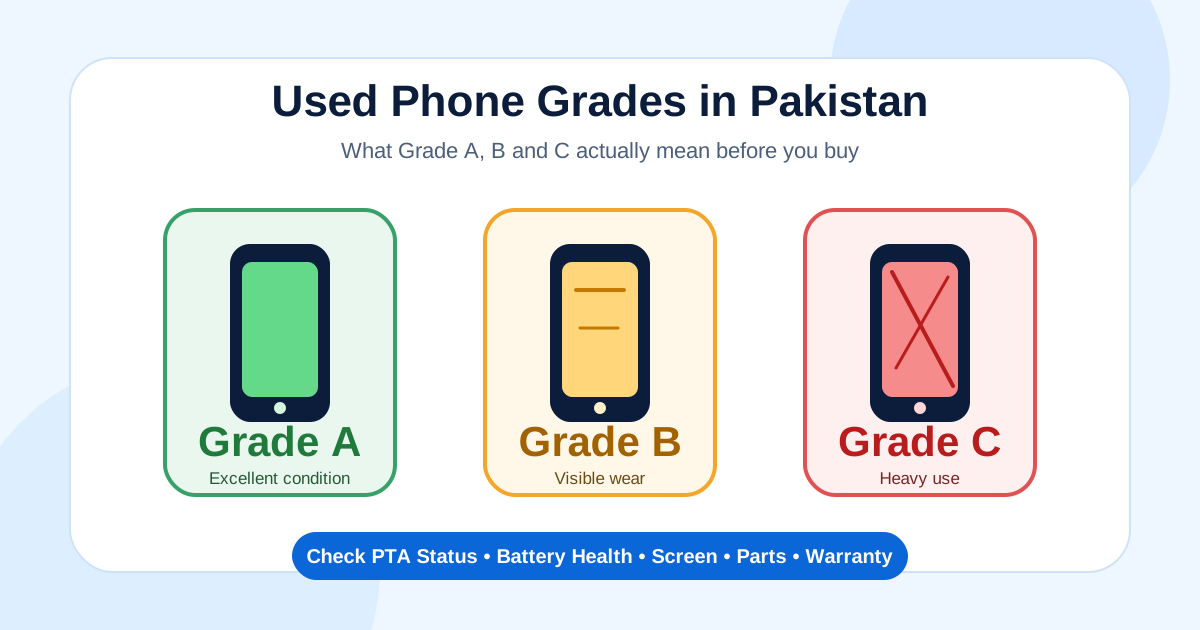
Grade A, B and C Used Phones in Pakistan – What the Condition Grades Actually Mean

Samsung Galaxy S22 Ultra
Every used phone listing in Pakistan has a grade attached to it — Grade A, Grade B, Grade C, Mint, Refurbished. None of these labels are official. None are verified by a third party. And none tell you anything about battery health, original parts, or account locks unless you ask the right questions. This guide tells you exactly what these grades actually mean in the local market, how they differ from international platforms like Back Market and Cashify, and precisely what to check before handing over a single rupee.
Why the Grade Is Just the Starting Point
Pakistan’s used phone market does not run on standardised grading. The Grade A sticker on a phone at Hafeez Centre means what the seller decided it means today. The same label at Saddar might reflect a completely different assessment. Unlike Back Market in Europe, which enforces documented condition tiers across all its sellers, or Cashify in India, which runs every phone through a 32-point quality check before assigning its Superb / Good / Fair labels, Pakistan’s market relies almost entirely on buyer inspection and seller reputation. That is not a criticism of the market — it is a fact that changes how you should approach every single purchase.
International comparison: Swappa, one of the US’s most trusted used phone platforms, enforces strict criteria even for its lowest “Fair” tier — no cracks, no significant screen issues, fully functional. Back Market’s cosmetic grade accounts for a 10–25% price premium between tiers for the same hardware. Cashify explicitly tests every phone regardless of grade and shows photos of the actual unit. None of this exists as standard in Pakistan’s OLX or walk-in market. The grade is a starting point for your own inspection, not a substitute for it.
This is why the question to ask a seller is not “what grade is it?” but “why is it this grade?” Does Grade A mean the screen is original? Does it mean the battery is above 85%? Does it mean there’s no repair history? A seller who can answer these questions specifically is worth trusting more than one who just says “Grade A bilkul theek hai.”
Battery Health — The Number That Actually Defines the Grade
If you had to pick a single number to evaluate a used iPhone, it is battery health percentage. Everything else — scratches, dents, missing accessories — has a known repair cost. A phone with a weak battery has hidden costs that accumulate daily: charging multiple times a day, throttled performance, unexpected shutdowns, and eventually a battery replacement that eats the discount you thought you were getting.
Global resale data makes the 80% threshold very clear. Buyback services internationally will not pay full price below it. Two iPhone 12s listed the same week on the same platform — one at 91% battery health sold in three days at full asking price, the other at 76% sat for three weeks and eventually sold at a meaningful discount. That gap exists in Pakistan’s market too, even if it is less formally documented.
Apple’s own documentation confirms that below 80%, the operating system may apply performance management — throttling the processor to prevent unexpected shutdowns. A phone showing this warning in Settings → Battery → Battery Health is effectively a different product from one at 90%. You are not buying a Grade A phone with a weak battery. You are buying a Grade C battery inside a Grade A body, and the battery is what you interact with all day.
️ The Screenshot Battery Health Trick
Always check battery health yourself by navigating to Settings → Battery → Battery Health on the phone in your hands. Do not accept a screenshot. Screenshots can be old, edited, or from a different device entirely. If the seller hands you the phone unlocked, go to battery health yourself before doing anything else. A seller who refuses to let you check this screen is a seller you should walk away from immediately.
What Grade A Actually Means at Hafeez Centre, OLX, and Saddar
Hafeez Centre Lahore, Hall Road Lahore, Saddar Karachi, and Blue Area Islamabad all operate on informal grading that varies shop by shop. One dealer grades only the body condition. Another includes battery health. A third uses Grade A to mean “no major issues I noticed when I bought it.” There is no uniform standard across even a single market, let alone the country. Online platforms like OLX are worse — the grade written in a listing is a seller’s unverified opinion, typed at 11pm when they were trying to get their listing to sound appealing.
This is not unique to Pakistan. Even in India, where Cashify and similar platforms have introduced more structured grading, the unorganised secondhand market — roadside shops, local classifieds — still operates on the same trust-and-inspect model. The difference is that platforms like Cashify now coexist with that informal market, giving buyers a reference point. In Pakistan, the reference point is this guide and your own hands-on testing.
The practical rule: treat every seller’s grade as one level below what they claim until your inspection confirms otherwise. If they say Grade A, verify it earns that designation. If they say A+, be more sceptical, not less — it is a marketing label, not a certification.
PTA Status and Condition Grade Are Completely Separate
This is the most common conflation in Pakistan’s used phone market, and it costs buyers money. PTA approval confirms one thing only: that the device’s IMEI is registered with the Pakistan Telecommunication Authority and can use local SIM cards without network blocking. It says nothing about battery health, original screen, repair history, water damage, or any aspect of the phone’s physical condition.
PTA Status ≠ Phone Condition
A Grade C phone with a cracked frame and replaced screen can be PTA approved. A pristine Grade A phone in near-mint condition can be non-PTA. A seller saying “PTA approved” is not telling you the phone is in good condition — they are telling you the SIM will work. Verify both separately: PTA at dirbs.pta.gov.pk, and condition through your own physical inspection. The Rs. 10,000–25,000 price difference between PTA and non-PTA on flagship models reflects only the duty cost of registration, not quality.
The more dangerous version of this conflation is when a seller lists a phone as “PTA approved, Grade A” and a buyer assumes both claims are equally verified. PTA status is checkable in 30 seconds at dirbs.pta.gov.pk. Grade A is not checkable — it is your inspection that confirms or refutes it. Do both. Do not trade one for the other.
Used, Refurbished, Open Box, Kit Phone — Defined for Pakistan
The terminology floating around OLX listings and Hafeez Centre shops is inconsistent enough to be genuinely misleading. Here is what each term should mean, and what it actually tends to mean in Pakistan’s market:
| Term | What It Should Mean | Pakistan Market Reality | Risk Level |
|---|---|---|---|
| Used | Pre-owned phone sold as-is | Accurate — but “as-is” hides a lot. Condition entirely depends on previous owner and seller honesty. | Medium |
| Refurbished | Tested, repaired where needed, cleaned, prepared for resale with some quality check | Often means cosmetically cleaned only. In Pakistan, “refurbished” is used so loosely it carries almost no information unless the seller can show a test report. | Medium–High |
| Open Box | Box opened, phone used minimally, should be near-new | Sometimes accurate for recent listings. Frequently applied to phones used for a few months that technically had the box “opened.” Ask how long it was used. | Lower |
| Kit Phone | Phone sold with original box, accessories, and documentation | Adds Rs. 2,000–5,000 premium depending on model. Accessories condition varies. Box presence does not guarantee original parts inside the phone. | Lower |
| Non-PTA / CPID | Device not registered for full local SIM use | Must be priced separately from condition grade. CPID/VIP-approved phones are still not equivalent to official PTA approval despite some seller claims. | Network Risk |
| Imported | Device brought from abroad, may or may not be PTA approved | Often a way of saying non-PTA. Sometimes used to imply quality (“directly imported from UK/US”) which has no bearing on the phone’s current condition. | Verify PTA |
The Pre-Purchase Checklist — What to Verify Before Any Money Changes Hands
The grade tells you almost nothing that matters. Your hands-on inspection tells you everything. Here is the complete sequence, ordered by what to check first:
Red Flags — Walk Away From Any of These
These Are Non-Negotiable Deal Breakers
- Seller refuses to show IMEI or allow PTA check. There is no legitimate reason for this refusal. Walk away.
- “PTA status can be checked after payment.” It cannot. PTA takes 30 seconds. If they’re asking you to pay first, they know the answer you won’t like.
- Phone has iCloud, Google FRP, or any account lock. A phone you cannot factory reset is a phone you cannot own. It can become a paperweight at any time.
- Battery health is hidden, “the feature isn’t showing,” or only available via screenshot. Navigate there yourself. If it’s broken or unavailable, the seller knows why.
- Face ID, fingerprint, front camera, or rear camera doesn’t work. These are not minor faults. Replacements are expensive and may affect PTA-level hardware authentication on iPhones.
- Phone heats up during basic browsing or a short video. Normal phones do not run hot at idle. Heat means battery or board problems.
- Price is dramatically below every comparable OLX listing with no clear explanation. Either the phone is stolen, locked, or has a serious hidden fault. Genuine deals exist — dramatic underpricing without a reason does not.
- Seller creates urgency, rushes you, or says “many other buyers are waiting.” This is a sales tactic to prevent inspection. Take your time or leave.
Which Grade Should You Actually Buy?
| Buyer Profile | Recommended Grade | Battery Floor | Why |
|---|---|---|---|
| Daily driver (general user) | Grade A | 83%+ | All-day use demands reliable battery. Lower grades cost more in frustration and repairs. |
| Student (school/university) | Grade A or strong Grade B | 78%+ | Classes, apps, camera, banking. Weak battery becomes a daily problem in exam season. |
| Freelancer / remote worker | Grade A | 85%+ | Calls, apps, mobile banking, WhatsApp Business. Downtime costs money. Buy the better grade. |
| Content creator | A+ or Grade A | 88%+ | Camera quality, microphone, battery under camera load. Non-original screen affects colour accuracy. |
| Mobile gamer | Grade A | 85%+ | Gaming drains battery fast and generates heat. Weak battery + gaming = throttling and shutdowns. |
| Budget buyer (mid-range Android) | Strong Grade B | 75%+ | Cosmetic wear is acceptable. Functional issues are not. Verify everything works, negotiate the rest. |
| Backup / second phone | Grade B or Grade C | 65%+ | Lower bar acceptable for calls and WhatsApp only. Know the faults before buying. |
How to Negotiate Using the Grade
Most buyers negotiate by asking “last price?” and accepting whatever comes back. That is not negotiation — it is hope. Real negotiation uses the phone’s actual condition against the seller’s claimed grade, systematically.
FAIR OFFER FORMULA
Fair Offer = Grade A market price
− cosmetic condition discount (if scratches/dents)
− battery health discount (if below 85%)
− repair history discount (if non-original screen/battery)
− PTA / non-PTA adjustment (if applicable)
− missing accessories (charger, box, etc.)
Walk this formula out loud with the seller. “This is listed as Grade A at Rs. 75,000. Battery is 79% — that is Grade B territory, so Rs. 5,000 off. Frame has a dent on the right corner — another Rs. 2,000. Charger is missing — Rs. 1,500. My offer is Rs. 66,500.” A prepared buyer with a specific number grounded in the phone’s actual condition is taken far more seriously than one who just says “kam kar do.”
The negotiation data supports this approach: internationally, cosmetic grade accounts for a 10–25% price premium between tiers for the same hardware. That is your leverage range. A phone genuinely earning Grade A and being sold as such deserves Grade A price. A phone claiming Grade A but showing Grade B characteristics does not.
Frequently Asked Questions
No. These grades are entirely seller-assigned with no verification, certification, or standardised criteria behind them. Unlike platforms such as Back Market or Cashify in India, Pakistan’s used phone market has no third-party grading authority. The grade is the seller’s opinion. Your inspection is the only verification that matters.
Yes, absolutely. A seller who grades only body condition may call a phone Grade A even if the screen was replaced with a non-original aftermarket panel. On iPhones, check Settings → General → About → Parts and Service History. “Unknown Part” next to Display means the screen is non-original. Non-original iPhone screens typically lose True Tone, may have worse colour accuracy, and affect the phone’s resale value significantly.
Yes, if the wear is cosmetic only, battery is above 75%, and everything works. No, if there are signal issues, charging port problems, account locks, or the seller won’t let you test everything. A Grade B phone priced Rs. 8,000–12,000 below equivalent Grade A can be excellent value if the discount reflects only cosmetic condition, not hidden functional problems.
No. PTA approval confirms only that the device’s IMEI is registered for local SIM use. A phone can be PTA approved with a dead battery, a replaced screen, water damage history, and a cracked frame. Verify PTA status at dirbs.pta.gov.pk. Assess condition yourself through physical inspection. These are two completely separate checks.
For daily use, 83% is the practical floor for Grade A pricing. At 80–82%, you should expect a discount and may need a battery replacement within a year. Below 80%, Apple’s own iOS will show a “Service” recommendation. Factor in battery replacement costs — typically Rs. 6,000–15,000 depending on model and service centre — when evaluating any phone below 83% and walk away if the asking price doesn’t reflect that future cost.
Neither is inherently safer — both require the same inspection discipline. Hafeez Centre dealers price more consistently to market, are easier to return to if something goes wrong quickly, and have wider selection for flagship models. OLX has more price variation — more chances of a genuine bargain, but also more amateur sellers who don’t know what they have. For a first-time used phone buyer, a reputable Hafeez Centre shop with a short verbal warranty is lower risk than a stranger from OLX. For experienced buyers who do thorough inspections, OLX can yield better prices.
Ready to Find Your Next Phone?
Browse current used phone prices in Pakistan, run the full 30-point inspection checklist at your meetup, and compare models before you commit.
Browse Used Phone Prices Full Inspection Checklist Compare Phones
Google Pixel 9 Pro

About Luqman
A passionate technology writer and digital researcher,Luqman specializes in simplifying complex tech trends into practical, user-focused insights. With a strong interest in smartphones, emerging gadgets, and digital ecosystems, Luqman delivers well-researched, unbiased content tailored for everyday users. From product deep-dives to buying guides, the goal is simple: help readers make smarter, more informed decisions in a fast-changing tech landscape.