Pakistan’s AI & Telecom Revolution: 5G, Smart Phones, and 20,000 AI Training Programs to Transform the Digital Economy

Samsung Galaxy A26 5G
Pakistan Enters the AI Era
Artificial Intelligence is no longer a Silicon Valley privilege. In 2026, Pakistan is actively reshaping its digital future through government-backed AI training, telecom partnerships, 5G network expansion, and a rapidly evolving startup ecosystem — and the impact is already being felt by smartphone users, freelancers, businesses, and mobile operators across the country.
The Ministry of IT and Telecommunication (MoITT) has announced plans to launch 20,000 online AI training programs under the National AI Advancement Initiative (NAIAI) — part of Pakistan’s broader National AI Policy 2025, which aims to build an AI-enabled digital economy and train 1 million Pakistanis in AI-related skills by 2030.
But AI in Pakistan is far bigger than online courses. It is now entering telecom networks, smartphones, banking apps, e-commerce platforms, and the very infrastructure powering everyday digital life.
Pakistan’s Telecom Sector Is Going AI-Driven
The timing of Pakistan’s AI push aligns directly with a transformational moment in its telecom industry.
Pakistan officially entered the 5G era in 2026, with Jazz, Zong, and Ufone receiving 5G licenses from PTA and beginning phased rollouts across major cities — including Islamabad, Lahore, Karachi, Rawalpindi, Faisalabad, Multan, Quetta, and Peshawar.
Major telecom operators — Jazz, Zong, PTCL, and Ufone — have all publicly discussed AI integration, particularly during Pakistan’s Indus AI Week 2026, where Jazz confirmed a strategic partnership with MoITT to accelerate AI-led transformation across the sector.
Globally, telecom companies are already deploying AI to:
- Predict and prevent network congestion
- Optimize tower and signal performance
- Detect fraud and spam calls
- Power AI-driven customer support chatbots
- Analyze subscriber behavior patterns
- Improve 5G network efficiency and coverage
Pakistan’s operators are expected to adopt these same capabilities at scale as 5G infrastructure expands nationwide.
5G and AI: Two Revolutions Arriving Together
The convergence of 5G and AI creates something more powerful than either technology alone. AI-powered applications perform significantly better on faster, lower-latency 5G networks — and the next generation of mobile experiences will depend on both working in tandem.
Future AI-powered mobile services will include real-time voice translation, cloud gaming optimization, AI-generated video editing, augmented reality experiences, smart navigation assistance, and AI-powered education apps.
For Pakistani consumers, this means that 5G readiness and on-device AI capability are becoming the next defining factors in smartphone value — not just camera megapixels or battery size.
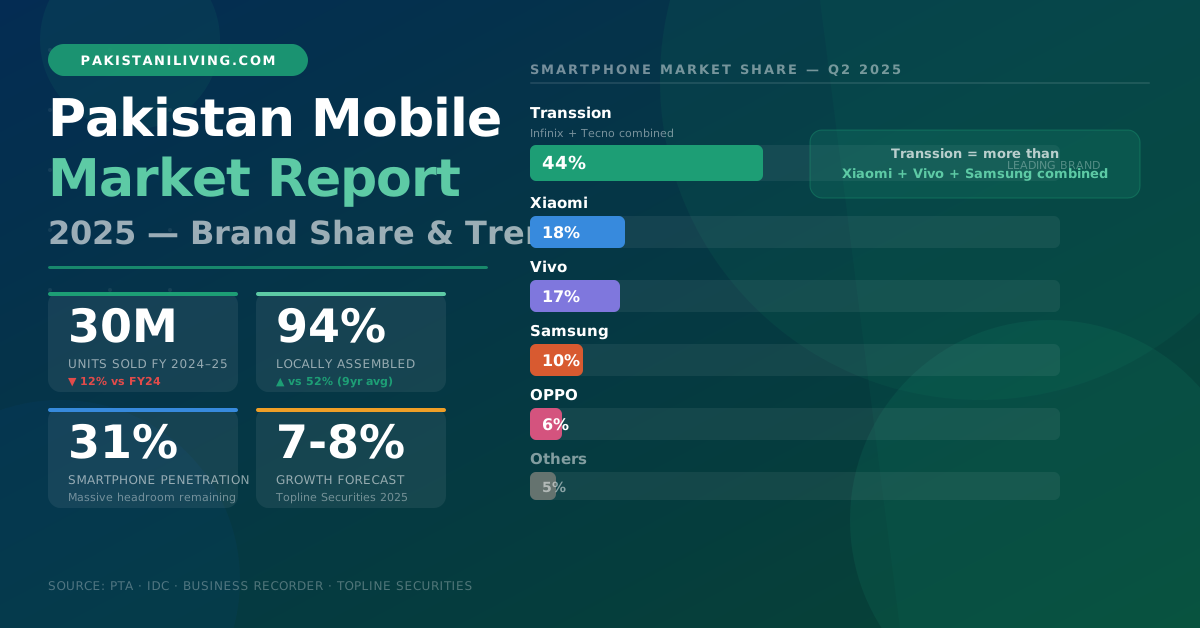
Handset availability, however, remains a key challenge. Industry reports indicate that many Pakistani users still rely on older 4G devices, creating a significant market opening for affordable AI-capable 5G smartphones from brands like Xiaomi, Tecno, Infinix, Vivo, and Samsung.
AI Is Already Inside Your Smartphone
Whether you use a flagship or a mid-range device, AI is now deeply embedded in how your phone works. Modern smartphones use AI for:
- Camera processing and night photography
- Battery and performance optimization
- Voice assistants and call noise cancellation
- Real-time translations
- AI photo editing and generation
- Smart search and content summaries
- AI-generated wallpapers and imagery
Flagship devices from Samsung, Apple, and Google now market AI experiences as their primary selling point — not just hardware specs. Even budget smartphones in Pakistan are increasingly introducing AI camera enhancements and smart battery management features.
For buyers, chipset selection is becoming more important than ever — specifically, how well a chip’s NPU (Neural Processing Unit) handles on-device AI tasks. Qualcomm Snapdragon, Apple A-series, MediaTek Dimensity, and Google Tensor are now competing on AI performance benchmarks as much as raw processing speed.
Future smartphone comparisons on PakistaniLiving will increasingly weigh AI camera quality, on-device AI processing, AI productivity and gaming features, 5G and AI readiness, and long-term AI software support.
20,000 Training Programs: Pakistan’s Workforce Bet
The government’s AI training ambitions go well beyond basic courses. Under the National AI Policy, Pakistan’s targets include:
- 20,000 AI training programs launched under NAIAI
- 20,000 paid AI internships annually
- 3,000 advanced AI scholarships per year
- AI hubs established across multiple cities
- AI adoption in healthcare, agriculture, governance, and education
- AI literacy programs for civil servants and policymakers
- Development of AI infrastructure and local compute resources
Pakistan already has one of the world’s largest freelance communities, with strong recognition on platforms like Fiverr and Upwork. But many freelancers still compete in low-value work — basic data entry, generic design, simple WordPress builds.
AI changes that equation. Writers can use AI for research and content optimization. Developers build applications faster using AI coding assistants. Designers generate and iterate concepts with generative AI. Video creators automate subtitles and editing workflows. Marketers automate ad copy and SEO processes.
Freelancers who learn AI-assisted workflows now are positioning themselves for higher-paying international markets — and Pakistan’s government initiative, if executed well, could accelerate that shift at a national scale.
AI Could Transform Key Pakistani Industries
Pakistan’s AI strategy targets sectors where automation and intelligent analytics can create real economic impact.
- Healthcare
AI can help hospitals improve diagnostics, patient management, telemedicine workflows, and medical imaging analysis — bringing better care to underserved regions.
- Agriculture
Pakistan’s agriculture sector could benefit from AI-based crop monitoring, irrigation optimization, weather forecasting, and pest detection systems that help farmers make smarter decisions at lower cost.
- Education
AI tutoring systems, automated assessments, and localized educational content could dramatically improve learning access in remote and rural regions where qualified teachers are scarce.
- E-Commerce
Pakistani online businesses can use AI for product recommendations, customer support automation, fraud detection, and personalized shopping experiences that drive higher conversion and retention.
- Government Services
AI-based document digitization, workflow automation, and data analytics can improve efficiency across public institutions and reduce administrative friction for citizens.
AI Could Unlock Urdu and Regional Language Technology
One of Pakistan’s most underappreciated AI opportunities lies in local language AI systems. Most global AI tools remain heavily English-first, leaving millions of Urdu and regional language speakers underserved.
Local AI development could unlock Urdu voice assistants, regional language search engines and chatbots, AI-powered customer support in native languages, voice-to-text tools for education access, and AI-assisted government services in local languages.
Pakistan’s telecom and AI sectors are already discussing sovereign AI infrastructure and local AI hosting solutions — a foundation that would support Urdu-first products built specifically for Pakistani users and businesses.
The Real Challenges Ahead
Despite the momentum, Pakistan’s AI future faces genuine structural obstacles that must be addressed honestly.
University curricula remain largely outdated, with most graduates entering the job market without hands-on experience in AI application development, cloud AI deployment, LLM integration, modern Python AI frameworks, or AI ethics and governance.
Infrastructure gaps persist outside major cities — slow internet speeds, expensive devices, heavy PTA taxes on handsets, and limited access to GPU computing remain real barriers to widespread AI adoption.
Execution history also matters. Pakistan has launched ambitious digital programs before that struggled with long-term consistency. Real AI development requires more than training certificates — it demands strong university-industry collaboration, startup financing, regulatory clarity, affordable cloud access, and ongoing mentorship ecosystems.
If these issues go unaddressed, Pakistan risks producing AI-certified graduates without genuinely AI-capable professionals.
Pakistan’s Digital Decade Starts Now
Pakistan’s AI and telecom convergence in 2026 represents one of the country’s most significant technology turning points in years. The 5G rollout is underway. The government is investing in mass AI upskilling. Telecom operators are integrating AI into their networks. Smartphones are becoming AI-first devices. And local startups are beginning to build for AI-native Pakistani consumers.
For smartphone buyers, the AI era means rethinking what makes a great device. For freelancers and developers, it means a genuine path to higher-value global work. For Pakistan’s digital economy, it represents a rare window to move from technology consumer to technology participant.
The next generation of Pakistani mobile users will not just compare cameras and batteries. They will compare AI experiences.
And that shift — if Pakistan seizes it — could be one of the most consequential technology transformations the country has seen in a decade.
Sources & References:
This article combines insights from official government policy documents, telecom industry announcements, and technology publications covering Pakistan’s AI ecosystem, 5G rollout, telecom modernization, and digital transformation initiatives.
- https://www.phoneworld.com.pk/pakistan-20000-ai-training-programmes-naiai-moitt-2026/
- https://jazz.com.pk/media-center/detail/jazzworld-drives-ai-led-transformation-through-strategic-partnership-with-moitt-at-indus-ai-week-2026
- https://www.dawn.com/news/1983896
- https://www.pakistantoday.com.pk/2026/05/07/pakistan-set-for-5g-launch-by-mid-august-despite-low-handset-availability
- https://www.datacenterdynamics.com/en/news/jazz-and-zong-launch-5g-services-in-pakistan/
- https://propakistani.pk/2026/02/08/ptcl-to-showcase-industry-first-ai-driven-use-cases-at-indus-ai-week-2026/
- https://moitt.gov.pk/SliderDetail/ZTY1Y2ZhMDgtZjNlZC00ODQ3LWE3MDMtMzgzMjZhZjE2YWQ0
- https://tribune.com.pk/story/2607234/govt-plans-20000-ai-training-programmes
- https://moitt.gov.pk/SiteImage/Misc/files/National%20AI%20Policy.pdf
- https://moitt.gov.pk/SliderDetail/NWIyMzEwYzktYTIwYy00ZTk0LWI5ODUtYjg5NjZmYTYyMTg2
- https://mettisglobal.news/Pakistan-targets-1bn-AI-economy-with-nationwide-digital-push-59729
- https://www.pakistantoday.com.pk/2026/02/25/pakistan-launches-nationwide-ai-training-drive-for-public-sector-workforce

Google Pixel 7 Pro

About Luqman
A passionate technology writer and digital researcher,Luqman specializes in simplifying complex tech trends into practical, user-focused insights. With a strong interest in smartphones, emerging gadgets, and digital ecosystems, Luqman delivers well-researched, unbiased content tailored for everyday users. From product deep-dives to buying guides, the goal is simple: help readers make smarter, more informed decisions in a fast-changing tech landscape.