
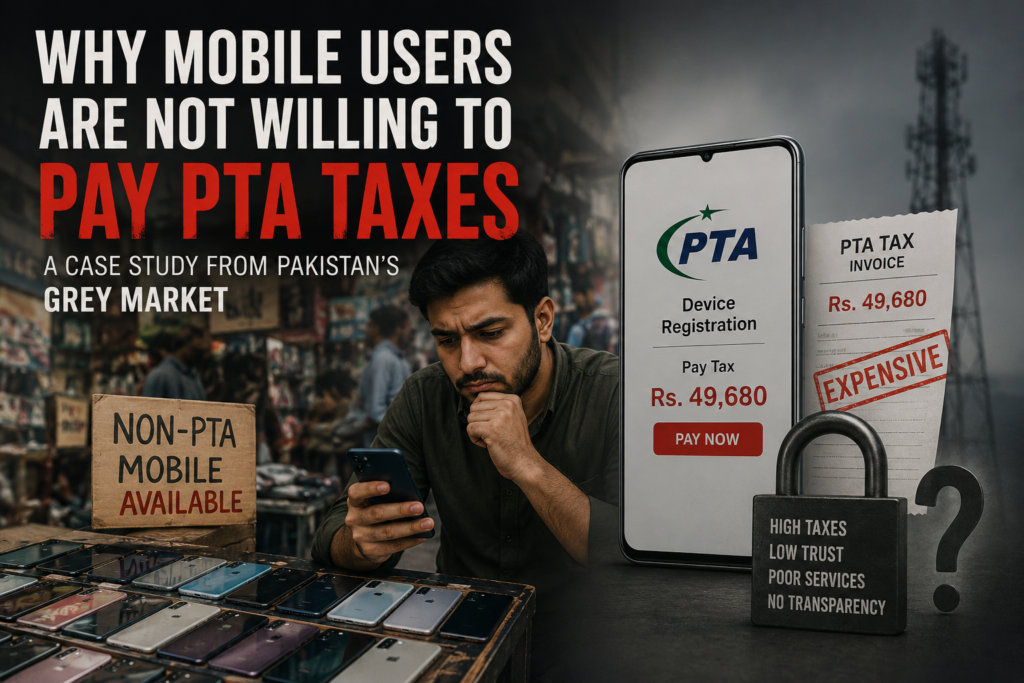
Why Mobile Users Are Not Willing to Pay PTA Taxes: A Case Study from Pakistan’s Grey Market
Xiaomi 13T Pro
The Tax Bill That Kills the Sale
Walk into any mobile market in Lahore’s Hall Road or Karachi’s Saddar, and ask a vendor about PTA-registered iPhones. The vendor will quote you a price, then quietly mention a second figure — the grey market alternative sitting in the drawer below the counter. In most cases, the difference runs between Rs. 30,000 and Rs. 80,000 for the same device. That gap is not a discount. It is the accumulated weight of PTA taxes, customs duties, and regulatory fees that the formal import channel adds to every handset entering Pakistan legally.
This is the core reason why mobile users across Islamabad, Karachi, Lahore, and smaller cities like Faisalabad and Multan are refusing to pay PTA taxes. It is not ignorance of the law. It is a rational economic decision made by buyers who have done the math and concluded that the official route does not deliver enough value to justify the premium.
What PTA Registration Actually Costs
When a phone arrives in Pakistan through informal channels — brought by a traveller or imported without proper documentation — it must be registered with the Pakistan Telecommunication Authority’s Device Identification Registration and Blocking System, known as DIRBS, to keep working on local networks. The tax applied during this registration is calculated on the declared value of the device and varies sharply by price bracket.
For a mid-range Android phone valued around Rs. 80,000 to Rs. 100,000, the PTA registration tax typically lands between Rs. 15,000 and Rs. 25,000. For a flagship iPhone in the Rs. 300,000 to Rs. 400,000 range, that figure can cross Rs. 60,000 to Rs. 80,000. These are not minor surcharges. For a household earning Rs. 60,000 to Rs. 80,000 per month — which covers a large share of urban salaried workers — a registration tax alone can equal an entire month’s income.
The Grey Market Is Not a Fringe Phenomenon
Industry estimates suggest that a significant share of smartphones circulating in Pakistan are either unregistered or registered through informal means. Hafeez Centre in Lahore, Saddar in Karachi, and Raja Bazaar in Rawalpindi remain busy precisely because buyers know they can purchase a working handset at a price that reflects none of the formal import costs.
The grey market is not populated exclusively by budget buyers. Buyers of premium Samsung Galaxy and Apple iPhone devices routinely opt for non-PTA or passport-registered units because the tax saving is too large to ignore. A passport-registered iPhone, for example, works perfectly on Pakistani networks for the duration of the passport holder’s stay — and sellers have found creative ways to extend or misuse this provision.
The behaviour pattern is consistent: when the tax burden reaches a point where it feels disproportionate to the service received in return, buyers exit the formal system. Pakistan’s mobile phone taxation has crossed that threshold for a substantial portion of the market.
What Buyers Say They Are Not Getting in Return
Tax resistance is rarely pure selfishness. It is usually tied to a perception that the value exchange is broken. In Pakistan’s case, buyers raising objections to PTA taxes point to several specific failures.
- Network quality remains poor in large parts of urban Pakistan, with frequent dropped calls and slow data speeds even in Lahore’s Defence Housing Authority and Karachi’s Clifton area.
- Load shedding — which in smaller cities can run eight to twelve hours a day — makes the smartphone less usable as a device, reducing the perceived value of keeping it formally registered.
- After-sales service for officially imported phones is limited. Authorised service centres are concentrated in major cities, and warranty claims are slow and disputed.
- The buyer sees no tangible benefit from PTA registration beyond the phone continuing to work. There is no insurance, no priority service, no consumer protection framework attached to the registration process.
When buyers compare paying Rs. 50,000 in taxes for a registration certificate that delivers none of these benefits against buying a grey market unit and keeping that Rs. 50,000 in their pocket, the choice is obvious to them.
The Pricing Structure That Makes the Problem Worse
Pakistan’s mobile taxation is structured in a way that punishes mid-range and premium buyers disproportionately. Entry-level phones below a certain declared value attract lower taxes, which means the formal market can sometimes compete on budget devices. But as soon as a buyer moves toward the Rs. 100,000 to Rs. 200,000 price bracket — where a large and growing segment of aspirational Pakistani buyers now shops — the tax burden becomes severe.
This bracket is significant because it covers phones that are neither cheap nor ultra-premium. These are devices that a buyer in Islamabad’s G-10 or Lahore’s Gulberg might stretch their budget to afford over six months of savings. Asking that buyer to then pay an additional 20 to 30 percent on top of the device cost for PTA compliance is asking for a commitment the formal market has not earned.
Pakistan Buying Guide: PTA Tax, Grey Market, and What to Expect
If you are buying a phone in Pakistan right now, here is a clear breakdown of your options and what each one actually means for your wallet and your risk level.
| Purchase Type | Typical Extra Cost | Network Risk | Warranty | Where Available |
|---|---|---|---|---|
| PTA-Approved (Official Import) | Built into retail price | None | Local brand warranty | Brand stores, authorised dealers |
| Passport Registered | Rs. 5,000 to Rs. 15,000 for registration | Low short-term, risk if rules tighten | None locally | Hafeez Centre, Saddar, online sellers |
| Non-PTA / Unregistered | Lower upfront price, zero tax paid | High — may be blocked by DIRBS | None | Grey market shops, informal vendors |
| Daraz Official Listings | Varies — some are PTA approved | None if PTA approved | Seller dependent | Daraz.pk |
Buyers who need a reliable daily driver with no network risk should buy PTA-approved stock, even if the upfront cost is higher. Buyers taking calculated risks should at minimum verify passport registration status before handing over money. Non-PTA phones carry real blocking risk as the DIRBS system continues to be enforced.
Bottom Line
The resistance to paying PTA taxes in Pakistan is not a cultural problem or a law enforcement failure alone. It is a pricing and value problem. When a tax adds Rs. 50,000 to Rs. 80,000 to a phone purchase and the buyer receives nothing measurable in return — no better network, no service guarantee, no consumer protection — the rational response is to find a way around it. Until PTA registration is tied to tangible consumer benefits, or until tax rates are recalibrated to reflect what the average Pakistani household can actually absorb, the grey market will continue to be the market of first choice for a large share of buyers from Karachi to Peshawar.
Frequently Asked Questions
What happens if I use a non-PTA phone in Pakistan?
A non-PTA registered phone can be blocked by the DIRBS system, meaning it will stop working on all Pakistani networks. The block is applied based on the device’s IMEI number. Once blocked, the phone cannot make calls or use mobile data until registration fees are paid and the device is cleared.
Can I register a phone brought from abroad at a lower tax rate?
Phones brought by Pakistani travellers from abroad can be registered using passport registration, which attracts a lower tax rate than commercial import taxes. However, this provision has limits — it is meant for personal use devices and is subject to quantity and frequency restrictions. Misuse of this channel is common and the authorities have periodically tightened enforcement.
Is buying from Daraz safe for PTA registration?
Daraz listings vary. Some sellers on Daraz list officially imported, PTA-approved stock, while others sell passport-registered or grey market devices. Always check the listing description carefully for the words PTA Approved before purchasing. If it says only Passport Registered or does not mention PTA status, confirm with the seller before payment.
Why is the PTA tax so much higher for iPhones than for budget Android phones?
PTA registration taxes in Pakistan are calculated on the declared value of the device. Higher-value phones attract higher absolute tax amounts because the tax is applied as a percentage of the device’s worth, sometimes with additional fixed charges at the top end. This means an iPhone that costs Rs. 350,000 will carry a dramatically larger tax bill than a phone valued at Rs. 40,000, making the formal purchase of flagship devices particularly expensive compared to grey market alternatives.

Apple iPhone 14

About Luqman
A passionate technology writer and digital researcher,Luqman specializes in simplifying complex tech trends into practical, user-focused insights. With a strong interest in smartphones, emerging gadgets, and digital ecosystems, Luqman delivers well-researched, unbiased content tailored for everyday users. From product deep-dives to buying guides, the goal is simple: help readers make smarter, more informed decisions in a fast-changing tech landscape.