
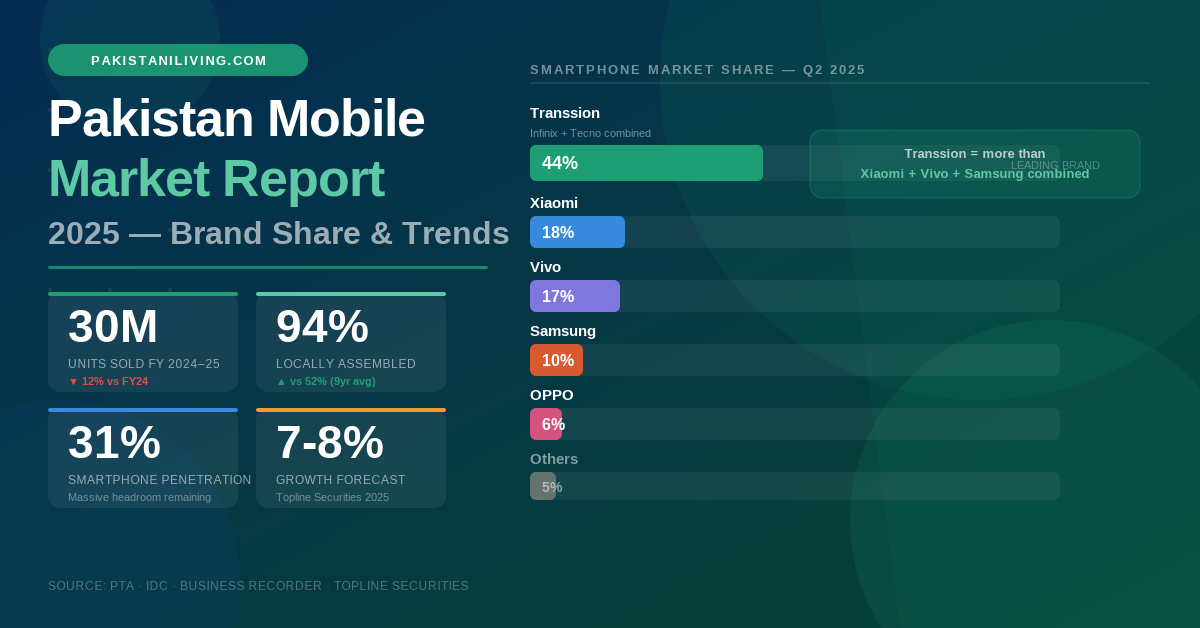
Pakistan Mobile Market Report — 2025

Samsung Galaxy S23 Ultra
Pakistan Mobile Market Report 2025 — Who’s Winning, Who’s Losing
The most complete brand share breakdown in Pakistan — PTA shipment data, quarterly trends, and what the numbers actually mean for buyers right now.
Two ways to measure who’s winning — and they tell different stories
Pakistan sells roughly 30 million mobile phones a year, making it one of the largest handset markets in South Asia — and one of the least reported on in plain language. In FY 2024–25, total sales dropped 12%, with 30 million units sold compared to 34 million the previous year. But underneath that headline decline, the competitive picture is far more interesting.
The shipment story: Transsion has quietly won
A brand most Pakistanis couldn’t name five years ago now controls nearly half the smartphones being sold in the country. Transsion Group — the Chinese company behind Infinix and Tecno — built its entire strategy around emerging markets by obsessing over what budget buyers actually want: long battery life, good low-light cameras, durable builds, and prices that don’t sting.
Infinix and Tecno have executed this strategy in Pakistan almost perfectly. Their phones dominate Hall Road in Lahore, Saddar in Karachi, and small city shops across Multan and Faisalabad. They’ve built deep retailer relationships in a market where 95% of smartphone sales come from independent shopkeepers — no carrier subsidies, no telecom-driven EMI schemes. [2]
Globally, IDC data confirms Transsion ranked first in smartphone shipments in Pakistan, Bangladesh, the Philippines and across Africa in the first three quarters of 2024 — a consistent pattern that continued into 2025. [9]
A quiet industrial revolution: 94% made locally
One of the most underreported stories in Pakistani tech is the manufacturing transformation. A decade ago Pakistan imported most of its phones. Today it assembles almost all of them domestically. The 94% local assembly figure for 2025 compares to a nine-year average of just 52% — a structural shift, not a short-term blip. [3]
Key assembly partners include Airlink Communication and Lucky Cement, which assemble phones for Xiaomi, Tecno, and others under PTA-approved frameworks. Xiaomi’s Pakistan head confirmed that all Redmi Note series phones priced between $100 and $300 are now locally assembled, with only flagship-tier Xiaomi devices still imported as complete units. [2]
2026 update: local assembly is down 7% and covers less of demand
PTA data cited by Topline Securities and reported by Profit (Pakistan Today) on 7 July 2026 shows local plants assembled 11.17 million handsets in January to May 2026, down 7% from 12.05 million in the same months of 2025. Local assembly met 85% of total demand in those five months, against the 94% shown for 2025 above. Total supply, including imports, was 13.08 million units. [10]
By brand, production changed year on year as follows: VGO Tel up 29%, Tecno up 24%, Samsung up 7%, Vivo down 30%, Itel down 29% and Infinix down 19%. [10] The brand share chart above is Q2 2025 IDC data. We did not find a newer IDC brand-share table, so that chart is unchanged.
Why Samsung still leads usage despite losing new sales
Samsung has been selling phones in Pakistan for over 15 years. Its older models stay in use for four, five, even six years — especially in middle-income households where a Galaxy A-series bought in 2020 remains the family’s primary device. Infinix’s rise in shipments is real, but it hasn’t yet displaced Samsung’s enormous installed base. Give it three to four more years of Transsion dominance in new sales and the usage picture will shift decisively.
Apple’s 8.8% active usage share is also notable — higher than you’d expect given iPhone pricing in a market where average household income is under Rs.100,000 a month. iPhones in Pakistan are mostly second-hand grey market imports, bought after two or three years of global depreciation. They are status symbols traded actively in Karachi and Lahore’s secondhand markets.
- Infinix / Tecno: the widest shop and technician presence. With 44% of smartphone shipments in Q2 2025 [2], Transsion phones are sold in almost every market, so a technician or a spare screen is usually easy to find. We have not audited service centres.
- Samsung: usually easy to resell. Samsung has sold phones in Pakistan for over 15 years and its older models stay in use. We have not compared resale prices, so check recent OLX listings for the exact model before you pay.
- Xiaomi Redmi Note: locally assembled and widely sold. Xiaomi held 18% of smartphone shipments in Q2 2025 [2], and its Redmi Note series is assembled in Pakistan, so PTA-approved units are easy to find. Compare current prices on Daraz and in Hafeez Centre before buying.
- 31% penetration means the next wave is still coming. Brands are competing for first-time buyers across smaller cities, which is why budget phones keep gaining features.
How current this report is
This report was last reviewed on 27 October 2026. The charts use 2025 data from the sources listed below; the 2026 update section above them shows the newest PTA assembly figures we found. We do not publish on a fixed schedule. If you spot something we missed, drop a comment.
Sources cited in this article
- [1]Pakistan Telecommunication Authority (PTA) — Monthly Assembly Statistics Official monthly data on mobile phone manufacturing, assembly volumes, and brand-level output used throughout. Figures for Jan–Oct 2025 local assembly totals, smartphone vs feature phone split, and 94% domestic demand coverage. pta.gov.pk Accessed via Business Recorder and Pakistan Today Profit reports, 2025.
- [2]Business Recorder — “Pakistan’s smartphone market remains a gold mine despite recent decline” Primary source for Q2 2025 brand market share (IDC data), Transsion 44% unit share, Xiaomi marketing head interview quotes, and independent retail channel (95%) breakdown. brecorder.com/news/40388277 Published October 20–21, 2025.
- [3]Business Recorder — “Smartphone manufacturing boom positions Pakistan for export-driven growth” Source for 10-month 2025 local assembly totals by brand, 25.11M unit total, 94% domestic coverage figure, and 31% smartphone penetration rate. brecorder.com/news/40394358 Published November 26, 2025.
- [4]Profit by Pakistan Today — “Mobile phone sales in Pakistan decline by 12% in FY 2024–25” Source for full-year FY25 vs FY24 sales decline (30M vs 34M units), H1 2025 brand assembly rankings, and 94% local assembly in first five months. profit.pakistantoday.com.pk Published July 31, 2025.
- [5]The News International — “Pakistan assembles 3.59m mobiles in July, up 123pc YoY” Source for July 2025 production surge (3.59M units, 123% YoY), June 2025 disruption context, and Topline Securities 7–8% growth projection. thenews.com.pk Published September 5, 2025.
- [6]Express Tribune — “Local mobile production up, sales down” Source for 5-month 2025 assembly data (12.05M units), smartphone vs 2G feature phone split (46% / 54%), and top 10 brand rankings for Jan–May 2025. tribune.com.pk Published July 6, 2025.
- [7]PhoneWorld — “Major smartphone brands battle for market share in Pakistan in 2026” Source for active web usage share figures across Pakistan’s major cities: Samsung 26.4%, Vivo 15.2%, Xiaomi 14.1%, OPPO 12.2%, Infinix 9.7%, Apple 8.8%, Tecno 4.7%, Realme 4.6%. phoneworld.com.pk Published May 2026.
- [8]Profit by Pakistan Today — “Pakistan’s mobile manufacturing sees 123% YoY growth in July 2025” Supporting source for July 2025 production data and Topline Securities analyst commentary on base effects and outlook. profit.pakistantoday.com.pk Published September 4, 2025.
- [9]IDC Global Mobile Phone Quarterly Tracking Report — Q1–Q3 2024 Source for Transsion Group global ranking (#3 in global mobile, #5 in smartphones) and confirmation of Transsion’s #1 position in Pakistan, Africa, Bangladesh, and Philippines. Cited via Business Recorder and 36Kr analysis. IDC proprietary data; cited in published reports October–November 2025.
- [10]Profit by Pakistan Today, mobile phone assembly report for January to May 2026 Source for 11.17M units assembled in 5M2026, the 7% year-on-year decline, the 85% share of demand met locally, total supply of 13.08M units and the brand changes in the 2026 update. Data: PTA, cited by Topline Securities. profit.pakistantoday.com.pk Published July 7, 2026.