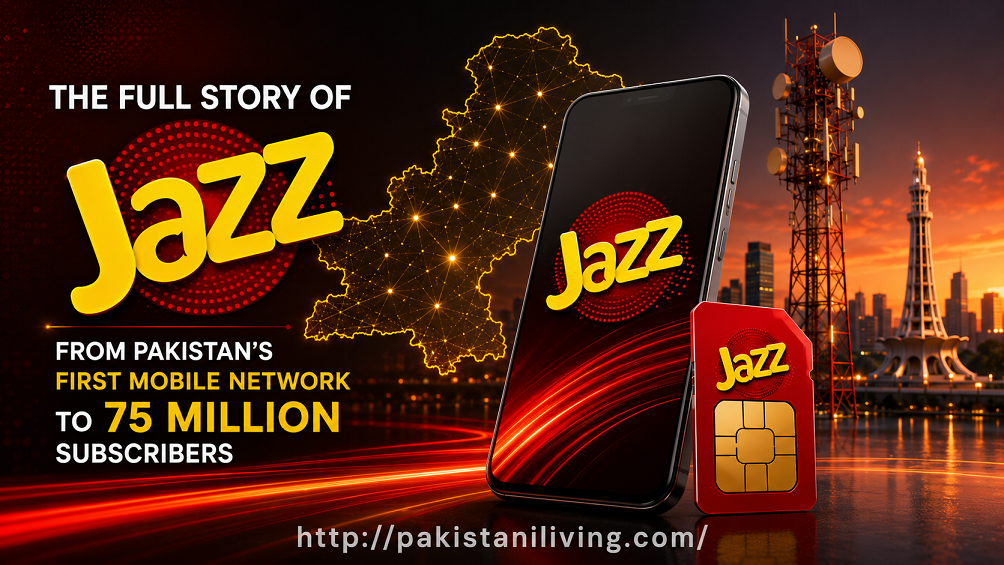
Jazz Pakistan: From Pakistan’s First Mobile Network to 75 Million Subscribers – The Full Story
Samsung Galaxy S23 Ultra
Jazz Pakistan: From Pakistan’s First Mobile Network to 75 Million Subscribers — The Full Story
Jazz was not always Jazz. For its first twenty-three years it was Mobilink — Pakistan’s first mobile operator, the company that launched the country’s mobile era in 1994. This is the story of how one network went from a luxury car-phone service for Karachi’s wealthy to a 75-million-subscriber platform that handles more financial transactions than most Pakistani banks.
The Beginning: Pakistan’s First Mobile Call (1994)
Pakistan Mobile Communications Limited (PMCL) launched commercial mobile services in 1994 under a license issued by the government. The company was initially a joint venture involving Motorola and Pakistani partners. The brand name used was Mobilink — a compound of “mobile” and “link” that would survive for over two decades.
The 1994 launch should not be imagined as a mass-market event. Handsets were analogue, large, and priced above Rs. 40,000. The network covered Karachi and Lahore and little else in the first years. Per-minute call rates made a month of regular use cost more than a junior civil servant earned in a year. Mobilink’s first customers were businessmen, government officials, large company executives, and the Pakistani upper class — people for whom the mobile phone was a tool of status as much as communication.
Paktel and Instaphone launched shortly afterward, giving Pakistan three mobile operators by the mid-1990s. But all three served the same narrow demographic. The mobile revolution that defined the 2000s was still nearly a decade away.
The Orascom Years and the Jazz Brand (2000–2006)
The transformation of Mobilink from elite service to mass-market operator began with a change of ownership. Egypt’s Orascom Telecom — then one of the Middle East and North Africa’s most aggressive mobile expansion companies — acquired majority control of PMCL in 2001. Orascom brought capital, operational expertise from Egyptian and other regional markets, and a clear thesis: the Pakistani market was vastly underserved, and the right price would unlock explosive growth.
Orascom’s most consequential decision was the launch of the Jazz prepaid brand in 2003, timed precisely with Pakistan’s telecom deregulation. The Jazz brand was designed for the Pakistani mass market — simpler, cheaper, and marketed in Urdu with an energy that the corporate Mobilink brand lacked. The Jazz SIM card at Rs. 300–500 was accessible at a price point that no previous mobile product in Pakistan had reached. The Jazz recharge card at Rs. 100 lowered the minimum entry cost further.
The Jazz brand succeeded partly because of its name. “Jazz” carried no corporate stuffiness. It was energetic, urban, and young-sounding in both English and in the way it was spoken in Urdu. The word crossed class lines — a university student and a factory worker could both own a “Jazz number” without either feeling that the product was not meant for them.
PMCL launches as Pakistan’s first mobile operator. Analogue network, luxury pricing, Karachi and Lahore only. Subscribers at end of year: under 10,000.
Orascom Telecom acquires majority control of PMCL/Mobilink. GSM digital network now fully operational. Ufone launches as first competitor — beginning of real competition.
Jazz prepaid brand launches, timed with deregulation. Rs. 100 recharge cards, aggressive marketing in Urdu. Subscriber growth accelerates sharply. Mobilink becomes the leading operator by subscriber count.
Telenor and Warid launch — five-operator era. Mobilink responds with price cuts and expanded bundle packages. Despite new competition, retains market leadership. Subscribers exceed 20 million.
Pakistan mobile market hits 63 million subscribers. Mobilink’s market share is approximately 37%. Orascom Telecom’s parent restructuring begins — VimpelCom (now Veon) begins acquiring Orascom assets globally.
The Advertising That Defined Pakistani Mobile Culture
Mobilink and Jazz’s advertising legacy is inseparable from the history of Pakistani commercial television. Between 2003 and 2010, Jazz campaigns were among the most watched and discussed advertising in the country. They understood their audience in a way that competitors frequently did not.
The “Har Dil Ki Awaz” (Voice of Every Heart) positioning articulated what the Jazz brand was attempting: to be the phone for every Pakistani, regardless of class, city, or background. Early Jazz TV commercials showed ordinary Pakistanis — not models, not aspirational fantasies — using their phones in recognisable situations. A student calling his mother from a hostel. A young man in a rickshaw coordinating with a friend. These were not glamorised depictions of mobile life; they were accurate ones, and they resonated precisely for that reason.
Ufone’s competing campaigns were funnier — their humour-based advertising won more creative awards. But Jazz’s emotional register was wider. It reached demographics that Ufone’s urban comedy did not, including rural and semi-urban Pakistanis who saw their own lives on screen.
VimpelCom Era and the Transition to Veon (2011–2016)
Russian telecommunications company VimpelCom — which later rebranded as Veon — acquired the Orascom assets including Mobilink Pakistan through a complex multi-year transaction that completed in 2011. The change in ownership was less visible to Pakistani consumers than the Orascom-to-VimpelCom corporate restructuring might suggest; the Jazz brand continued, the network continued, and for most customers the parent company’s nationality was irrelevant.
What changed under VimpelCom/Veon was the strategic emphasis. The parent company was navigating a global portfolio that included Russia (Beeline), Italy (Wind), Algeria (Djezzy), Bangladesh (Banglalink), and Pakistan (Mobilink). Pakistan was one of Veon’s larger markets and received continued investment, but the company’s attention was divided.
JazzCash launched in 2012 as Mobilink’s answer to Easypaisa. The mobile wallet product, building on Easypaisa’s agent model, grew more slowly in its early years but eventually reached comparable scale. JazzCash’s advantage was its integration with the Jazz mobile network and billing system — Jazz subscribers could load and use JazzCash with less friction than a competing network’s wallet. This integration would become a significant competitive advantage as mobile banking volumes grew through the 2010s.
The Warid Merger: Creating Pakistan’s Largest Operator (2015–2016)
Warid Telecom, backed by the Abu Dhabi Group, had built a significant subscriber base — approximately 15 million at the time of the merger — and held valuable spectrum assets including a 4G LTE license. Veon’s acquisition of Warid, announced in late 2015 and completed in 2016, was motivated partly by spectrum and partly by scale economies. Combining two networks — sharing towers, spectrum, and back-office costs — produced savings that neither could achieve independently.
The Warid brand was retired. Warid subscribers migrated to the Mobilink network. The combined entity became Pakistan’s largest mobile operator by subscriber count, with approximately 55 million subscribers at the time of the merger and a spectrum portfolio that gave it capacity advantages in urban data markets.
The Jazz Rebrand: Retiring Mobilink After 23 Years (2017)
The decision to retire the Mobilink brand and rename the company Jazz was announced in 2017. From a corporate perspective, the logic was straightforward: the Jazz name was the consumer-facing brand that Pakistanis actually used. “I have a Jazz number” was how subscribers described their SIM. “I recharged my Jazz” was how they described adding credit. Mobilink was a corporate name on a letterhead; Jazz was a name on a Rs. 100 card sold in 400,000 shops across Pakistan.
But retiring Mobilink was not merely a brand management exercise. It was the end of a 23-year name that had been present through every era of Pakistani mobile history. Mobilink had been Pakistan’s first mobile operator. The Mobilink name had been in Pakistani consciousness since 1994 — since before most of its own 2017 subscriber base had been born. The decision to replace it felt, to some observers, like replacing something irreplaceable.
The rebrand was executed in full. Physical stores, SIM cards, advertising, billing systems, and all customer-facing material migrated to Jazz branding. The transition was managed over several months rather than overnight. By mid-2017 Mobilink had effectively ceased to exist as a consumer brand, though the corporate legal entity (PMCL) retained its registration.
“Yaar, my Mobilink number since 2003. Now they say call it Jazz. It is still my number but the name is gone.”
— A Karachi-based user, 2017, a sentiment shared across social media during the rebrand.
JazzCash: When a Telecom Became a Bank
JazzCash’s growth trajectory in the second half of the 2010s and through the 2020s transformed Jazz from a telecom company with a financial services product into something more accurately described as a financial services platform that also operates a mobile network.
JazzCash reached 10 million active wallets by 2018. By 2020, helped by COVID lockdown-driven digital payment adoption, it crossed 30 million. By 2026, the figure exceeds 50 million — a number that exceeds the combined deposit accounts of most conventional Pakistani banks.
| Year | JazzCash Active Wallets | Key Feature / Milestone |
|---|---|---|
| 2012 | Launch | Over-the-counter money transfer (agent model) |
| 2015 | ~5M | Mobile wallet (account-based) launched; bill payments added |
| 2018 | ~12M | DIRBS compliance integration; government payments |
| 2019 | ~18M | JazzCash app redesign; QR payments piloted |
| 2020 | ~30M | COVID lockdown accelerates adoption; government relief payments via JazzCash |
| 2021 | ~38M | Raast integration; instant bank transfers |
| 2023 | ~45M | Merchant QR network expands to 500,000+ outlets |
| 2026 | 50M+ | JazzCash becomes Pakistan’s largest digital payments platform by active users |
JazzCash’s success reflects a deeper structural fact about Pakistan’s financial landscape. Conventional banking in Pakistan requires documentation, branch proximity, and minimum balance requirements that exclude a large portion of the population. JazzCash requires a CNIC (national identity card) and a mobile phone — two things that a far larger proportion of Pakistanis possess. The result was financial inclusion at a scale that decades of conventional banking expansion had not approached.
Jazz and 4G: Playing Catch-Up, Then Regaining Ground
Jazz’s 4G story is one of the more interesting competitive dynamics in Pakistani telecom. In the 2014 spectrum auction, Mobilink (as it then was) acquired 3G spectrum but did not bid for 4G. Zong and Telenor won 4G licenses. This left Pakistan’s largest network by subscriber count without 4G capability while its competitors began 4G rollouts.
The gap proved costly in the data market. From 2014 to 2016, Jazz customers who wanted 4G were forced to either remain on slower 3G or switch networks. Some did. Zong in particular gained mobile internet subscribers at Jazz’s expense during this window, building a data network reputation that persisted even after Jazz acquired 4G capability.
Jazz acquired 4G spectrum through the Warid merger (Warid had an LTE license) and through subsequent direct spectrum acquisitions. By 2018 Jazz had a competitive 4G LTE network in major cities. By 2020 its 4G coverage had caught up with or surpassed competitors in rural and semi-urban areas where Jazz’s extensive tower network — built over twenty years of being the country’s largest operator — gave it infrastructure advantages that newer networks lacked.
The 5G Position (2026)
Jazz is one of three operators offering commercial 5G services following the March 2026 launch. Its initial 5G deployment covers Karachi, Lahore, and Islamabad on the Non-Standalone architecture. Jazz’s 5G positioning emphasises enterprise applications — smart manufacturing, logistics, and large-venue connectivity — alongside consumer services, reflecting its scale advantage in serving both B2C and B2B customers.
For Jazz, 5G is as much a JazzCash enabler as a mobile network upgrade. Higher-bandwidth, lower-latency connectivity enables real-time payment scenarios — point-of-sale terminals at high-volume merchants, instant settlement for e-commerce, and the kind of always-on financial service infrastructure that mobile wallets require to move from supplement to primary financial service for tens of millions of users.
What Jazz Built
Jazz’s thirty-two-year history — from Mobilink’s 1994 launch through the Jazz rebrand to 5G in 2026 — is the story of Pakistan’s mobile era told through a single company. The company was present at every inflection point: the first commercial mobile call, the mass-market breakthrough, the price war, the Warid consolidation, the JazzCash financial inclusion story, and now 5G.
Its competitors have been present for most of these chapters too. But no other Pakistani mobile operator has been present for all of them. No other has operated continuously from the country’s first mobile call to its first 5G session. That continuity — with all the institutional memory, the 400,000 retail points, the tower network, and the 50 million financial wallets it represents — is Jazz’s deepest competitive advantage heading into the next decade.
Coming Next
Zong’s story: how Paktel — one of Pakistan’s weakest early operators — became the country’s fastest data network after China Mobile acquired it in 2007. The CPEC connection, the 4G bet, and why Zong consistently has the fastest mobile internet speeds in Pakistan’s major cities.