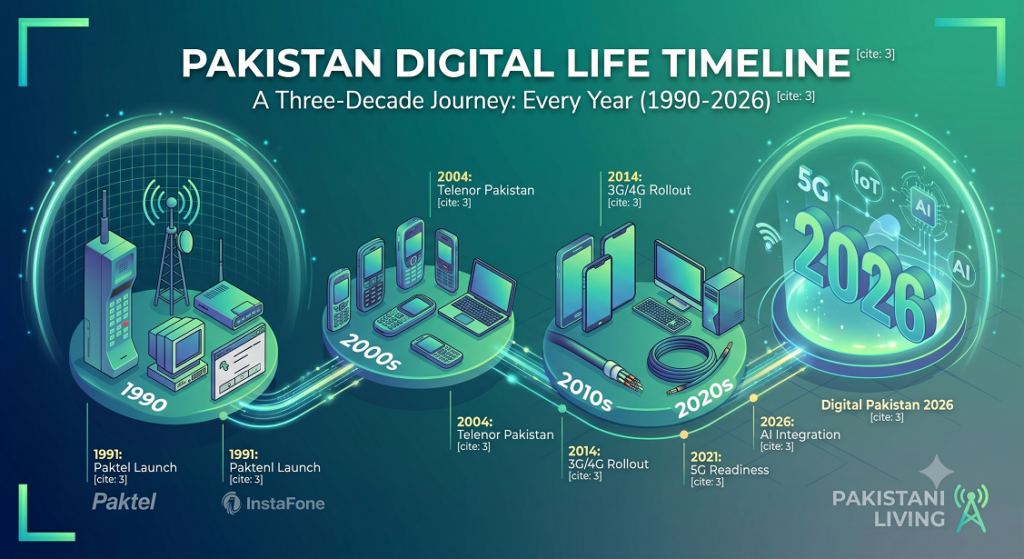
Pakistan Digital Life Timeline – Every Year from 1990 to 2026
Realme 13 Plus 5G
Pakistan Digital Life Timeline: Every Year from 1990 to 2026
This is Pakistan’s complete digital timeline — every significant milestone in telecommunications, mobile technology, internet access, and digital culture from 1990 to 2026. Built from verified sources and updated annually. If you remember a year differently, use the comments below.
How to use this page: Each decade has a summary at the top. Individual years follow in timeline order. Landmark years are highlighted. Use Ctrl+F / Command+F to jump to a specific year. This page is updated as new milestones occur.
The 1990s — The Monopoly Decade
PTCL controls everything. Landlines are scarce, expensive, and require years of waiting. Mobile arrives as a luxury product. The internet is unknown to most Pakistanis.
Pakistan has 900,000 landlines for 110 million people
Teledensity is under 1 per 100. PTCL (as PTC at this time) operates a complete monopoly. International calls are routed through a single government exchange. Waiting list for a new landline: 2–5 years in major cities.
Pakistan’s first mobile network launches
Pakistan Mobile Communications Limited (PMCL), operating as Mobilink, launches the country’s first commercial mobile telephone service. Handsets cost Rs. 40,000–80,000. Per-minute rates are Rs. 15–20. Mobile is strictly for the wealthy.
Paktel and Instaphone launch
Second and third mobile operators enter the market. All operate on analogue AMPS technology. All three networks serve the same tiny wealthy demographic. Combined subscriber count: under 100,000 nationally.
PTA established; PTCL restructured as PTCL Ltd.
Pakistan Telecommunication Authority created as a regulator. Pakistan Telecommunication Company Limited incorporated as a listed entity (government retains majority). PTCL monopoly on fixed-line services continues unchanged. PTA in early years largely protects PTCL rather than promoting competition.
Internet arrives in Pakistan — very slowly
Dial-up internet becomes available in Karachi, Lahore, and Islamabad through a handful of ISPs including Brain Telecommunication Ltd (Brain.net.pk). Connection speeds: 14.4 kbps–56 kbps. Cost: Rs. 600–1,200 per month. Dial-up ties up the home telephone line. Internet users: estimated 30,000–50,000 nationally.
Nokia 3210 and GSM transition begin
Mobile operators begin GSM digital network rollouts, replacing analogue AMPS. Nokia’s consumer-friendly handsets — beginning with the 3210 — start to make mobile more accessible, though prices remain out of reach for most. PCO booths at peak commercial operation across Pakistan.
The 2000s — The Revolution Decade
Deregulation opens the market. Five operators compete. Subscriber count explodes from under 5 million to 100 million in eight years. SMS becomes a mass communication medium. Missed call culture peaks. Nokia 1100 defines the era.
Ufone launches — PTCL enters mobile
Pakistan Telecom Mobile Limited (Ufone), a PTCL subsidiary, launches mobile services. Ufone’s PTCL parentage gives it significant fixed infrastructure advantage. The Ufone prepaid SIM at under Rs. 500 begins making mobile accessible beyond the premium tier.
SMS becomes mainstream; Nokia 1100 enters Pakistan
Text messaging takes off as per-SMS costs fall below Rs. 1. The Nokia 1100 — Rs. 4,000–5,000 — brings mobile to the lower-middle income bracket for the first time. Internet cafes at their commercial peak in university areas. Internet users: approximately 500,000.
Telecom Deregulation Policy — The watershed moment
Musharraf government issues comprehensive deregulation policy. PTCL’s fixed-line and long-distance monopoly ends. New mobile licenses to be issued. PTA remit expanded and genuinely competition-focused. This single policy decision sets the mobile revolution in motion. Mobilink launches the “Jazz” prepaid brand.
New mobile licenses auctioned
PTA auctions mobile licenses. Telenor (Norway) and Warid Telecom (Abu Dhabi Group) win licenses. Pakistan prepares for five-operator competition. Per-minute rates begin to fall as anticipation of competition builds. Mobile subscribers reach approximately 5 million — still a small fraction of the population.
Telenor and Warid launch — Five-operator era begins
Telenor Pakistan launches in March 2005. Warid Telecom launches in May 2005. Pakistan now has five competing mobile networks: Mobilink, Ufone, Telenor, Warid, Paktel. Per-minute rates collapse from Rs. 5–8 to under Rs. 2 within twelve months. Subscribers: 12 million by year-end.
Etisalat acquires 26% of PTCL for $2.6 billion
Abu Dhabi-based Etisalat acquires controlling stake in PTCL — Pakistan’s largest ever FDI at the time. PTCL begins modernisation programme. EVO (CDMA-based mobile broadband) begins trials. Ufone advertising campaigns reach peak cultural influence. Subscribers: 36 million.
China Mobile acquires Paktel; Subscribers hit 63 million
China Mobile acquires a controlling stake in Paktel — China’s first major telecom investment in Pakistan. Paktel rebranded in 2008 as Zong. Pakistani mobile subscribers reach 63 million — 13x growth in four years. Rs. 10 mobile recharge cards launch, making mobile accessible to the lowest-income tier. Missed call culture at its absolute peak.
Paktel rebrands as Zong; Internet cafes peak
Zong launches with aggressive data pricing ambitions. PTCL DSL broadband available in major cities. Internet cafe culture at its commercial peak: 5,000+ cafes across Pakistan’s cities, serving university students and professionals who cannot afford home broadband. Facebook reaches first million Pakistani users.
Easypaisa launches — Mobile banking arrives
Telenor Pakistan and Tameer Microfinance Bank launch Easypaisa, Pakistan’s first mobile money service. Initial focus: over-the-counter money transfers through enrolled agents. Pakistan’s formal banking penetration at approximately 12% of adults — Easypaisa begins addressing the gap. Mobile subscribers: 94 million. SMS volumes at all-time peak.
The 2010s — The Internet Decade
3G and 4G transform Pakistan from a voice-SMS country to a data country. WhatsApp replaces SMS. Facebook becomes primary news source for millions. Smartphones go mainstream. Mobile banking reaches tens of millions. YouTube is blocked, then returns.
Subscribers hit 100 million; Facebook ban and lift
Pakistan reaches 100 million mobile subscribers. Facebook is briefly blocked in May 2010 following a content controversy (Draw Muhammad Day campaign). Restored within weeks. Incident establishes the PTA’s content-blocking machinery as a recurring fixture. Mobile Internet penetration: under 2% — data is too slow and expensive for most.
Smartphones enter Pakistan; JazzCash prepares
First Android smartphones at Rs. 15,000–20,000 appear in Pakistani markets. WhatsApp launches (January 2010 globally) begins reaching Pakistani users. First QMobile Android devices offer a locally assembled budget smartphone option. Mobilink begins developing JazzCash mobile wallet as Easypaisa competitor.
YouTube blocked; JazzCash launches; 3G trials begin
YouTube blocked in September 2012 following the “Innocence of Muslims” controversy. The block lasts until January 2016 — three and a half years. JazzCash mobile wallet launches as Pakistan’s second mobile money service. First 3G LTE trials conducted in controlled environments. PTA announces 3G spectrum auction “imminently” — a promise repeated for two more years.
WhatsApp reaches critical mass; Android under Rs. 10,000
WhatsApp becomes the default messaging app for urban Pakistanis under 35. SMS traffic begins its long decline. Chinese Android smartphones (Huawei, ZTE, and local assemblers) fall below Rs. 10,000. Smartphone penetration in urban areas crosses 20%. Missed call culture begins contracting as WhatsApp provides a free text alternative.
3G/4G auction — $1.12 billion and the mobile internet era begins
April 2014: Pakistan’s historic spectrum auction raises $1.12 billion. Four 3G licenses and two 4G licenses issued. Zong and Telenor commit to 4G LTE. Mobilink and Ufone receive 3G. All four networks begin commercial 3G rollout within months. Mobile internet users grow from under 3 million to over 20 million by year-end. DIRBS programme announced.
4G goes live; Mobilink-Warid merger announced
Zong and Telenor launch 4G LTE services commercially. 4G coverage limited to major urban centres but rapidly expanding. Mobile internet users cross 25 million. WhatsApp voice calls launch globally — begin replacing GSM voice calls on data-connected devices. Mobilink parent VimpelCom announces acquisition of Warid Telecom.
YouTube unblocked; Mobilink-Warid merger completes; 4G expands
January 2016: YouTube restored in Pakistan after 3.5 years. Pakistani content creators return en masse. The YouTube ecosystem in Pakistan expands dramatically within eighteen months. Mobilink-Warid merger completes — combined entity becomes Pakistan’s largest operator. PTCL EVO and WiMAX services begin declining as 4G renders them obsolete.
Jazz brand launches; Telenor reaches 40M; Mobile internet at 44M
Mobilink formally rebrands to Jazz — retiring the Mobilink name after 23 years. The Jazz rebrand is Pakistan’s biggest corporate identity change. Mobile internet subscribers reach 44 million. Smartphone penetration crosses 40% nationally. Pakistani YouTube creators begin monetising — content economy begins. CPEC-linked fibre optic projects accelerate backbone capacity.
DIRBS enforcement; TikTok arrives; Mobile banking grows
PTA enforces DIRBS — unregistered handsets blocked from networks. Grey market phones disrupted. TikTok launches globally and begins reaching Pakistan’s younger demographics. Easypaisa and JazzCash combined active wallets cross 30 million. Mobile internet: 56 million subscribers. 4G coverage now in 200+ cities.
TikTok grows; digital payments expand; Telenor strategic review
TikTok reaches 10 million Pakistani users. Pakistani TikTok creators build followings in hundreds of millions of views. Mobile data prices fall below Rs. 10/GB on major networks. Telenor Group begins strategic review of Pakistan operations — exploring options including merger or sale. Digital payment transactions exceed 1 billion annually for the first time.
The 2020s — The Digital Services Decade
COVID accelerates digital adoption by 5 years in 18 months. Neobanks launch. Raast instant payments go live. TikTok defines youth culture. 5G arrives in 2026. Pakistan becomes one of the world’s most active mobile internet markets by usage hours per day.
COVID-19 transforms digital adoption overnight
March 2020: Pakistan goes into COVID lockdown. Remote work, online education, and digital payments become necessities rather than conveniences. Mobile data traffic increases 40–60% within six weeks. Zoom, Google Classroom, and Microsoft Teams reach millions of new Pakistani users. Easypaisa and JazzCash digital wallets onboard millions during lockdown. TikTok briefly blocked in July 2020 over content concerns, restored in October.
Raast instant payments; SadaPay launches; 4G reaches 80M
State Bank of Pakistan launches Raast — Pakistan’s first instant payment system, enabling free real-time bank transfers. SadaPay launches as Pakistan’s first neobank with a digital wallet and physical Mastercard. NayaPay receives approval. 4G subscribers reach 80 million. Mobile internet users cross 100 million. YouTube Pakistan becomes one of the platform’s top 10 markets globally by view hours.
Twitter blocked; 5G trials begin; Easypaisa reaches 50M wallets
Twitter blocked in February 2022 during political protests — restored within days. VPN usage spikes. 5G trials begin in Islamabad, Karachi, and Lahore under PTA supervision. Easypaisa reaches 50 million registered wallets. Pakistan’s IT export revenue hits $2.6 billion — the freelance tech economy, built on mobile internet infrastructure, becomes a significant GDP contributor.
5G spectrum framework agreed; Mobile subscribers reach 220M
PTA and operators agree on 5G spectrum pricing and allocation framework after two years of negotiation. Mobile subscribers reach 220 million — penetration over 95% of population. Smartphone penetration crosses 60% nationally. Pakistani freelancer count on Upwork and Fiverr exceeds 1 million registered accounts. Internet speeds in Karachi and Lahore now comparable to regional averages on 4G.
Pre-5G infrastructure build; AI apps reach Pakistan
Operators begin 5G tower upgrade programme in major cities, modifying existing 4G infrastructure for NSA 5G deployment. ChatGPT and AI apps reach mainstream Pakistani users — usage driven by students and freelancers. Internet shutdowns during protest events trigger significant public and economic debate about network access rights.
5G pre-commercial trials; IT exports cross $3B; Neobanks grow
5G pre-commercial services available to select enterprise customers in Karachi, Lahore, Islamabad. IT export revenue exceeds $3 billion — second-largest export sector. SadaPay and NayaPay combined users cross 5 million. Telenor completes acquisition discussions — structure finalised. Mobile data prices: Pakistan among world’s cheapest per GB markets.
5G commercial launch — March 2026; Subscribers hit 230M+
March 2026: Pakistan launches commercial 5G services in Karachi, Lahore, and Islamabad. Initial deployment on Non-Standalone (NSA) architecture using existing 4G LTE core. Three networks — Jazz, Zong, Telenor — offer 5G. Mobile subscribers: 230 million. Pakistan is among the last major Asian markets to launch 5G commercially but brings a smartphone base of over 150 million to the launch, enabling faster initial adoption than early 3G/4G rollouts.
What This Timeline Shows
Reading across 36 years, Pakistan’s digital trajectory has three distinct characteristics. First, Pakistan consistently arrived at technology transitions later than regional peers, partly due to state protection of PTCL and fiscal delay on spectrum auctions, but then adopted at speeds that compressed the gap. 3G took two decades to arrive after it was technically feasible; it reached 20 million subscribers in twelve months after the 2014 auction.
Second, the cultural adoption of each technology was distinctly Pakistani — the missed call grammar, the Eid SMS tradition, the WhatsApp voice note as everyday communication, the TikTok comedy genre that references specifically Karachi traffic or Lahore street food. Pakistan did not import digital behaviour wholesale; it adapted each platform to its own social needs.
Third, the infrastructure gap between urban and rural Pakistan remained significant throughout every era. While mobile voice reached near-universal penetration nationally, mobile internet, 4G quality, and now 5G are still primarily urban phenomena as of 2026. The timeline’s next chapter will be measured partly by how fast high-quality data coverage reaches the roughly 40 percent of Pakistanis who live outside major cities.
Samsung Galaxy S24 Ultra

About Luqman
A passionate technology writer and digital researcher,Luqman specializes in simplifying complex tech trends into practical, user-focused insights. With a strong interest in smartphones, emerging gadgets, and digital ecosystems, Luqman delivers well-researched, unbiased content tailored for everyday users. From product deep-dives to buying guides, the goal is simple: help readers make smarter, more informed decisions in a fast-changing tech landscape.