
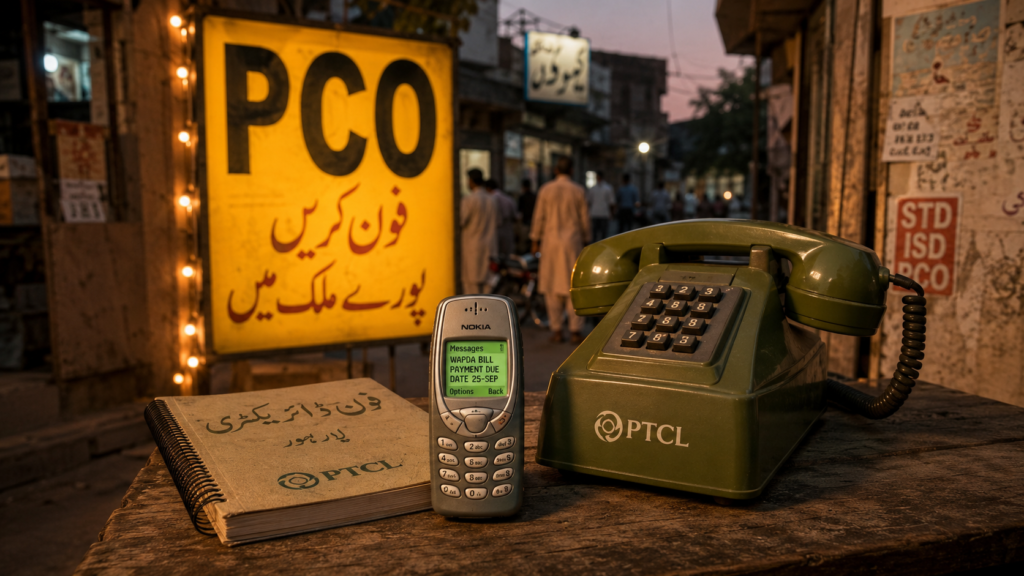
Before Smartphones: How Pakistan Communicated — PCO Booths, Missed Calls, Nokia 1100 and the Culture They Made
Moto G37
Before WhatsApp, before 3G, before the smartphone — Pakistan had its own language of communication. Invented not by engineers, but by ordinary people: students with empty balance, mothers waiting for overseas calls, girls who couldn’t speak freely on a shared family phone, and truck drivers who knew a single missed call meant main aa gaya hoon. This is their story.
The PTCL Landline — If Your Family Was Lucky Enough
Most Pakistani families in the 1990s did not have a telephone at home. Not because they didn’t want one — because PTCL’s waiting list ran from six months to eighteen. The connection was tied to your address, your neighbourhood exchange, and the mood of whoever processed your application at the PTCL office.
When it arrived, the PTCL phone was placed in a specific spot in the house — usually the drawing room or a hallway — and treated with a formality that the smartphone generation will never understand. It was not a personal device. It was a household asset. Shared with neighbours. Answered by whoever was nearest. Eavesdropped upon without apology.
| Call Type | Cost / Minute | What that meant in real life |
|---|---|---|
| Local call (same city) | Rs. 25–30 | You rehearsed exactly what you’d say. You timed yourself. |
| Long-distance STD (city to city) | Rs. 8–12 | A call from Karachi to Lahore cost a family’s grocery money for a day. |
| International to UK / USA | $5 / minute | Roughly a labourer’s daily wage — per minute. |
| PTCL fault repair time | 10–15 days avg. | If the line broke, you waited. There was no alternative. |
A call to a son in England, a brother in Saudi Arabia, or a sister in Dubai was not spontaneous. It was an event. The night before, someone wrote a list. Who needed to know what. What needed to be asked. How to compress a month of news, health updates, financial requests, and emotional reassurance into three minutes before the cost became unbearable.
“Beta theek ho? Sab theek hain? Haan haan, Allah ka shukar. Main theek hoon. Abba bhi theek hain. Haan. Allah hafiz.”
Every international call from Pakistan, 1990–2002. Under 90 seconds. Cost: Rs. 200+. Everything communicated.
The PCO Booth — Pakistan’s Original Social Network
Outside Karachi’s Empress Market, a PCO stayed open until midnight because the women buying fabric in the day would come back to make calls in the evening — the one time the shared family phone at home was safely in the hands of someone else. Outside Lahore’s General Bus Stand, the PCO outside the terminal did its busiest trade at midnight — travellers calling ahead to say the bus was late. Outside Rahim Yar Khan Railway Station, the PCO uncle knew by the luggage who was arriving from Karachi and who was coming back from the Gulf.
The PCO was not just a phone service. It was social infrastructure. Run by PTCL and private operators — Dancom, Worldcall, Telecard — these booths existed because most people could not afford the Rs. 300–500 monthly rental of a personal landline, let alone the six-to-eighteen-month waiting list for a new connection.
What actually happened at the PCO
- Lahore Students calling home from university: “Main theek hoon, paise bhejo.” Two sentences. Sixty rupees. The PCO uncle heard a thousand versions of this call. Never judged. Never told anyone.
- Karachi Rishta calls: A boy’s family calling a girl’s family for the first time. Everyone in the PCO queue involuntarily becoming witnesses to the opening negotiation of a marriage.
- Peshawar Business calls: Traders in Qissa Khwani Bazaar confirming orders from suppliers in Faisalabad, prices from importers in Karachi. The PCO as trading floor.
- Multan Emergency relay: “Jaldi aa jao, abbu hospital mein hain.” The PCO uncle as the fastest news network in the neighbourhood.
- Faisalabad The message service: “Agar Ahmed aa jaye toh bata dena, maine call kiya tha.” The PCO uncle as answering machine, secretary, and postman combined.
- Hyderabad Informal money transfer: “PCO wale bhai ko 500 rupaye dena, woh mere abba ko de denge.” Trust-based hawala before Easypaisa existed. This actually worked.
There was none, and everyone knew it. Three to five people waited close enough to hear every word. The PCO uncle heard everything — your debts, your health, your marriage troubles, your salary delays. He repeated nothing. This was an unspoken code of honour so universal that people never even thought to articulate it. It just was.
The decline was swift and final. Telenor and Warid launched in 2005 and drove per-minute rates from Rs. 6–8 to Rs. 1–2 in eighteen months. The PCO booths that had three-hour queues became empty stools. By 2008, they were struggling. By 2015, the yellow PCO sign was almost gone from urban Pakistan. The uncle who ran the PCO in your neighbourhood either pivoted to selling top-up cards from the same counter, or closed entirely.
The PCO uncle now sells Jazz cards and USB cables from the same corner shop. The counter is the same. The signage has changed. The community role — the one that mattered — is gone.
The “Dubai Walay Chacha” — How Overseas Calls Shaped Pakistan
No account of Pakistan’s communication history is complete without the overseas call. In the 1990s and early 2000s, an extraordinary proportion of Pakistan’s communication economy was built around one direction of travel: calls from the Gulf, from the UK, from Saudi Arabia, from Qatar, from any of the dozens of countries where Pakistani workers had gone to earn money their families at home could not.
Every family had a version of this story. The Dubai walay chacha. The London walay phupho. The brother in Riyadh who called every Sunday at 10pm and whose call the entire extended family waited for, drawing room chairs arranged around the telephone, children warned to be quiet.
The economics of the overseas call
Calling Pakistan from the UK cost £1–£2 per minute in the 1990s — astronomical. Calling from the Gulf was slightly cheaper but still inaccessible for daily use. The calling card system emerged as the first workaround: international calling cards sold at Pakistani grocery shops in Birmingham, Manchester, Dubai, and Riyadh, offering discounted rates to Pakistan through foreign carriers that bypassed PTCL’s international monopoly.
The typical call pattern was rigid and emotionally loaded:
- Duration: Usually 10–15 minutes. Every minute cost money the worker had earned through physical labour.
- Content: Health checks first. Money next. Family politics third. Everything personal last, or not at all.
- The list: The family in Pakistan kept a physical list of things to tell him. New health issue. School fees due. Roof needs repair. Neighbour’s dispute. The list was the week’s accumulation.
- The emotional reality: A father in Karachi had not seen his son in Dubai for two years. Fifteen minutes on a Sunday was everything. Neither of them said this out loud.
If you missed the Sunday call — if you were out, if the line was busy, if the exchange was down — the entire following week had a different quality. There was no voicemail. No WhatsApp. No way to know if everything was alright. The next Sunday felt further away than seven days.
This is why the 2003 deregulation policy was not just an economic decision for Pakistani families — it was emotional relief. When Telenor and Warid brought prices down and when calling cards became widely available, the Sunday call became a daily call. When WhatsApp launched, it became a dozen voice messages a day. The technology changed. The need never did.
The Pager — For the Professional Who Couldn’t Wait
Before the mobile phone reached ordinary Pakistanis, there was a more exclusive device: the pager. In Pakistan it was carried by doctors on call at the Aga Khan Hospital and JPMC in Karachi, by senior journalists at Dawn and Jang, by textile mill owners in Faisalabad, by government officers in Islamabad.
The workflow was entirely dependent on the PCO: your pager buzzed and displayed a phone number. You found the nearest PCO. You called back. Total time: ten to twenty minutes. By 2004–2005, as Nokia 1100-level phones became affordable, the pager vanished almost overnight. Almost no Pakistani under 35 has ever held one.
Women and the Shared Phone — A Story Not Often Told
The history of communication in Pakistan is often told as a gender-neutral story. It was not.
In millions of Pakistani homes through the 1990s and 2000s, the telephone — whether a PTCL landline or later a shared family mobile — was implicitly controlled. Not by malice, always, but by structure. The phone was in the common room. Calls were audible. Private conversation was not a concept that existed in shared household architecture.
How SMS changed women’s communication
The bulk SMS package — 1,000 messages for Rs. 10–15 — was revolutionary for many Pakistani women precisely because it was silent, private, and left no audible trace. A text could be sent from a shared room without anyone knowing who you were talking to or what you were saying. It could be deleted before anyone saw it. For the first time, private communication was possible on a shared device.
- The ladies’ hostel phone: University hostels often had one landline and a rotation system. Girls had 3-minute slots for calls home. Everything else — friend conversations, personal matters — happened via SMS on a separate SIM bought with pocket money, unknown to families.
- The second SIM: Many girls kept a separate SIM — a prepaid card with no registered name, topped up with pocket money — purely for communication that did not pass through family oversight. This was not extraordinary. It was standard.
- Missed call as coded signal: Among female students, missed call language was more elaborate. One miss from a specific contact at a specific time meant very different things from two misses at a different hour. The missed call became a private frequency.
- Eid SMS as equaliser: The Eid SMS required no phone call, no overheard conversation, no family permission. A girl could send an Eid message to anyone in her contacts. In many households, it was the only direct, unsupervised communication channel available.
The Nokia 3310’s SMS inbox was not just a collection of messages. For millions of Pakistani women, it was the first private space they had ever owned.
The Missed Call — Pakistan’s Most Ingenious Invention
The missed call culture was formally studied in “The Rules of Beeping: Exchanging Messages Via Intentional Missed Calls on Mobile Phones”, Journal of Computer-Mediated Communication, 2007. Researchers studied this behaviour across developing countries. Pakistan was among the primary case studies.
The missed call is perhaps the most Pakistani invention in the history of telecommunications. Not a device. Not a network. A behaviour. Communicating meaning at zero cost, using nothing more than the act of calling and immediately disconnecting.
In Pakistan it was called a “flashcall.” And every Pakistani above 25 understood its grammar perfectly without ever being taught it.
The economics
Making a call costs money. Receiving a call is free. This single asymmetry, built into every Pakistani mobile plan, created an entire communication language. If you could transmit your full message through the act of calling alone — without the call ever being answered — you paid nothing, and the person who had more credit called you back.
| Signal | Meaning | Real-world use |
|---|---|---|
| 1 missed call | “I’ve arrived, come outside” | Drivers, husbands picking up wives, friends waiting below the apartment |
| 2 missed calls | “I’m waiting — hurry up” | Anyone waiting anywhere |
| 3 missed calls | “Emergency — call me NOW” | Family emergencies, urgent matters |
| Miss at 7am | “I’m awake, you can call” | Couples, close friends — morning check-in, zero cost |
| Miss from unknown number | “I’m out of balance — call back on this number” | Everyone, always. Pakistan had a permanent population of people with Rs. 0 balance. |
| 3 misses + 1 after a pause | “I’m outside your house right now” | Specific to certain friend groups — hyper-local language evolution |
The people who lived by it
Drivers: One miss meant “I’m downstairs.” The employer called back. Cost transferred from the driver, who earned less, to the employer, who earned more. An entirely rational economic arrangement, arrived at without anyone ever designing it.
Factory workers in Faisalabad: When the shift ended and a worker needed a ride, one miss to his brother was the signal. The brother had a motorcycle. The brother called back only if he couldn’t come. No credit needed.
Domestic staff: A miss at 8am from the cleaning lady meant she’d be late. The employer called back if it mattered. Otherwise understood.
Couples: Among young Pakistanis with strictly monitored phone bills, the missed call was the entire relationship’s communication layer. A miss was goodnight. A miss at 7am was good morning. Three fast misses from him meant his parents had left the house.
“Maine teen miss maari thein, tune call kyun nahi kiya?” This sentence was the source of genuine, lasting relationship conflict in Pakistan for a decade. The missed call carried emotional weight that cost exactly nothing.
When WhatsApp reached mass adoption in Pakistan in 2012–2013, the missed call culture faded within eighteen months. But it never fully died. Pakistanis still say “ek miss maar do” on WhatsApp conversations today. The phrase outlived the technology by more than a decade. It will probably outlive the people who coined it.
SMS Culture — 160 Characters That Became a Language
Pakistan ranked #3 globally for SMS traffic (Nokia, 2010). Decline began with WhatsApp adoption in 2012–13.
The first SMS in Pakistan arrived with GSM networks in the late 1990s, initially at Rs. 2 each. By the mid-2000s, bulk packages of 1,000 SMS for Rs. 10–15 transformed the technology into a mass communication medium. Pakistan eventually sent 151 billion texts in a single year — but the number is less interesting than what those texts contained.
Roman Urdu — born in a text message
There was no Urdu keyboard on early Nokia phones. Urdu was written in Roman script. And within 160 characters, even Roman Urdu got compressed into something that existed nowhere else in the world:
| What you meant | What you sent | Why |
|---|---|---|
| Kya hal hai yaar? | khl h yr? | Saves 9 characters — nearly 6% of your total budget |
| Main aa raha hoon thori der mein | m aa rha hn thri dr m | Full sentence in under 25 characters |
| Mujhe call karo please, important hai | muje cll kro imp h | Maximum urgency, minimum cost |
| Allah Hafiz, ghar pohuncho toh batana | AL HFZ ghr pu bt dna | Goodbye and a request, compressed |
A generation grew up reading and writing Urdu in Roman script with aggressive vowel dropping. This was not laziness. It was engineering within a constraint. The SMS limitation created a written dialect — Roman Urdu with its own grammar, conventions, and in-group signals — that existed nowhere else and was understood perfectly within Pakistan’s networks.
The forward economy
Before viral content was a concept, Pakistanis invented it in SMS. The infrastructure was bulk packages. The content was:
- Jokes: Multi-part series forwarded endlessly. You received the same joke from four different contacts within a week. Everyone sent it anyway.
- Islamic messages: Hadith, duas, Friday reminders — forwarded as acts of piety. “Forward this to 10 people and earn sawab” predates every chain letter you’ve received on WhatsApp.
- Cricket scores: Pakistan versus India, forwarded person-to-person in real time, before any cricket app existed. The SMS as live sports ticker.
- Chain messages: “Forward this to 10 people or something bad will happen.” Participated in enthusiastically by a population that still does this on WhatsApp for exactly the same reasons.
Eid SMS — Pakistan’s Purest Digital Tradition
عید مبارک
“Wishing you and your family a blessed and happy Eid. May Allah’s blessings fill your life with happiness and open all the doors of success now and always. EID MUBARAK!!!”
The template that reached 50 million Pakistanis every Eid, 2002–2012. You sent it. You received it. You knew it was forwarded. You didn’t care.
From roughly 2002 to 2013, the Eid SMS was a cultural institution as distinctly Pakistani as Eid ki sevaiyan and chaand raat shopping. The ritual had its own rules, hierarchy, and competitive elements that no one explicitly taught anyone:
Nokia’s SMS data confirms what everyone who lived through it already knows: the Eid spikes were measurable at the network level. Operators launched Eid-specific bulk packages every year — 5,000 free Eid messages for Rs. 5 — because the demand was that predictable, that large, and that beautiful.
WhatsApp killed Eid SMS in approximately two Eid cycles — 2012 and 2013. It had survived for a decade, connected a nation annually, and produced billions of messages. It deserves to be remembered as what it was: a national tradition.
Hafeez Centre, Hall Road, Rainbow Centre — Where Mobile Culture Was Built
Pakistan’s mobile culture was built in these markets — before e-commerce, before online reviews, before PTA verification
Before e-commerce, before PTA-approved certification, before any online review — Pakistan’s mobile culture was physically located in a handful of markets that every tech-aware person visited in person.
Lahore Hafeez Centre in Gulberg was not just a building — it was a city within a city. Hundreds of shops across multiple floors, each one a specialist: this shop for Nokia only, that one for batteries and chargers, another for screen replacement, a corner shop for SIM unlocking that everyone knew about and nobody acknowledged officially. If something electronic existed in Pakistan, someone in Hafeez Centre had it or could get it.
Lahore Hall Road near Anarkali was older, denser, and more wholesale in character. The shops here stocked what Hafeez Centre sold retail. Dealers came here. Schools sent their IT coordinators here. If you needed 50 identical phones for a corporate order, Hall Road was your destination.
Karachi Rainbow Centre in Saddar was legendary for a specific reason: it was where you went to get things loaded. Memory cards filled with Bollywood soundtracks — complete, 128kbps, every track — for Rs. 50. Nokia ringtone collections. Counter-Strike game files. Before any streaming service existed, Rainbow Centre was Pakistan’s content distribution centre. A 512MB card here gave you more music than most people had owned in their entire lives.
These markets shaped mobile culture in ways that no digital platform has replicated. The shopkeeper who remembered what phone you bought last year. The repair stall that fixed your cracked screen in forty minutes while you waited. The grey market phone that looked official until the PTA blocking started. The entire ecosystem of informal certification, reputation-based trust, and word-of-mouth that functioned as the consumer protection layer before DIRBS existed.
Nokia 1100, Loadshedding, and the Flashlight That Mattered
The Nokia 1100 was not just a phone. In Pakistan, it was infrastructure.
The Nokia 1100 arrived in Pakistan in 2003–2004 at Rs. 3,500 to Rs. 4,000. It sold 250 million units globally and became the best-selling mobile phone in history. But in Pakistan, it sold for a reason that had nothing to do with the features on the box.
It had a built-in flashlight.
This sounds small. In Pakistan, where power outages — loadshedding — could mean four to eight hours without electricity in the mid-2000s, a device that provided light during a power cut was not a convenience. It was genuinely useful in ways that no Western review could capture. A torch with a two-week battery that fit in your pocket, did not break when dropped, and cost less than a month’s mobile phone rental — the Nokia 1100 was designed accidentally for Pakistani conditions.
- Battery life measured in weeks: Not hours. The Nokia 1100 could sit unused for ten days and still have charge when you picked it up. No Pakistani smartphone today comes close to this.
- Durability: Dropped on marble floors, on concrete, into dust — the phone continued working. The word “Nokia brick” was not a metaphor in Pakistan; it was a specification requirement.
- The flashlight during loadshedding: Every house in Karachi, Lahore, Faisalabad, Multan, Hyderabad had a Nokia 1100 placed near the bed or by the electricity meter. Not because it was a mobile phone. Because it was the fastest available light source.
- The price: Rs. 3,500 was a working-class family’s one-time investment. The phone lasted three to five years. The cost-per-year was lower than any alternative.
The Nokia 1100 did not become Pakistan’s defining phone because of its specs. It became Pakistan’s defining phone because it solved Pakistan’s actual problems — darkness, dust, drops, and a budget that didn’t allow for replacements.
QMobile — The First Smartphone for Millions of Pakistanis
Every account of Pakistan’s mobile phone history mentions Samsung, Nokia, HTC. Almost none of them give adequate space to QMobile — and this is a significant omission, because between 2011 and 2016, QMobile was more important to Pakistan’s smartphone transition than any of those international brands.
QMobile launched in 2009 and found its footing during the Android explosion of 2011–2014. Its pitch was simple: smartphone-style hardware at prices that made sense for the Pakistani market. An Android touchscreen phone for Rs. 5,000–15,000, when Samsung’s equivalent was Rs. 25,000–40,000.
Why QMobile mattered
For millions of Pakistanis — in Lahore, in Multan, in Peshawar, in rural Punjab and Sindh — QMobile was their first Android phone. Not their second or third upgrade device, but their literal introduction to the internet, to WhatsApp, to Facebook, to the touchscreen interface. The fact that it was a Chinese-manufactured device badged for Pakistan was irrelevant. What mattered was that it existed at a price point that nothing else did.
- The Z-series and X-series: QMobile Z3, X15, Z4 — these names were as recognisable in the Rs. 5,000–15,000 market as Samsung Galaxy was in the Rs. 30,000+ market.
- Cricket sponsorship: QMobile associated its brand with Pakistan cricket at exactly the moment when mobile phones and cricket viewership intersected. The association worked.
- The after-sales reality: QMobile’s after-sales service was inconsistent and its build quality varied enormously. The phone often slowed to near-unusability within twelve to eighteen months. But it had done its job: it had brought someone online who was not online before.
- The displacement: Tecno and Infinix entered Pakistan’s budget market with better-quality hardware at comparable prices around 2015–2016. QMobile’s market share collapsed almost immediately. It exists today but is not a significant force.
QMobile did not make good phones. It made accessible phones. For a specific window — 2011 to 2015 — these were not the same thing. The people it brought online for the first time are still online, now on Tecno and Xiaomi and Samsung. QMobile gave them their entrance ticket.
Internet Cafés — Pakistan’s First Digital Public Spaces
Before 3G arrived in 2014, before most Pakistanis had mobile internet, and before broadband reached residential areas at affordable prices, there was the internet café.
In Karachi’s Saddar, in Lahore’s Gulberg, in Islamabad’s Super Market, in every university district of every Pakistani city, internet cafés were the first point of contact between millions of Pakistanis and the internet. They charged Rs. 20–40 per hour. They had rows of desktop computers. They smelled of cigarettes and blue screen glow. They were open until midnight.
What people did there
- Yahoo Messenger: Free text and voice calls to overseas relatives — the first time many families could hear each other’s voices without paying Rs. 500 for three minutes. Yahoo Messenger’s voice call feature was the most important Pakistani telecom development of 2002–2008 that no one discusses.
- Orkut: Social media arrived in Pakistan through Orkut before Facebook. Communities, scraps, testimonials — a generation had its first social media experience on a platform that no longer exists.
- Limewire and Kazaa: Music downloads on a shared connection, burned to CD or transferred to memory card. Piracy as community practice, openly, unapologetically.
- Counter-Strike: LAN gaming was a café feature in every major city. Teenage boys would book two hours, arrive in groups of six, and play until someone’s mother rang the PCO outside to say it was time to come home.
- CVs and school projects: Practical tasks for people who had no computer at home. Print a CV, download a form, email an application. The internet café as digital secretary.
Yahoo Messenger’s voice call feature gave Pakistani families separated by the Gulf or UK something that the telephone had cost them Rs. 500 per three minutes to access. It was free. It worked. It completely changed the emotional calculus of overseas migration.
The Orkut-to-Facebook transition
Orkut peaked in Pakistan around 2006–2008. Facebook overtook it roughly 2009–2010. The transition was not smooth — many Pakistani users who had built extensive Orkut communities resisted Facebook for months, then abandoned Orkut almost overnight as the social critical mass shifted. It was the first time most Pakistanis experienced platform migration: the understanding that your social network exists on the platform where your people are, and when they move, you move.
Today Orkut is gone and Facebook has 68 million Pakistani users. The internet café generation grew up and moved their social activity to mobile. The cafés, like the PCO booths, became redundant — and then disappeared.
Bluetooth and Infrared — Before Streaming, There Was Sharing
Before YouTube was usable in Pakistan, before Spotify, before any streaming service reached mass adoption, Pakistan had Bluetooth. A single 3MB MP3 file took four to six minutes to transfer between two Nokia phones sitting side by side. You watched the progress bar. You did not move. When it finished, you both had the song.
At Karachi Rainbow Centre and Lahore Liberty Market, specialist shops loaded memory cards with complete Bollywood soundtracks — every track, 128kbps — for Rs. 50. A 512MB card held roughly 100 songs. This was not just music piracy. It was the primary distribution mechanism for Pakistani pop music, Indian film music, and Arabic nasheeds for an entire decade. The mainstream music industry lost 80% of its revenue to it. Nobody felt guilty. The economics made legal purchasing impossible for most buyers.
Nokia Snake, T9 Mastery, and the Games That Needed No Internet
Nokia Snake
The universal Pakistani game. Every Nokia 3310, 3330, 1100. High score as social currency: “Mera 1,500 hai — tera kitna hai?” No internet. No updates. Just a snake eating dots on a green screen.
Space Impact
The side-scrolling monochrome shooter. Harder than it looked. Completing a level on a 84×48 pixel screen felt genuinely satisfying. It was.
Bounce
Ball physics on a Nokia screen. Levels. Replay value that has no rational explanation given what it was. Pakistanis played it for hundreds of hours.
T9 mastery
“Main bina dekhay SMS kar leta hoon” — the Nokia T9 typing skill that an entire generation developed. 3 presses for C. Zero hesitation. Muscle memory for 26 letters on 12 keys.
These games required no internet connection, no app store, no subscription, no in-app purchase, no Wi-Fi, no update. They were simply present in the firmware — available always, in any loadshedding outage, in any waiting room, on any rooftop in Pakistan where there was nothing else to do. A Nokia 3310 found in a drawer today will still run Snake. No other device made in the last twenty years can say the same.
The last time you used a PCO, you probably didn’t know it was the last time.
The last Eid SMS you sent was not announced as the final one. You sent it, received thirty replies, and then WhatsApp arrived and the tradition ended without a ceremony, without an obituary, without anyone deciding anything.
The last Bluetooth song transfer happened somewhere in Pakistan around 2014. Someone’s Nokia N73, someone’s memory card, someone’s four minutes watching a progress bar. No one marked the occasion.
The last missed call from a specific friend became, some months later, a WhatsApp notification. The missed call meaning — “I’m here, come outside” — moved smoothly to a text, then a voice note, then a location pin. The technology changed shape around the same human need.
Cultures don’t disappear. They migrate.
Today we carry phones a thousand times more powerful than the Nokia 1100 that lit up our rooms during loadshedding. We communicate with overseas relatives in real time, free, in video, every day — something that cost a week’s wages per hour in 1998. We have 204 million mobile connections in a country of 230 million people.
And yet.
One phrase survived the PCO, the pager, the Nokia, the QMobile, the Android era, the 3G auction, the 4G rollout, and the commercial launch of 5G: “Ek miss maar do.” It is said on WhatsApp. It is said over voice notes. It is said by people who have never in their lives had Rs. 0 balance on a SIM card. It is the last remaining linguistic fossil of a communication culture that built itself out of constraint, creativity, and the very Pakistani instinct to find a way to say what needs to be said — regardless of what it costs.

Apple iPhone 17 Pro Max

About Luqman
A passionate technology writer and digital researcher,Luqman specializes in simplifying complex tech trends into practical, user-focused insights. With a strong interest in smartphones, emerging gadgets, and digital ecosystems, Luqman delivers well-researched, unbiased content tailored for everyday users. From product deep-dives to buying guides, the goal is simple: help readers make smarter, more informed decisions in a fast-changing tech landscape.