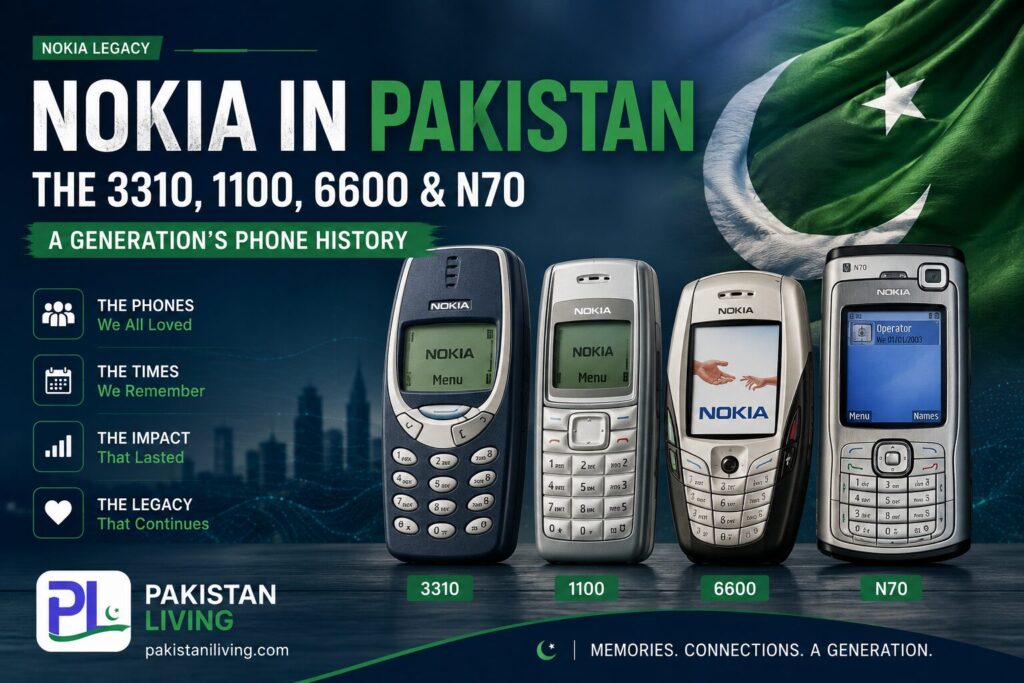
Nokia in Pakistan: The 3310, 1100, 6600, and N70 — A Generation’s Phone History
Samsung Galaxy S23 Ultra
If you were between 15 and 40 years old in Pakistan between 2001 and 2010, your mobile phone story is a Nokia story. Four models in particular — the 3310, the 1100, the 6600, and the N70 — defined successive stages of what mobile meant for Pakistani users. This is their story.
Why Nokia?
Nokia dominated Pakistan’s mobile market for nearly a decade not because it had no competition, but because it understood something its competitors did not: Pakistan was not one market. It was many markets layered on top of each other, separated by income, by geography, and by what people actually needed a phone to do.
Motorola and Ericsson sold one type of phone for one type of customer. Nokia built a product ladder — phones for every rung of Pakistan’s income distribution, each with a specific value proposition, each priced at exactly the point where its target buyer could stretch to reach it. The Nokia 1100 at Rs. 4,500 reached people the 3310 at Rs. 7,000 could not. The 6600 at Rs. 20,000 served people the 1100 could not. The N70 at Rs. 25,000 served people the 6600 was beginning to feel insufficient for. Each phone was a step on a ladder that Nokia owned from bottom to top.
The Nokia 3310: When Mobile Became Personal
The Nokia 3310 was not Pakistan’s first affordable phone. But it was the first affordable phone that felt like a product designed with the user’s personality in mind. The interchangeable coloured covers — sold in Karachi’s Hafeez Centre and Lahore’s Hall Road in yellow, orange, blue, green, and transparent — allowed something unprecedented: you could make your phone look like yours.
Pakistani mobile phone shops developed a small but lucrative side business in Nokia 3310 accessories. Custom covers with Pakistani flag patterns, cricket team designs, and floral motifs for female users were available within months of the phone’s arrival. This was the beginning of Pakistani mobile phone culture as a personal expression rather than merely a communication tool.
The 3310’s Snake game — pre-installed, free, instantly accessible — introduced millions of Pakistani users to mobile gaming. Snake on the 3310 was not impressive by any objective measure. It was a pixel line eating pixel dots. But it was there, on your phone, whenever you had a spare moment. Students played it between lectures. Waiting for a bus. In the back seat of a car. The concept of a game that lived in your pocket, always available, with no cartridge or console required, was genuinely novel in 2001 Pakistan.
Nokia 3310 — Pakistan Profile
The Nokia 1100: The Phone Pakistan Actually Used
The Nokia 1100, released globally in 2003, was engineered to solve specific problems in emerging markets. Nokia’s research teams had studied usage patterns in India, Africa, and Southeast Asia and identified what low-income first-time mobile users actually needed: a phone that survived rough treatment, lasted days on a charge, worked in dusty and humid environments, and — critically in South Asia and Africa — had a built-in flashlight.
Every one of these decisions was exactly right for Pakistan. Loadshedding — scheduled power outages that by 2007 ran to 8–18 hours daily in many Pakistani cities — made the 1100’s torch a practical necessity. A phone that also served as your flashlight during a blackout had value that no specification sheet could adequately capture. Pakistani buyers understood this immediately and bought accordingly.
The 1100’s 55-hour standby battery meant that even if you could not charge for two days — entirely plausible during heavy loadshedding — your phone survived. The dust-resistant keyboard meant that a phone carried in a shirt pocket on a Lahore summer day, exposed to fine particulate matter and perspiration, did not fail. These were engineering decisions made in Nokia’s research facilities in Finland based on field observations in markets very different from Helsinki. They were correct.
The Nokia 1100 became the world’s best-selling mobile handset in history, with over 250 million units sold. Pakistan’s market was a meaningful contributor to this figure. Mobilink, Ufone, and Telenor all used the Nokia 1100 (and its successors) as their recommended entry-level device in promotional materials. The brand association between Nokia 1100 and “your first mobile phone” was so strong that for a generation of Pakistani users, Nokia and mobile were effectively synonymous.
Nokia 1100 — Pakistan Profile
The Nokia 6600: The Phone That Changed What Mobile Could Mean
The Nokia 6600, released in Pakistan at approximately Rs. 18,000–22,000 in 2004–2005, was a category shift. Everything before it had been a voice-and-SMS device with minor features. The 6600 was a camera. It was an MP3 player. It was a video recorder. It ran Symbian OS — a full operating system that could run third-party applications. It was, in the contemporary vocabulary that had not yet arrived in Pakistan, a smartphone.
The 6600’s camera — a 0.3-megapixel sensor (later upgraded to 1.2MP in the 6600’s successors) — was not impressive by any technical measure. But the concept of a camera that was always with you, inside your phone, ready at a moment’s notice, was transformative. Pakistani users with 6600s photographed things no one had previously photographed because no one had previously carried a camera to those places. Family moments. Street scenes. Friends at university. The casual, unhurried documentation of everyday life that smartphones normalised globally in the 2010s — Pakistani Nokia 6600 users began this practice in 2004–2005.
Bluetooth file sharing on the 6600 created Pakistan’s first peer-to-peer digital content economy. Before the internet was accessible on phones, and before any streaming service existed, the Nokia 6600’s Bluetooth function enabled Pakistani users to share MP3 ringtones, Nokia games, short video clips, and later — controversially — pirated software and media between phones at zero cost. A new ringtone would spread from one 6600 to twenty others across a university campus in a single afternoon via Bluetooth daisy-chaining. This was not the internet. It was faster than the internet available in Pakistan at the time.
The Nokia N70: Peak Nokia in Pakistan
The Nokia N-Series, launched from 2005 onward, represented Nokia’s ambition to own the premium smartphone category before Apple’s iPhone redefined it. In Pakistan, the N70 — launched at approximately Rs. 22,000–28,000 in 2006 — was the model that reached significant numbers of professional and aspirational buyers.
The N70’s 2-megapixel camera was a genuine improvement over the 6600’s first-generation sensor. It produced photos that could be printed at 4×6 inches and look acceptable — a standard that mattered in a culture where physical photo prints for family albums remained the dominant way of preserving images. The N70’s camera was used at weddings, at Eid celebrations, at family gatherings, and increasingly on the street — street photography as a casual practice was beginning among Pakistani users with camera-capable phones.
The N70 appeared in Pakistani drama serials and music videos of 2006–2008 as a visual shorthand for “modern urban Pakistani.” A character shown with an N70 was communicating something about their class position and their engagement with contemporary technology — much as a MacBook in a Pakistani drama today communicates certain things about a character without a word of dialogue. These product placements were sometimes paid and sometimes simply reflected the props department’s sense of what a contemporary urban Pakistani would use.
The Nokia Family in Pakistan: A Complete Picture
2000–2003 — Rs. 7,000–9,000
Urban middle-class entry. Iconic ringtone. Interchangeable covers. Snake. The phone that made mobile personal.
2003–2007 — Rs. 4,500–5,500
Mass-market defining device. Built-in torch. 55-hour standby. World’s best-selling phone. The missed call era’s perfect hardware.
2005–2008 — Rs. 4,000–6,000
FM radio added. Colour screen. Hugely popular in semi-urban Pakistan where radio remained primary media.
2004–2007 — Rs. 18,000–22,000
First camera phone at aspiration price. Symbian OS. Bluetooth sharing. MP3. The beginning of mobile content culture in Pakistan.
2006–2008 — Rs. 22,000–28,000
2MP camera, full multimedia. Appeared in drama serials as signifier of urban modernity. Nokia’s peak aspiration product in Pakistan.
2007–2009 — Rs. 35,000–45,000
5MP camera, GPS, Wi-Fi. Nokia’s technological masterpiece. Unaffordable for most, but defined premium mobile for a generation.
Nokia’s Decline: What Happened
Nokia lost Pakistan — and every other market — because it failed to make the operating system transition that the iPhone forced. Symbian, Nokia’s OS, was designed for an era of limited processing power and tiny screens. When touchscreen smartphones running iOS or Android arrived, Symbian’s interface looked like what it was: a system built for a keypad, awkwardly adapted for a touchscreen.
Nokia’s Windows Phone experiment (2012–2014) produced technically decent hardware but came too late and with too little app ecosystem support to reverse the Android tide. In Pakistan, where app availability mattered increasingly as 3G made mobile internet practical, an operating system without WhatsApp, Facebook, and the Google app ecosystem was commercially unviable.
Microsoft acquired Nokia’s mobile division in 2014 and largely wound it down. HMD Global relaunched the Nokia brand on Android smartphones from 2017 onward. These new Nokia phones are competent but unremarkable mid-range Androids. They carry the name but not the cultural weight. The Nokia that matters to Pakistani mobile history — the Nokia of the 3310, the 1100, the 6600, the N70 — ended sometime around 2011–2012, when Android had won and Nokia had not yet accepted it.