
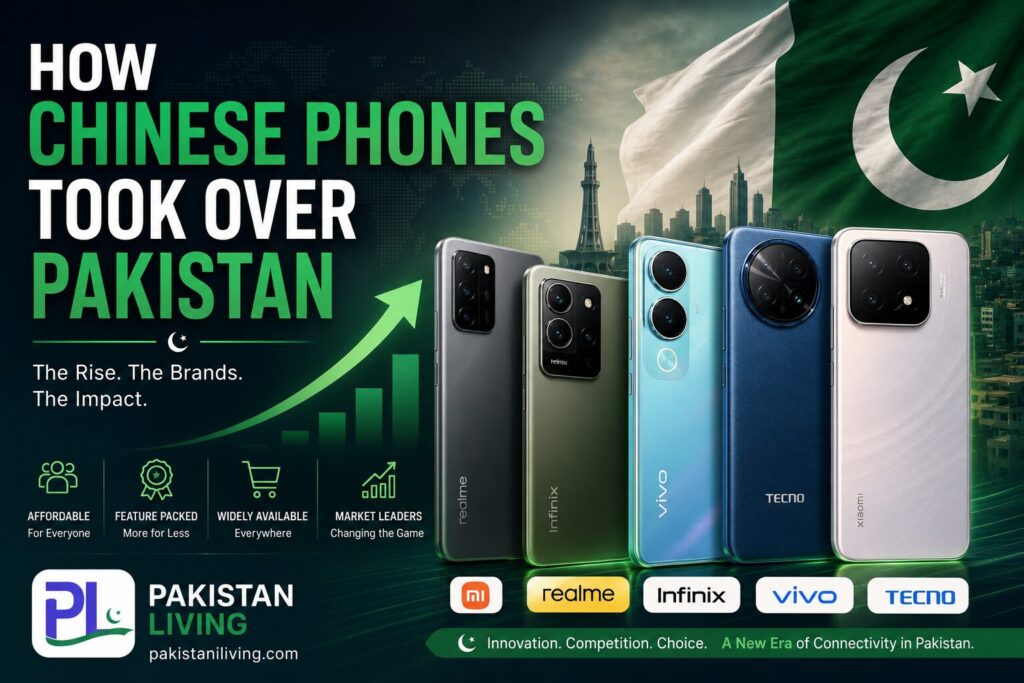
How Chinese Phones Took Over Pakistan: From QMobile to Xiaomi (2009–2026)

Vivo X90 Pro Plus
In 2008, Nokia had 45% of Pakistan’s mobile market. In 2026 it has under 3%. The story of how Chinese phones — first through QMobile, then through Huawei, Oppo, Vivo, and Xiaomi — dismantled Nokia’s dominance and then Samsung’s challenge is one of the most instructive brand battles in Pakistani consumer history.
Phase 1: QMobile and the Pakistani Brand Experiment (2009–2015)
QMobile was founded in 2009 by Zeeshan Akhtar with a simple premise: source mobile phones from Shenzhen’s ODM factories under Pakistani branding, with local warranty support, and price them below Nokia’s entry level. The model was not new — dozens of small Chinese brands were doing versions of it globally. What made QMobile different was the intensity of its local marketing investment.
QMobile’s celebrity endorsement campaigns — featuring leading Pakistani drama and film stars across Urdu-language television — were aggressive and effective. The brand understood something Nokia did not: Pakistani consumers did not just buy specifications. They bought cultural association. A phone endorsed by a drama star they admired felt different from a phone that existed only as a model number on a spec sheet.
QMobile’s Noir A-series Android smartphones, launched from 2012 when 3G was already anticipated, offered Android at Rs. 6,000–12,000 — a price point that made touchscreen smartphones accessible to buyers who had been locked out entirely. At peak QMobile held approximately 22–25% of Pakistan’s smartphone market (2013–2014). This was a genuine achievement for a brand that had not existed five years earlier.
The decline was equally instructive. QMobile’s hardware quality was inconsistent. As Chinese ODM factories cut costs under price pressure, QMobile devices at the bottom of the range developed reputations for short lifespans — screens failing, batteries swelling, charging ports breaking within six months. Pakistani buyers, who purchase phones with a 2–3 year expected lifespan and use them hard, learned through experience not to trust QMobile’s lower-end products. The brand lost ground from 2015 onward and has never recovered its peak position.
Phase 2: Huawei, Oppo, and Vivo Establish Direct Presence (2014–2018)
Where QMobile had been a distributor of Chinese hardware under local branding, the second wave of Chinese entrants were actual Chinese brands establishing direct Pakistani presence. Huawei, Oppo, and Vivo all opened Pakistani offices, authorised service centres, and distribution partnerships in the 2014–2016 period — no coincidence that this aligned with the 3G/4G auction that suddenly made mobile internet relevant for tens of millions of Pakistani buyers.
Huawei in Pakistan
Huawei’s Y-series (budget, Rs. 12,000–20,000) and P-series (mid-premium, Rs. 25,000–50,000) grew rapidly in Pakistan from 2015–2019. The brand’s strongest period in Pakistan coincided with its global peak. US sanctions from 2019 onward, which prevented Huawei from using Google Mobile Services on new devices, were fatal to retail sales in Pakistan — a market where Google apps (especially YouTube, Google Maps, Gmail) are considered essential rather than optional. Huawei Pakistan’s market share fell sharply from 2020 onward.
Oppo in Pakistan
Oppo positioned itself as the camera phone for Pakistan’s selfie generation. Its marketing — heavily social media-focused, targeting young women specifically with “selfie expert” messaging — was effective in urban markets. Oppo’s A-series devices at Rs. 20,000–35,000 offered front-camera quality that competitors underestimated as a purchase driver. Oppo remains a top-5 Pakistani brand in 2026, stronger in female-skewing demographics than its competitors.
Vivo in Pakistan
Vivo’s strategy in Pakistan combined camera marketing with music event sponsorship — cricket match sponsorships, music concerts, and television drama tie-ins. The brand reached the top 3 in Pakistan by 2018 and has maintained that position. Vivo’s V-series mid-range and Y-series budget phones cover the Rs. 15,000–50,000 range that drives most Pakistani smartphone volume.
Phase 3: Xiaomi’s Redmi Revolution (2018–Present)
Xiaomi’s entry into Pakistan’s mass market — particularly through the Redmi Note series — changed the competitive dynamics more fundamentally than any previous Chinese brand entrant. The Redmi Note offered specifications that Samsung’s A-series could not match at the same price: larger battery, more RAM, higher-resolution camera, and MediaTek/Snapdragon processors that performed well on the gaming benchmarks Pakistani buyers used to evaluate purchases.
Xiaomi’s POCO sub-brand, targeting the gaming-performance segment at Rs. 25,000–45,000, further strengthened Xiaomi’s position with younger male buyers for whom PUBG Mobile performance was the primary purchase criterion. POCO F-series and POCO X-series became genuine status symbols in Pakistani gaming communities — as aspirational within their price tier as the Nokia N70 had been fifteen years earlier.
The 2026 Landscape: Who Sells What to Whom
| Brand | Approx. Share 2026 | Strongest Segment | Why They Win There |
|---|---|---|---|
| Samsung | 21% | Rs. 25,000–70,000 | Brand trust, after-sale network, Galaxy A-series design, software updates |
| Vivo | 15% | Rs. 15,000–40,000 | Camera marketing, cricket sponsorship, Vivo V-series brand recognition |
| Xiaomi / Redmi / POCO | 14% | Rs. 20,000–45,000 | Spec-per-rupee leadership, gaming performance, MIUI feature set |
| Oppo | 11% | Rs. 20,000–40,000 | Front camera quality, fashion-adjacent marketing, female-skewing |
| Tecno / Infinix | 9% | Rs. 8,000–20,000 | Budget tier; fill QMobile’s old position with better quality control |
| Realme | 7% | Rs. 18,000–35,000 | OPPO spin-off with aggressive pricing; younger demographic |
| Apple | 5% | Rs. 150,000+ | Premium status, ecosystem lock-in, content creator aspirational |
| Others (Nokia, QMobile, etc.) | 18% | Mixed | Residual distribution, specific use cases |
What Pakistani Buyers Taught Chinese Brands
Chinese brands that succeeded in Pakistan learned several lessons that their home-market playbooks did not prepare them for. Pakistani buyers care intensely about after-sale service. A phone brand with no visible service network — no authorised repair centre within 30 minutes of a major city — faces a structural disadvantage. Chinese brands that established service centres before launching advertising campaigns (Vivo and Oppo did this; some smaller Chinese entrants did not) outperformed those that went advertising-first.
Pakistani buyers are among the most specification-literate in Asia. The retail culture of Hafeez Centre in Karachi, Hall Road in Lahore, and their equivalents in every Pakistani city has produced generations of buyers who compare RAM, processor benchmark scores, and camera sensor sizes before purchasing. This spec literacy means that under-specifying at a given price point is immediately penalised — buyers know, within weeks of a phone’s launch, whether it offers good value, and that assessment travels rapidly through social networks and retail-floor conversations.
Pakistan also has a strong used-phone market that Chinese brands initially underestimated. A phone’s resale value in Pakistan’s secondhand market is a real factor in purchase decisions — buyers explicitly consider what they will get for the phone in 18–24 months. Samsung commands a resale premium. Most Chinese brands do not. This premium is part of why Samsung’s absolute market share has held above 20% despite Chinese competitors offering better specifications at lower prices: the total cost of ownership calculation, for buyers who trade phones regularly, still favours Samsung in the mid-range.

vivo X500e

About Luqman
A passionate technology writer and digital researcher,Luqman specializes in simplifying complex tech trends into practical, user-focused insights. With a strong interest in smartphones, emerging gadgets, and digital ecosystems, Luqman delivers well-researched, unbiased content tailored for everyday users. From product deep-dives to buying guides, the goal is simple: help readers make smarter, more informed decisions in a fast-changing tech landscape.