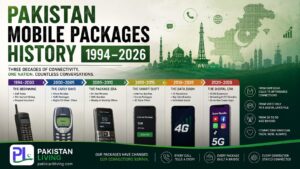
The PCO Uncle: Pakistan’s Public Call Office and the Men Who Ran Them

Apple iPhone 16 Pro
There was a yellow sign on the corner of almost every mohalla in Pakistan. It said PCO. Behind it sat a man who knew everyone who walked in, heard everything they said, and repeated none of it. For twenty years, the Public Call Office was Pakistan’s most democratic institution — the one place where a factory worker and a government official stood in the same queue, for the same reason, paying the same price to speak to the people they loved.
A Scene, Before Anything Else
It is eleven at night. The bus from Multan arrived three hours late. A man in a shalwar kameez, dusty from the journey, stands at the PCO counter. He gives the uncle a piece of paper with a phone number. The uncle dials. The man picks up the receiver and says four words: “Main aa gaya hoon.” Then he listens for eight seconds, says “haan, theek hoon,” and hangs up. The uncle marks two minutes on his ledger even though the call lasted forty-five seconds, because that is the minimum charge. The man pays without complaint. He has just told his family he arrived safely. The whole transaction costs Rs. 20 and took ninety seconds. For those ninety seconds, the man standing in that booth is the most connected person in Pakistan.
That scene happened millions of times, in thousands of PCO booths, in every city and town in Pakistan, for two decades. It was not dramatic. It was not technologically remarkable. It was, in the most basic sense, people reaching each other across distance. The PCO was the infrastructure that made this possible before the mobile phone arrived — and for years after it arrived, for the millions who could not yet afford one.
What a PCO Actually Was
PCO stands for Public Call Office. In practical terms, it was a payphone facility housed in a small shop, a stall, or a partitioned counter — usually a single PTCL-issued telephone set mounted on a desk, with a chair for the caller, a counter for the operator, and a ledger in which every call was recorded by number, duration, and charge.
PCOs in Pakistan were operated by PTCL directly or through licensed private operators — Dancom, Worldcall, and Telecard were among the main ones. The franchise model was straightforward: the operator bought a licensed PCO connection from PTCL at a discounted rate, charged retail customers the standard PTCL tariff or slightly above, and kept the margin. It was not a lucrative business. It was a consistent one.
PCO booths had two service tiers that shaped how Pakistanis thought about distance. STD (Subscriber Trunk Dialling) was the national long-distance service — city to city within Pakistan. ISD (International Subscriber Dialling) was the overseas connection. A PCO displaying both “STD” and “ISD” on its signboard was offering the full range. Many smaller PCOs offered STD only. The presence or absence of ISD on the sign told you something about the neighbourhood — ISD PCOs clustered near bus stands, railway stations, and areas with high overseas-worker populations, because those were the communities who needed them most.
The pricing was a direct reflection of PTCL’s monopoly structure. Before deregulation in 2003 and the entry of Telenor and Warid in 2005, the rates had not meaningfully changed in years:
| Call Type | Approximate Rate | What It Meant |
|---|---|---|
| Local call (same city) | Rs. 25–30 / min | A three-minute call to someone across town cost Rs. 75–90 |
| STD (city to city) | Rs. 8–12 / min | Karachi to Lahore, ten minutes: Rs. 80–120 |
| ISD to Gulf countries | Rs. 40–60 / min | Five minutes to Dubai: Rs. 200–300 |
| ISD to UK or USA | $5 / min (Rs. 150+) | Three minutes to Birmingham: Rs. 450. A family’s weekly grocery bill. |
These prices were not arbitrary cruelty. They were the structural consequence of a state monopoly operating without competitive pressure, on infrastructure that had not been modernised in decades. PTCL had no incentive to reduce prices and the government had no mechanism to force it. For twenty years, this was simply the cost of communication in Pakistan.
The PCO existed because most families could not afford a residential landline — either the upfront costs, the monthly rental, or the waiting period — and yet they still needed to make calls. The PCO was the workaround that the market provided before the government got around to deregulation.
The PCO Uncle — A Portrait
Every PCO had its uncle. This is not a stereotype. It is a demographic fact. The PCO operator was, in virtually every case across Pakistan, a man of middle age or older, operating from a fixed address, known by name and face to everyone in the surrounding streets. He was not running a telephone service. He was running a community institution.
Consider what the PCO uncle knew about his locality after five years of operation:
- Which families had relatives in the Gulf and received calls every Sunday
- Which young man called a particular number every evening at 8pm with exactly two minutes of credit
- Which family’s patriarch had gone to Karachi for work and was expected to call on the first of the month
- Which neighbourhood dispute had escalated to the point where one party was calling a lawyer
- Which student had passed his exams and which had not, because both calls had been made from his booth
The PCO uncle was the most comprehensively informed person in any Pakistani neighbourhood — not because he was nosy, but because information passed through him continuously, inescapably, for years. He used none of it. This was understood without ever being stated.
The physical setup reinforced the intimacy. PCO booths were small. The counter was often the width of two people. In many booths, there was no partition between the counter and the caller — the uncle sat within arm’s reach of whoever was speaking. The caller’s voice was audible. Sometimes both sides of the conversation were audible, depending on the volume setting of the earpiece. Privacy was a theoretical construct at the PCO.
And yet, people told the PCO uncle things they would not tell their neighbours. They made calls they would not make from home. They arranged things at the PCO that needed to stay outside the household. The booth was simultaneously the most public and the most private space in the neighbourhood — public because it was a shared physical location, private because what happened there stayed there, enforced by nothing more than the social contract that the uncle silently upheld for decades.
City by City — How PCO Culture Looked Across Pakistan
| City | Famous PCO Location |
|---|---|
| Lahore | Hall Road / Bus Stand |
| Karachi | Saddar / Empress Market |
| Peshawar | Qissa Khwani |
| Islamabad | F-7 / Blue Area |
| Multan | Hussain Agahi |
| Faisalabad | Clock Tower |
| Hyderabad | Saddar Bazaar |
| Abbottabad | Mansehra Road |
| PCO booths were present in every city, every district, every town with a PTCL exchange | |
Every major city had its own PCO culture — shaped by local economics, migration patterns, and community structure
Karachi Saddar, Empress Market and the 24-Hour PCO
Karachi’s PCO culture was the densest and the most commercially driven in Pakistan. In Saddar — the old commercial heart of the city — PCO booths operated from morning until well past midnight, because Karachi never fully slept and neither did its need to communicate. Near Empress Market, where vendors, traders, and workers from across Sindh converged, PCOs served as the first stop for anyone arriving in the city without a local number. The ISD booth on Burns Road, near the restaurant strip, was perpetually busy after 10pm because that was when Gulf workers calling family from nearby accommodations would queue up after dinner. Karachi’s PCO economy was also where the informal money transfer function was most elaborate — the PCO uncle in a migrant neighbourhood might be trusted with more cash per day than a small bank branch.
Lahore Hall Road, the Bus Stand, and the Literary PCO
Lahore’s PCO culture was inseparable from the city’s transport infrastructure. The General Bus Stand was ringed with PCO booths that served travellers arriving from across Punjab — people who had just completed journeys of four, six, eight hours and needed immediately to tell someone they had arrived. Hall Road — the electronics and mobile market that predated even Hafeez Centre — had PCO booths integrated into its commercial ecosystem. Traders called suppliers in Karachi and Faisalabad from Hall Road PCOs to confirm prices before placing orders. Lahore also had its university-district PCO culture: booths near Punjab University and Kinnaird College were the primary communication lifeline for students living away from home, the place where the weekly call to parents happened on a schedule as regular as prayer.
Peshawar Qissa Khwani Bazaar — Where Every Call Was a Story
The name Qissa Khwani means “Street of Storytellers.” It is one of the oldest continuously inhabited commercial streets in South Asia, and its PCO booths carried this legacy into the telecommunications age. In Peshawar, the PCO was not just a utility — it was a meeting point. Men gathered outside PCO booths the way they gathered at a hujra, the traditional communal meeting space. The call was an occasion. The waiting was social. In a city where oral tradition and communal gathering were deeply embedded in culture, the PCO fitted naturally into existing patterns. The Pashto conversations that flowed through Peshawar’s PCO booths were often longer than the same calls in Karachi or Lahore — not because the content was more complex, but because the culture of conversation demanded it.
Faisalabad and Multan — The Industrial and Agricultural PCO
In Faisalabad, Pakistan’s textile capital, the PCO booth served a heavily industrial population — mill workers, factory supervisors, traders in the wholesale cloth markets around the Clock Tower. The calls from Faisalabad’s PCOs were often brief and transactional: confirming a delivery, checking a price, telling a supplier a payment had been made. In Multan, with its deep agricultural roots and its role as a centre for the Gulf worker diaspora of south Punjab, the PCO carried the weight of seasonal separation. When the wheat was harvested and the young men returned from Dubai or Riyadh or Kuwait, the PCO near Hussain Agahi was where they called first — before they had gone home, often before they had found transport from the bus stand.
Small Towns Rahim Yar Khan, Sahiwal, Mingora and beyond
In smaller cities and towns — Rahim Yar Khan, Sahiwal, Abbottabad, Mingora, Larkana — the PCO was often the only reliable communication point in the area. The post office might have a phone. The government office might have one. But the PCO was accessible, open in the evenings, and run by someone who understood his neighbours. In these towns, the PCO uncle was not one person among many. He was the communications node for an entire community. His memory — the number scrawled on a piece of paper, the relative’s address in Riyadh, the lawyer’s phone number in Lahore — was the community’s collective phone book.
What the PCO Was Really Used For
The official function of the PCO was telephony. The actual functions were considerably broader.
Family calls
The weekly call home from a student in another city. The call to confirm a family member had arrived safely after a long journey. The most common use by volume.
Business calls
Traders confirming prices, suppliers confirming deliveries, employers calling workers. In smaller cities, entire trade networks operated through PCO calls.
Emergency relay
“Jaldi aa jao” — the PCO as the fastest way to summon family in a crisis. Hospital admissions, accidents, deaths. News that could not wait for a letter.
Rishta and social calls
Marriage negotiations initiated. Relatives contacted for family events. Social obligations managed. The PCO as the medium for formal social coordination.
Money transfers
The PCO uncle trusted as an informal relay point. Cash handed to him in one city, a call made, cash collected by a relative in another neighbourhood. Pre-Easypaisa hawala.
Message relay
“Agar Ahmed aa jaye, bata dena main ne call kiya tha.” The PCO uncle as answering machine, message board, and postal service in one.
Women and the PCO — The Complicated Access Story
The PCO was a public space in a country where public spaces were not always equally accessible to women. In most Pakistani cities and towns through the 1990s and early 2000s, a woman going alone to a PCO booth was not unusual — but it was situational. It depended on the neighbourhood, the time of day, the purpose of the call, and the specific social norms of the community.
In Karachi’s commercial areas, in Lahore’s university districts, in the larger cities where women’s public presence was more normalised, PCO access was relatively unproblematic. Women queued alongside men, made their calls, paid, and left.
In more conservative neighbourhoods and in smaller cities and towns, the picture was more complicated. Women’s PCO use tended to happen within specific windows — early morning, when the queue was shorter and the foot traffic lower. Or in the company of another woman. Or at PCOs operated by women — there were female PCO operators in some areas, specifically because the community needed a booth that women could use without social friction.
A woman who needed to make an urgent call — to a doctor, to a relative, to a husband working abroad — and who could not access the PCO easily was dependent on a male family member to make it for her, or on the shared household phone whose conversations were not private. The structural inaccessibility of the PCO for some women was not neutral. It shaped what they could communicate, when, and to whom. This is part of the PCO’s history too.
The mobile phone — personal, pocketable, private — solved this specific problem more completely than any other technology in Pakistan’s history. When the Nokia 3310 arrived at Rs. 3,500–4,000 in the early 2000s and then cheaper Chinese feature phones followed, women’s access to private communication changed fundamentally. The PCO’s gender dynamics were one of the quiet reasons why mobile phone adoption among women in Pakistan was not merely enthusiastic — it was, in many cases, emancipatory.
The Overseas Call — The PCO’s Most Important Function
No account of the PCO is complete without the overseas call. For Pakistan in the 1990s and early 2000s, the ISD PCO was not just a communication service. It was the physical link between families separated by economic migration across the Gulf, the UK, the USA, and dozens of other countries.
The scale of this separation was enormous. By the late 1990s, millions of Pakistani workers were living abroad. They sent remittances home. They planned to return eventually. In the meantime, they communicated with their families through the PCO — calling from international payphones, calling centres, or worksite phones into the PCO their family used, or directly into the household landline if there was one.
Ten minutes past nine in the evening. A woman sits beside the PTCL phone in her drawing room. Her husband has been in Riyadh for eighteen months. He calls every Sunday at nine o’clock. At nine-fifteen, the phone has not rung. She walks to the PCO two lanes away. The uncle knows her. He dials the number she reads from a worn piece of paper. The line connects. There is static, then her husband’s voice. The uncle steps outside. The call lasts seven minutes. It costs Rs. 400. It covers: his health, her health, the children’s school results, the roof that needs repair, money that will come next month. What it does not cover: everything that cannot be said in seven minutes for Rs. 400 at the PCO uncle’s booth.
The ISD PCO also served the reverse direction: Pakistanis abroad calling back to a PCO near their family’s home in Pakistan, the PCO uncle writing down the message and sending a boy to deliver it to the house. This relay system — foreign phone to Pakistani PCO to household delivery — was the international telecommunications infrastructure of working-class Pakistan for a generation.
The Privacy Paradox
The PCO had no privacy. This is a fact. The booth was small. The uncle was present. The queue was listening. And yet, people used the PCO for their most private communications — medical crises, financial stress, family disputes, relationships that existed outside approved social structures.
How do we explain this? The answer is social rather than technical. The PCO uncle was not an anonymous stranger. He was a known community figure with a known reputation. His silence was not a legal obligation but a social one, enforced by nothing except the community’s trust in him — and the understanding that any violation of that trust would destroy the only business he had.
Privacy in Pakistani community life has never primarily been about physical separation. It has been about trust and the expectation of discretion. The PCO uncle was trusted because he understood that his role was to facilitate communication, not to participate in it. He was present without being involved. The booth was public; the information in it was not.
There were exceptions. The occasional PCO uncle who talked too much, whose booth became avoided, whose business quietly died as people found a different booth two streets away. The market for discretion was efficient. It self-regulated through reputation.
The Trunk Call Ritual
Before STD dialling was standard — before you could dial directly to another city — there was the trunk call. To make a trunk call, you went to the PCO, gave the operator the number and the city, and he submitted a booking through the PTCL exchange system. Then you waited. Sometimes thirty minutes. Sometimes two hours. Sometimes the rest of the day.
When the call was ready, the exchange called the PCO. The PCO uncle sent word to your house, or you sat and waited at the booth. The entire neighbourhood could become aware that you were waiting for a trunk call — because word spread in the way that words spread in close-knit communities where nothing is secret for long.
When it finally connected, the pressure of the waiting made the conversation both more urgent and more careful. You had prepared what to say. The line was often poor — crackling, with delays, with the occasional crossed connection from another call. “Hello? Sunai de raha hai?” was not a humorous cliche. It was the literal opening of most trunk calls in Pakistan before digital exchanges arrived. Sometimes the connection was so poor that the entire booking had to be resubmitted and the wait began again.
The trunk call ritual built patience into Pakistani communication culture. You prepared. You waited. You compressed. You appreciated. A generation that grew up booking trunk calls never took instant communication for granted in the way that later generations did — because they had lived through what communication cost when infrastructure was scarce and distance was real.
The Decline — How the PCO Died
The PCO Uncle’s Pivot
The PCO uncle did not disappear. The booth disappeared. The uncle stayed.
The same counter that had held a PTCL phone set now held, in most cases, a mobile top-up machine. The same stool where callers had once sat now displayed SIM cards and screen protectors. The same wall that had listed STD and ISD rates now showed Jazz and Zong prepaid packages. The transition was physical, commercial, and in many ways symbolic — the telecommunications landscape had changed, and the man in the middle of it had changed with it.
Some PCO uncles made this transition successfully and built viable mobile accessories businesses. Others found that the mobile retail market was far more competitive than the PCO monopoly had been — lower margins, faster-moving stock, customers with more options and less need for relationship-based loyalty. The expertise in community relationships that had made the PCO uncle valuable did not straightforwardly transfer to a market where customers could buy top-up from a hundred different outlets.
A small number of PCO booths survived past 2015, serving very specific functions — near bus stands and railway stations where travellers without credit needed to make a single call, or in areas where elderly residents still preferred a landline call to a mobile. These were outliers. The institution had ended.
What Was Actually Lost
The mobile phone gave Pakistan affordable, private, universal communication. This was unambiguously good. The PCO was not a better technology than the mobile phone. It was not a more efficient system. It did not provide better service. Everything the mobile phone replaced the PCO with was an improvement on the measurable dimensions of cost, accessibility, and convenience.
What the mobile phone could not replace was the specific social texture of the PCO — and it is worth being precise about what that was, because it was not simply nostalgia.
The PCO was a physical, communal space for communication. It was a place you went to. You encountered other people there — in the queue, at the counter, waiting for your trunk call booking. These encounters were not planned. They were the casual collisions of community life in a shared physical space. The PCO uncle was a known figure whose presence gave the space continuity and trust. The booth was embedded in a neighbourhood in a way that no mobile network can be embedded anywhere.
When the PCO closed, this physical gathering point for neighbourhood communication closed with it. The mobile phone gave every individual private communication — which is exactly what people wanted — but it did so by dissolving the communal space that had existed around the shared infrastructure. Communication became individual. The community aspect of it became invisible.
You can send a message to two hundred people from your bedroom and never leave the house. This is a technical miracle. It is also the reason you no longer stand in a queue at a corner booth and discover that your neighbour’s son has passed his university exams, or that the family three streets down is expecting a visitor from Dubai. The PCO was inefficient communication. It was efficient community.
The yellow PCO sign is almost completely gone from Pakistan’s cities now. Occasionally you see one — faded, often repurposed, the lettering still legible but the phone long disconnected. Near a bus stand in Multan. At a market entrance in Peshawar. On a wall in a Karachi neighbourhood where the building has not yet been repainted.
The PCO uncle still exists, in many cases. He is older. He sells Jazz top-up and screen guards from the same counter. His ledger is a digital float system now. He knows the mobile packages the way he once knew the STD rates. He is still the person in the neighbourhood who knows everyone who comes in.
What he no longer knows is what they are saying. The conversations have moved into pockets, into screens, into earphones. The community has not gone anywhere. But its communication has become invisible, distributed, and private in a way that the PCO era never was.
The last time you passed a working PCO, you probably did not notice it. That is perhaps the most accurate measure of how completely it served its purpose and how completely it was replaced. It did its job. It became unnecessary. It left quietly, the way all truly useful things do.
Samsung Galaxy A14

About Luqman
A passionate technology writer and digital researcher,Luqman specializes in simplifying complex tech trends into practical, user-focused insights. With a strong interest in smartphones, emerging gadgets, and digital ecosystems, Luqman delivers well-researched, unbiased content tailored for everyday users. From product deep-dives to buying guides, the goal is simple: help readers make smarter, more informed decisions in a fast-changing tech landscape.