
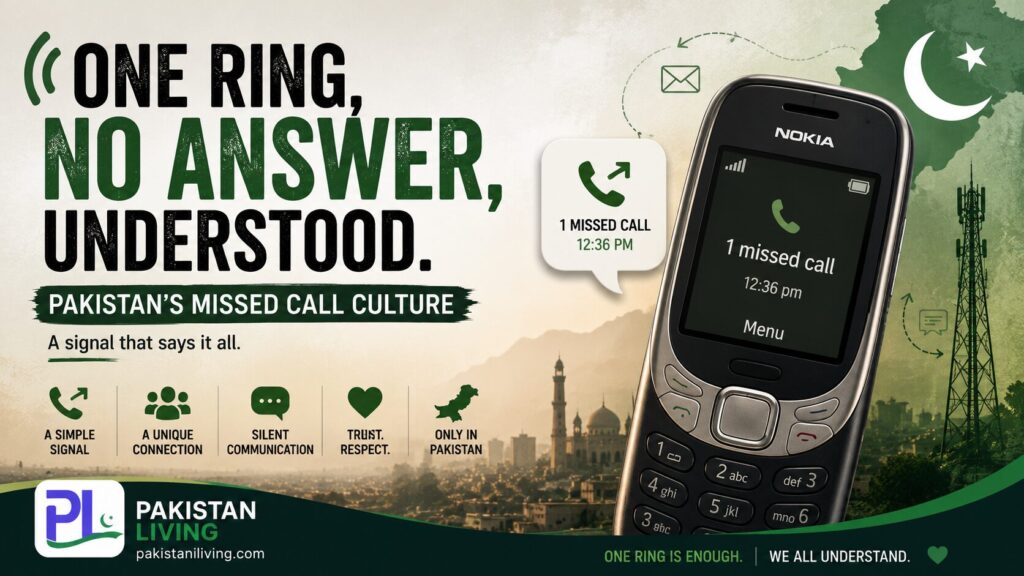
One Ring, No Answer, Understood: Pakistan’s Missed Call Culture

OnePlus Nord CE 3 Lite
Before WhatsApp ticks, before read receipts, before voice notes — Pakistan had a communication system so efficient it needed no words at all. One missed call meant I am outside your gate. Two meant call me back. Three meant it is urgent. And everyone understood perfectly.
The Economy That Made It Possible
To understand missed call culture, you first have to understand the mobile billing structure that created it — specifically one asymmetry that defined an entire decade of Pakistani communication: incoming calls were free.
From roughly 2000 through 2014, Pakistani mobile networks operated on a Calling Party Pays (CPP) model. The person who dialled paid per minute. The person who received the call paid nothing. This single tariff structure had profound social consequences that no telecom company fully anticipated.
A call that was answered for just a second — or disconnected before the other side picked up — cost the caller almost nothing, sometimes as little as the pulse charge for the connection attempt, sometimes literally zero if the network billed only on sustained connections. But it cost the receiver nothing at all. And the receiver, who saw your number, understood exactly why you called.
Per-minute mobile call cost, early 2000s (peak-hour)
Cost of receiving a call on any Pakistani network, CPP era
Cost of a one-second “missed call” attempt, where charged at all
Peak era of Pakistani missed call culture
For millions of Pakistanis living on tight household budgets — students with Rs. 10 credit left, labourers who recharged with Rs. 50 for a week, housewives who were not permitted to freely spend on phone credit — the missed call was not a trick or an inconvenience. It was a lifeline. It was the only way to say “I’m here” when you could not afford to be heard.
The Codebook Nobody Wrote Down
What is remarkable about Pakistani missed call culture is not that it existed — variations appeared in India, Bangladesh, Egypt, Kenya, and dozens of other countries with similar billing structures. What is remarkable is how elaborately it was codified. Over five or six years in the early 2000s, Pakistani mobile users developed a nuanced grammar of rings that was understood across class, city, and generation.
Nobody announced the code. There was no TV campaign, no SMS forward explaining the rules. It emerged organically, neighbourhood by neighbourhood, university campus by university campus, until it was simply common knowledge — the way everyone knows that a car horn in a Pakistani city means something different from a car horn in Tokyo.
I have arrived / I am outside
The most universal signal. Driver parked outside the house. Friend at the university gate. Delivery at the door. No words needed.
Call me back / I need to talk
The speaker has credit. The receiver has credit. The receiver should call. The conversation belongs to the receiver’s bill.
Urgent — call immediately
Three rings crossed from polite into pressing. Something required attention. The three-ring missed call was rarely ignored.
Do not ignore me
Multiple rapid missed calls from the same number meant anger, panic, or desperation. The social cost of ignoring four missed calls from a known contact was real.
Beyond the ring-count system, the relationship between caller and receiver added layers. A missed call from your mother meant something different from the same missed call from a university friend. A missed call from an unknown number was received with suspicion. A missed call back — returning a missed call with another missed call — acknowledged receipt without incurring full call cost on either side. These were not written rules. They were absorbed through use.
The Rs. 1 Balance: A Cultural Reference Point
The phrase “Rs. 1 balance” became a cultural shorthand for an entire life condition in Pakistan’s mobile era. When your balance hit Rs. 1 or below, many networks restricted outgoing calls entirely. You could receive calls for free. But you could no longer dial out. The Rs. 1 balance was not poverty in the acute sense — it was an in-between state, a temporary paralysis familiar to virtually every Pakistani mobile user regardless of class.
The Rs. 1 balance missed call was also a social signal. It communicated not just a message but a context. When someone gave you a missed call from a number known to belong to a student or a young working person, you understood the economics behind it. You called back. It was an unspoken social contract: the person with credit calls the person without. The arrangement rotated based on who had recharged most recently.
Class, Context, and Who Was Calling Whom
While missed call culture cut across economic lines, the way it was used varied sharply by social context. Consider the different communities for whom it became essential:
Students
University and college students were the heaviest users. Meeting coordination, lecture updates, exam result signals, and social plans ran almost entirely on missed call shorthand. Hostel culture made it essential — corridor landlines were public, mobile credit was scarce.
Drivers & Domestic Staff
The household driver giving one missed call to signal he was waiting outside became so universal that some employers adopted it as a formal arrangement. No need to park and walk to the door. One ring, and the household knew to come down.
Working-Class Men
Daily-wage workers, delivery riders, and factory labourers used missed calls to check in with families at minimal cost. A daily one-ring call at a fixed time — 7 PM, after the shift — told the household everything was fine without the worker spending a single rupee.
Joint Families
In large joint family households, missed calls coordinated kitchen timings, meal readiness, and shopping returns. The returning husband giving one ring while two streets away gave the household fifteen seconds to freshen up and turn on the stove.
Small Shopkeepers
Vendors and shopkeepers used missed calls to signal stock delivery, price confirmations, and payment readiness. The wholesale market runner who gave two missed calls to the shop owner meant “your order is ready, come collect” — a free logistical update.
Religious Gatherings
Mosques, madrasas, and community leaders used missed call chains to coordinate attendance at events. One person called five, each called five more. An entire neighbourhood mobilised to a janaza or a wedding with zero collective credit expenditure.
The Gender Dimension: Missed Calls and Surveillance
Missed call culture in Pakistan had a gender dimension that cannot be politely omitted. For young women, the incoming call was also a surveillance point. Parents and brothers monitored call logs. Unexplained numbers in the received calls list required explanation. The mobile phone — which had offered girls unprecedented private communication — also created new avenues for family control.
Young men discovered that a missed call from an unknown number could initiate contact with a girl without leaving a retrievable voice recording or an SMS thread. The missed call said only: someone with this number thought of you. It was deniable. The girl who called back was the one who had made a choice. This asymmetry — the caller initiates, the receiver decides — was exploited constantly.
For women with controlling household situations, the missed call also served as a secret language. A girl who was not permitted to freely receive calls at home could pre-arrange a code with a trusted friend: one missed call means “I cannot talk right now,” two missed calls means “all clear, call on the second ring and I will pick up before anyone notices.” The phone itself had become a site of negotiation.
Women’s use of missed calls was not only romantic or secretive. Mothers coordinating with daughters about school pick-up times, sisters checking if the other had reached safely, friends confirming they had boarded the bus — for women who paid close attention to their remaining credit because it was not always easy to recharge privately, the missed call was a practical tool as much as a social one.
Nokia and the Technology of the Missed Call
The Nokia handsets that dominated Pakistan’s mobile market between 2000 and 2010 were, inadvertently, perfect instruments for missed call culture. Their call log kept a clear list of missed calls, dialled numbers, and received calls. The small screen showed you the number, the time, and how many times that number had called. You could reconstruct an entire social calendar from a Nokia 1100’s call register.
The Nokia 1100, released in 2003 and which became the best-selling mobile phone in history at over 250 million units, was the phone most associated with this era in Pakistan. Priced around Rs. 4,000–5,000 in the mid-2000s, it was accessible to middle and lower-middle income buyers and became the default handset for the class of people for whom missed call culture was most economically important.
| Nokia Model | Approx. Pakistan Price | Missed Call Relevance |
|---|---|---|
| Nokia 1100 | Rs. 4,000–5,500 (2003–2005) | The people’s phone; most associated with missed call era; clear log, long battery, single-volume ring |
| Nokia 3310 | Rs. 6,000–8,000 (2001–2003) | Pre-missed call era but established Nokia trust; its ring tone — the classic Nokia tune — was the universal “someone is calling” sound |
| Nokia 2600 | Rs. 4,500–6,000 (2004–2006) | Slightly upmarket; FM radio added; still fully the missed call era |
| Nokia 6600 | Rs. 18,000–22,000 (2004–2006) | Affluent students and young professionals; Symbian-based; missed calls were less financially necessary but culturally embedded |
| Nokia N70 | Rs. 22,000–28,000 (2006–2007) | Camera phone aspirational tier; the owner gave missed calls less for credit reasons, more by habit |
The Nokia 1100’s ringtone volume — loud enough to hear from another room, from inside a pocket, above traffic noise — was not incidental. Pakistan’s streets and homes were noisy. A phone that rang quietly would miss its one-second window. The fact that Nokia’s entry-level phones were designed for maximum audibility in noisy environments made them ideal for a communication style that depended on the recipient noticing a single ring.
The Networks’ Complicated Relationship With the Missed Call
Pakistani mobile operators — Mobilink (Jazz), Ufone, Telenor, Warid, Zong — had an ambivalent relationship with missed call culture. On one hand, it was a sign of high engagement: people were actively using their phones, keeping them charged, maintaining active SIMs. On the other hand, it was a deliberate avoidance of billable call minutes, which directly reduced revenue.
Different operators tried different approaches to either monetise or discourage the missed call:
As deregulation opened Pakistan’s market and new operators entered, the focus was purely on subscriber acquisition. Missed calls were not yet understood as a significant revenue drag. Networks competed on per-minute rates.
Ufone’s “Tum Hi Tum” campaign and similar packages from rivals brought per-minute rates below Rs. 0.50 on-net. The strategy was to make actual calls cheap enough that the missed call became unnecessary. It partially worked — call volumes increased dramatically — but did not eliminate missed call culture, which by then was behaviorally embedded.
Operators introduced formalised “please call me” features — typically dialling a short code to send a free text to a contact requesting a callback. This acknowledged missed call culture explicitly while trying to channel it into a trackable, monetisable interaction. Uptake was moderate; many users found it slower than simply giving a missed call.
Per-minute bundle packages (100 minutes for Rs. 12, unlimited on-net calls on certain plans) made call-back behaviour affordable enough that the missed call lost some of its economic urgency. Social habit was slower to shift than economics.
The shift to smartphone ownership and mobile internet access — driven by low-cost Android devices below Rs. 8,000 — brought WhatsApp into daily life. WhatsApp’s free messaging and, from 2013, free voice calling began to make the missed call system redundant in urban, younger demographics.
The Missed Call as Social Performance
It would be inaccurate to reduce missed call culture to pure economics. By the mid-2000s it had become a social performance — a language with etiquette, violations, and humour around it. The rules were enforced not by any authority but by social expectation.
To not call back after a clearly intentional missed call was a social statement. If someone gave you two missed calls — the understood “call me back” signal — and you had credit but chose not to call, you were communicating something. Indifference. Avoidance. The end of a friendship, sometimes. The equivalent of reading a text message and deliberately not replying.
The missed call also carried comedic possibility. University friend groups developed elaborate variations: a rapid-fire sequence of five missed calls meant “where are you, the biryani is here, come immediately.” One missed call repeated every thirty seconds meant the sender was bored and wanted company. The call back to a missed call that was itself a missed call — the “missed call ping-pong” — became a joke about two people who refused to spend credit and yet urgently needed to speak to each other.
“Yaar, woh tera missed call tha ke mera? Main nay bhi missed call diya tha jab tu nay diya tha.”
(“Was that your missed call or mine? I had also given a missed call just as you gave yours.”)
— Every Pakistani who lived through this era has had this conversation.
The Alarm Missed Call: Waking Someone Up
One distinctly Pakistani application of the missed call deserves its own section: using it as an alarm. Nokia phones before about 2004 had limited alarm functionality. Even when alarms were available, setting them correctly on Nokia’s slightly counterintuitive menu system was not guaranteed. The backup was a friend with a different sleep schedule.
Calling someone at 6 AM to wake them for Fajr, for an early bus, for an exam, for a flight — but not wanting to wake the entire household with a ringing phone — required a delicate calibration. The protocol became: give one missed call. If they do not stir within two minutes, give another. If after three attempts there is no response, you have done your duty and they have missed their bus on their own terms.
This served a dual social purpose. The caller demonstrated care — “I remembered your early morning” — while not spending credit on an actual conversation. The receiver, woken by the familiar ringtone pattern at an unusual hour, understood immediately. No groggy conversation was required. You glanced at the screen, saw the known number, checked the time, and got up.
Missed Call Chains and Community Organisation
Pakistani communities — mohalla committees, masjid networks, school parent groups — quietly used missed call chains to coordinate collective action long before WhatsApp broadcast lists existed. The chain worked like this: one central person gave a missed call to five people. Those five each gave a missed call to five more. Within fifteen minutes, fifty people had been notified of something, and not a single rupee had been spent.
Political mobilisation used this too, though less efficiently. In the pre-social-media era, local politicians and party workers used missed call trees to call supporters to rallies. It was slower than modern tools and subject to the chain breaking if any link failed, but in communities with tight social bonds it was surprisingly effective.
When the Networks Took It Away: The Incoming Call Charging Controversy
The economics of missed call culture shifted when Pakistani regulators and operators began discussing charging for incoming calls, a move being discussed in various forms between 2005 and 2008 as part of broader tariff restructuring. The public reaction was fierce, disproportionate even by Pakistani standards of mobile-related public feeling.
The proposal — that receivers of calls might pay a small per-minute fee, shifting from pure CPP toward a partial Receiving Party Pays (RPP) model — struck directly at what had become a deeply embedded social assumption. Incoming calls were free. They had always been free. Charging for them was not just an economic change but a social one: it would destroy the missed call’s foundational logic and force people to be more careful about even receiving calls.
The backlash came from every direction. Consumer groups, newspaper columnists, mobile users on early SMS-based public forums, and the operators themselves (who feared subscriber churn to any competitor that maintained free incoming) resisted the change. Pakistan largely retained free incoming calls through the peak missed call era, which allowed the culture to continue uninterrupted until WhatsApp replaced it from the bottom up rather than from operator policy from the top down.
The Social Death of the Missed Call: 2013–2018
Missed call culture did not die in a single moment. It contracted. It retreated to specific demographics and specific use cases while the broader culture moved on.
The agents of its decline were familiar: the Rs. 5,000–8,000 Android phone that arrived in Pakistani markets in significant volume around 2012–2013, cheap 3G data following the 2014 spectrum auction, and WhatsApp which by 2015 had become the default communication tool for urban Pakistanis under forty.
WhatsApp’s voice call feature, launched in 2015, was free on data and offered better voice quality than GSM on a good connection. More importantly, it showed delivery receipts and missed call notifications in a way that was fully logged and shareable. The social logic of the missed call — deniable, cheap, quick — was partially replicated by WhatsApp’s free calling. But WhatsApp calls were answered or rejected explicitly; there was no elegant one-ring signal that communicated precisely without conversation.
Some aspects of missed call culture survived the transition. The driver-outside-the-gate ring migrated to WhatsApp in the form of a single missed call through the app, which cost nothing on data. The wake-up missed call became a WhatsApp message or a voice note. The two-rings “call me back” became a WhatsApp text. The grammar survived even as the medium changed.
| Missed Call Signal | WhatsApp Equivalent | Quality of Replacement |
|---|---|---|
| 1 ring: I am outside | WhatsApp missed call or “here” message | Good replacement; WhatsApp missed call is free on data |
| 2 rings: call me back | “Call karo” or a brief voice note | Good replacement; more explicit, less ambiguous |
| 3 rings: urgent | Multiple “???” messages or urgent voice note | Partial replacement; urgency harder to signal without words |
| Wake-up ring at Fajr | WhatsApp message with alarm clock context | Weaker; message may not wake receiver, does not have same pavlovian ring quality |
| Missed call chain for community event | WhatsApp group broadcast | Superior replacement; faster, more information, confirmation possible |
| Rs. 1 balance “I cannot call, please call me” | Irrelevant; WhatsApp messaging is data-based, not balance-based | Problem dissolved rather than replaced |
Who Still Uses It
The missed call has not entirely disappeared from Pakistan in 2026. It persists in specific communities and contexts where smartphones have not fully penetrated, or where the old habits are deeply enough ingrained to survive alongside new tools.
Rural Pakistan, where smartphone penetration and data access remain uneven, still uses feature phones and the missed call system to a meaningful degree. Seasonal agricultural labourers, domestic workers in wealthier households, and elderly users who received their first phone as a Nokia in 2005 and see no compelling reason to change — for these groups the missed call is still a live communication tool rather than nostalgia.
Urban Pakistan has retained specific use cases. The driver-outside-the-gate ring has become almost a professional formality in Karachi and Lahore, even among drivers who use WhatsApp for other communication. Some workplace cultures — construction sites, warehouses, field sales teams — where workers cannot always attend to a ringing phone but can glance at a screen, still use the one-ring system as a check-in signal.
What the Missed Call Revealed About Pakistan
The missed call was not a Pakistani invention. But the specific way it was adopted, codified, and defended in Pakistan says something true about the country.
Pakistan is a high-context society, which means much of its communication relies on shared assumption, relationship, and context rather than explicit statement. The missed call fit naturally into this framework. It required both parties to understand context: who was calling, at what time of day, from what number, in what relationship. Without that shared context the signal was meaningless. With it, the signal was perfectly precise.
Pakistani social life also places enormous weight on maintaining contact and demonstrating care without the weight of formal obligation. A missed call said “I thought of you” without requiring a conversation. It acknowledged relationship without demanding time. In a culture where the phrase “phone karo” (call me) carries warmth but also expectation, the missed call offered warmth without expectation. It was the affectionate nod across a crowded street — sufficient in itself.
It also revealed the Pakistani genius for working creatively within constraints. The balance was low, the minute rates were high, and the social need to communicate was high. The missed call was not a workaround. It was an optimised solution. It extracted maximum communicative value from a near-zero-cost interaction. Pakistan’s street economics — the jugaar, the adaptive improvisation — applied to digital communication, and it worked beautifully for a decade.
The Missed Call in Pakistani Pop Culture
Pakistani television drama, advertising, and eventually social media all engaged with missed call culture as a recognisable social reality. The drama serial trope of a missed call used to signal a forbidden meeting — hero outside the heroine’s house, one ring, she makes an excuse and comes downstairs — became a cliché precisely because it was accurate. Audiences recognised it instantly. No exposition was needed.
Pakistani advertising leaned into the missed call to sell mobile packages. Ufone’s celebrated advertising campaigns of the mid-2000s, among the most beloved in Pakistani commercial television history, acknowledged the missed call indirectly by selling cheap callback rates — “so you won’t have to give missed calls.” The missed call was treated as a slight social embarrassment, something you did when you had to, but not something you should have to do if your package was right. This framing both normalised and slightly stigmatised the practice.
The SMS forward culture of the same era produced thousands of jokes about missed calls. The “please call me, I have no balance” forward. The “I gave you five missed calls” frustrated text from someone who had eventually spent credit to complain about not spending credit. These jokes circulated precisely because everyone had lived them.
A Fitting Epitaph
In 2026, the missed call exists in the digital archaeology of Pakistani memory the way the trunk call does — something the over-thirty generation remembers with the specific texture of lived experience, and the under-twenty generation has heard about as a piece of how-did-people-manage-before history.
The missed call was never just about saving money. It was a shared language, developed collectively and used with genuine sophistication. It encoded relationships, communicated urgency, maintained connection across economic constraint, and did so with an elegance that the explicit, over-documented world of read receipts and voice notes has not quite replaced.
When a Pakistani driver today gives one WhatsApp call that he immediately disconnects, he is not being rude. He is speaking a sentence in a language that his employer, if they are old enough, still understands perfectly. Some grammars survive the disappearance of the dictionary.
Coming Next
Pakistan’s telecom journey from PTCL’s monopoly era through deregulation, the 2003 opening, explosive mobile growth, the 2014 3G/4G auction, and 5G in 2026 — the full history, with the political decisions, corporate battles, and on-the-ground impact that shaped how 230 million people communicate today.
Also in this series: The Ufone vs. Mobilink price war that halved call rates, the Warid story, how Zong (China Mobile) changed the market, and what Jazz’s Easypaisa did to banking.

Xiaomi Redmi Note 12

About Luqman
A passionate technology writer and digital researcher,Luqman specializes in simplifying complex tech trends into practical, user-focused insights. With a strong interest in smartphones, emerging gadgets, and digital ecosystems, Luqman delivers well-researched, unbiased content tailored for everyday users. From product deep-dives to buying guides, the goal is simple: help readers make smarter, more informed decisions in a fast-changing tech landscape.