
Pakistan Mobile Packages History: How Call Rates Fell from Rs. 20 to Almost Nothing (1994–2026)

Apple iPhone 16 Pro
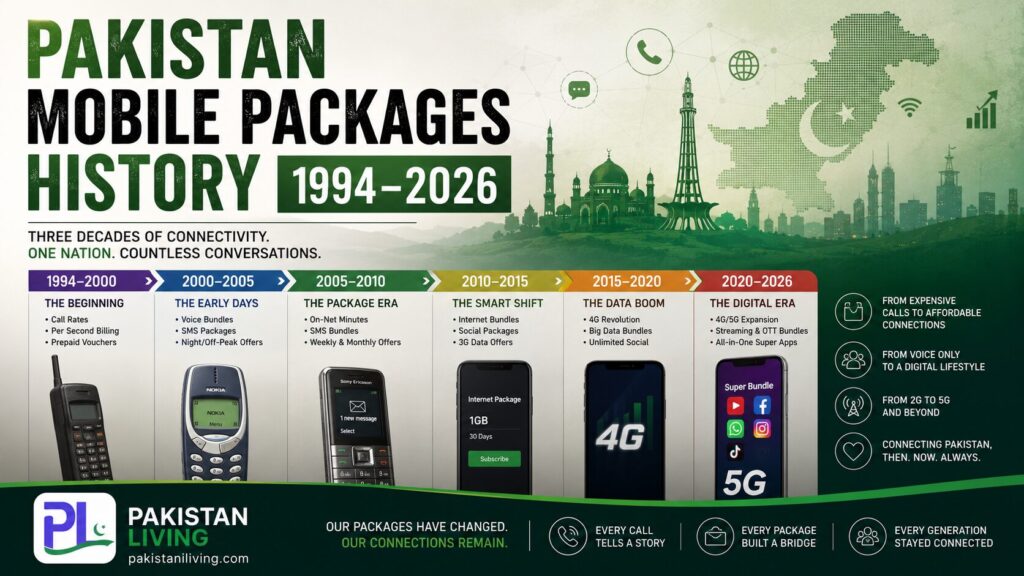
In 1994 a one-minute mobile call in Pakistan cost Rs. 15–20. In 2026 you can make unlimited on-net calls for Rs. 12 per day. This is the story of how Pakistan’s mobile tariff history unfolded — era by era, operator by operator — and what each transition meant for how Pakistanis communicated.
Era 1: The Monopoly Rates (1994–2003)
Pakistan’s first mobile tariffs reflected a luxury product for a captive market. With Mobilink as effectively the only significant operator (Paktel and Instaphone serving negligible subscriber counts), there was no competitive pressure to reduce prices. The per-minute rate of Rs. 15–20 on peak hours was simply the price of the product — take it or leave it. Almost everyone left it.
The billing model was post-paid only for most of this era. Subscribers received a monthly bill. Credit checking was required. The minimum monthly commitment made mobile service inaccessible for users who could not guarantee consistent monthly spending. For the small professional class that used Mobilink in the late 1990s, this was acceptable. For anyone else, it was irrelevant.
SMS pricing in this era was Rs. 1–2 per message, which sounds cheap compared to call rates but was not free. The concept of unlimited SMS was years away. Each text cost money, which meant Pakistanis in this era — those who had phones — were disciplined and purposeful in their SMS use rather than the casual, high-volume style that emerged after 2005.
Era 2: Deregulation and the Price War (2003–2008)
The 2003 deregulation and the entry of Telenor and Warid in 2005 triggered the most aggressive price war in Pakistani consumer history. Per-minute rates fell from Rs. 5–8 at deregulation to below Rs. 1 on promotional packages within three years. This was not a slow decline — it was a collapse driven by five operators competing for the same subscriber pool.
Ufone’s “Tum Hi Tum” (2006–2007)
Ufone’s Rs. 0.50/minute on-net package, marketed under the “Tum Hi Tum” campaign, was a breakthrough. It offered on-net (Ufone to Ufone) calls at half the prevailing market rate, acknowledging directly that Pakistani users primarily called within the same network. The campaign created urgency to switch networks if your most-called contacts were on Ufone. Competitor responses were rapid — Jazz and Warid matched similar on-net rates within months, and the floor for all on-net rates moved to under Rs. 1/minute across the market.
The prepaid revolution was equally significant. Mobilink’s Jazz prepaid SIM at Rs. 300–500, rechargeable with Rs. 100 cards, transformed mobile from a post-paid contract product to a pay-as-you-go tool accessible to anyone with Rs. 500. Telenor and Warid entered with comparable prepaid structures. Ufone, as PTCL’s mobile subsidiary, was slightly slower to compete on prepaid but matched market rates by 2006–2007.
SMS bundles emerged in this era as a separate revenue stream. The first SMS bundle products — typically 100 SMS for Rs. 5 or Rs. 10 — arrived around 2006–2007 and immediately became popular. The Eid SMS culture described elsewhere in this series was made economically possible by these bundle products. Without cheap bundled SMS, the Eid forward chain that circulated millions of messages would have been prohibitively expensive for ordinary users.
| Year | Typical Peak On-Net Rate | Typical Off-Net Rate | SMS Rate | Key Development |
|---|---|---|---|---|
| 1994–2000 | Rs. 15–20/min | Rs. 15–20/min | Rs. 2–3/SMS | Single operator era |
| 2003 | Rs. 5–8/min | Rs. 5–8/min | Rs. 1–2/SMS | Deregulation; competition begins |
| 2005 | Rs. 2–4/min | Rs. 3–5/min | Rs. 0.5–1/SMS | Telenor and Warid enter |
| 2007 | Rs. 0.50–1/min | Rs. 1.5–2/min | Rs. 0.20/SMS (bundles) | Peak price war; bundle era begins |
| 2009 | Rs. 0.25–0.50/min (bundles) | Rs. 0.80–1.5/min | Rs. 0.05–0.10 (bundles) | SMS bundles mainstream; data emerging |
Era 3: The Bundle Revolution (2008–2014)
By 2008–2009, per-minute pricing as the dominant model was being replaced by bundle-based pricing. Rather than paying per minute, subscribers subscribed to daily, weekly, or monthly bundles that offered a fixed number of minutes (and SMS) for a flat fee. The shift was driven by operator economics — bundles provided more predictable revenue — and by consumer preference for simplicity.
The daily bundle became Pakistan’s standard mobile package format by 2010. For Rs. 5–15 per day, a subscriber could get 200–500 on-net minutes, 100 off-net minutes, and 100 SMS. The economics were radically different from per-minute billing: a subscriber spending Rs. 10/day was committing Rs. 300/month — equivalent to what a high-usage customer might spend on per-minute rates, but with unlimited (within bundle) access rather than rationed minutes.
Era 4: Mobile Data Pricing (2014–2020)
The 3G/4G auction of 2014 introduced a new dimension to mobile packages: data. From near-zero mobile internet usage, Pakistan moved to mass mobile data adoption within two years of the auction. The pricing evolution of mobile data in Pakistan from 2014 to 2020 mirrors the voice price war of 2003–2008 — entry prices that were high relative to what the market would sustain, followed by rapid competitive collapse.
In 2014, 3G data was priced at approximately Rs. 5–8 per MB (megabyte) on PAYG (pay-as-you-go) rates — expensive enough that casual use would consume a significant budget rapidly. Data bundles at launch: 500MB for Rs. 100–150 per month. By 2016, 1GB per day bundles were available from all major operators for Rs. 15–25. By 2018, 10GB monthly bundles were under Rs. 200. By 2020, 5–10GB data per day at Rs. 15–20 was common in promotional packages.
| Year | Typical Monthly Data Bundle | Price | Speed |
|---|---|---|---|
| 2014 | 500MB–1GB | Rs. 100–200 | 3G (HSPA+, 5–10 Mbps) |
| 2015 | 2–3GB | Rs. 200–350 | 3G/early 4G |
| 2017 | 5–8GB | Rs. 250–400 | 4G LTE (20–40 Mbps) |
| 2019 | 15–25GB | Rs. 300–500 | 4G LTE |
| 2022 | 40–60GB | Rs. 400–700 | 4G LTE Advanced |
| 2026 | Unlimited (FUP 50–100GB) | Rs. 500–900 | 4G LTE / 5G (where available) |
Era 5: The All-in-One Bundle (2020–2026)
Pakistan’s current mobile package landscape is characterised by all-in-one bundles that combine calls, SMS, and data into a single product at a daily, weekly, or monthly price. The complexity of separate voice, SMS, and data products that characterised 2015–2019 has largely simplified into a few standard tiers.
The daily bundle remains Pakistan’s most popular format, reflecting Pakistani financial behaviour: spending a small daily amount feels more manageable than a large monthly commitment, even when the monthly equivalent would be cheaper. Operators know this and price daily bundles accordingly — daily bundles are typically 20–30% more expensive on a per-unit basis than monthly equivalents.
The WhatsApp and OTT Effect on Pakistani Packages
WhatsApp’s emergence as Pakistan’s dominant communication tool after 2013 had direct consequences for mobile package economics. Voice calls, whose revenues had driven operator growth, were increasingly being replaced by WhatsApp calls that consumed only data. SMS, which had been a significant revenue line, was replaced by WhatsApp messages on data bundles. Operators watched substantial per-unit revenue shift from high-margin voice to lower-margin data.
The operator response was to bundle aggressively — making data cheap enough that subscribers did not feel they were paying a premium to use WhatsApp, while ensuring total monthly spending stayed consistent. Social media-only bundles — data packages valid only for Facebook, WhatsApp, and TikTok, not general internet — were introduced and found popularity among users who used their phone primarily for social media rather than full internet access. These were controversial among digital rights advocates (zero-rating specific apps distorts the open internet) but commercially successful.
Taxes and the Pakistan Mobile Package Reality
No account of Pakistani mobile packages is complete without acknowledging the tax structure that affects every transaction. Pakistan applies multiple levies on mobile services: advance income tax, withholding tax, provincial sales tax, and telecom-specific levies vary by province and by the type of service (call, SMS, data).
The practical effect is that the advertised package price and the actual balance deducted frequently differ. A Rs. 30 daily bundle may result in a balance deduction of Rs. 35–38 after taxes. Pakistani mobile users have developed a resigned familiarity with this discrepancy, but it creates friction in the customer relationship that operators regularly attempt to address through transparent pricing communication with limited success. The tax structure itself — set by federal and provincial governments — is outside operators’ control.

Xiaomi Redmi 12C

About Luqman
A passionate technology writer and digital researcher,Luqman specializes in simplifying complex tech trends into practical, user-focused insights. With a strong interest in smartphones, emerging gadgets, and digital ecosystems, Luqman delivers well-researched, unbiased content tailored for everyday users. From product deep-dives to buying guides, the goal is simple: help readers make smarter, more informed decisions in a fast-changing tech landscape.