Warid Telecom: The Pakistani Mobile Brand That Disappeared Into Jazz

Infinix Smart 20
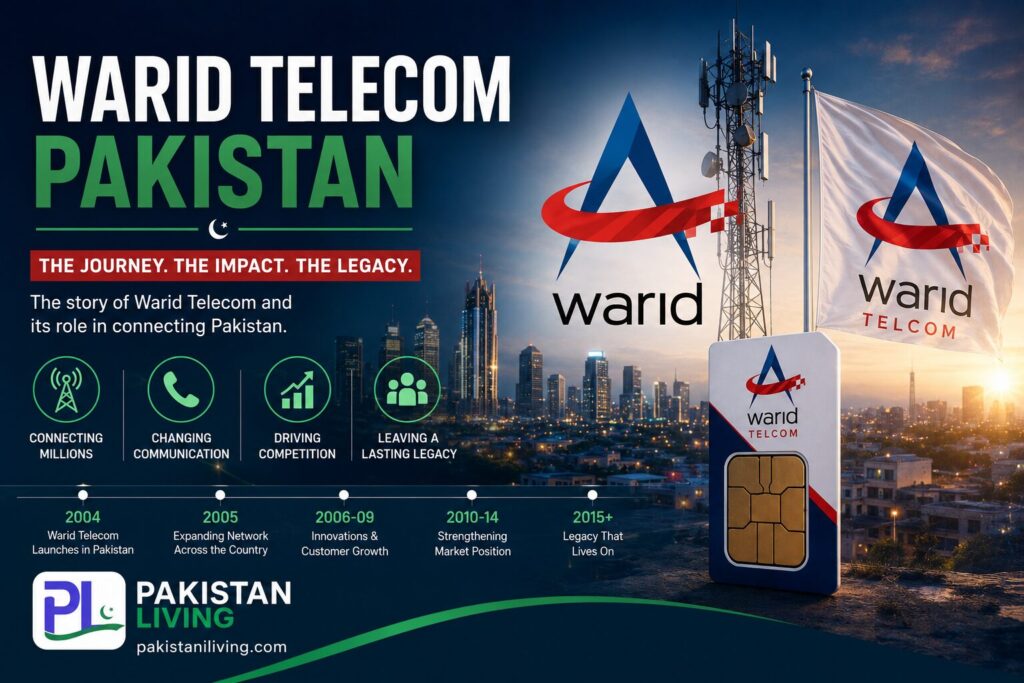
Warid Telecom launched in Pakistan in 2005 with the backing of Abu Dhabi’s wealthiest business group and the ambition to become Pakistan’s premium mobile network. Eleven years later the brand was gone, absorbed into what became Jazz. This is the story of what Warid was, why it mattered, and why its loyal users still remember it.
The Abu Dhabi Group Behind Warid
Warid Telecom was owned by the Abu Dhabi Group, a conglomerate controlled by Pakistani-Emirati businessman Nahayan Mabarak Al Nahayan and associated interests. The group had significant investments in Pakistan’s banking sector (Bank Alfalah), media, and real estate, and saw mobile telecommunications as the next major investment opportunity as the 2003 deregulation opened the market to competition.
The Abu Dhabi Group paid approximately $1 billion for a mobile license and initial infrastructure investment — a significant commitment reflecting both the group’s confidence in Pakistan’s mobile growth trajectory and its existing commercial relationships in the country. Warid was never going to be a scrappy startup; it launched with capital, infrastructure contracts, and management talent that smaller entrants could not match.
The Warid Premium Positioning
Warid entered Pakistan’s market in 2005, the same year as Telenor, into a competitive environment already defined by Mobilink’s mass-market Jazz prepaid strategy and Ufone’s PTCL-backed infrastructure advantage. Rather than compete directly on price, Warid initially positioned itself at the quality end of the market.
Warid’s early network received consistently strong reviews for call clarity and dropped-call rates in urban areas. The company invested heavily in base station quality rather than coverage breadth in its first years, which produced a network that was better in Karachi’s Clifton and Lahore’s Gulberg than its subscriber count might have suggested, but weaker in semi-urban and rural areas where coverage rather than quality was the deciding factor.
Warid’s postpaid offerings were particularly well-regarded. In a market that was rapidly going prepaid, Warid maintained a quality postpaid product with business-focused billing and customer service that appealed to corporate accounts. Small and medium businesses in Karachi and Lahore used Warid postpaid as their corporate mobile network because of its urban call quality and the credibility that came with the Abu Dhabi Group backing.
The Competitive Pressure and the Subscriber Struggle
Warid’s premium positioning was commercially correct in a narrow sense and strategically insufficient in a broader one. Pakistan’s mobile market in 2005–2010 was being defined at the bottom, not the top. The explosive subscriber growth that transformed the market from 12 million to 100 million subscribers happened in the lower-middle and working-class brackets where price was the primary consideration and call quality was secondary to being able to afford to call at all.
Warid gained subscribers steadily but never approached Mobilink’s mass-market scale. By 2010–2011, Warid had approximately 18–20 million subscribers — meaningful but consistently fourth or fifth among Pakistan’s five operators. The company attempted to compete on price more aggressively from 2010 onward, but entering a price war from a premium position is difficult: cutting prices signals the premium was never real, while maintaining them concedes the mass market permanently.
The 4G License and the Strategic Asset
Pakistan’s 2014 spectrum auction assigned Warid a 4G LTE license — one of only two (alongside Telenor) initially allocated for 4G. This single allocation transformed Warid from a struggling fourth-tier operator into a strategic asset with something that Pakistan’s market leader (Mobilink/Jazz) did not have: a 4G license.
Mobilink’s decision to bid only for 3G spectrum in the 2014 auction, leaving Warid and Telenor as the initial 4G operators, was a strategic miscalculation that the company recognised within a year. The solution — acquiring a company that held 4G spectrum — made Warid’s acquisition both logical and, given the 4G license value, financially straightforward to justify to Veon (Mobilink’s parent) shareholders.
The Merger and the End of Warid
Veon (then VimpelCom, parent of Mobilink) announces acquisition of Warid Telecom from Abu Dhabi Group. Deal value: approximately $150 million plus assumption of Warid’s network liabilities. The price reflected Warid’s declining subscriber trajectory but recognised the 4G spectrum value.
Regulatory approval obtained. Warid subscriber base migrated to Mobilink network. Combined entity has approximately 55 million subscribers, becoming Pakistan’s largest operator. Warid SIM cards continue to work on the Mobilink network during the transition period.
Mobilink announces the Jazz rebrand. Both the Mobilink and Warid brands are retired simultaneously. The Jazz brand, which had been Mobilink’s prepaid sub-brand since 2003, becomes the single consumer identity for the combined entity. Warid retail shops close or convert to Jazz branding.
Warid brand fully retired. All Warid numbers now carry Jazz branding. The 011 number series (Warid’s distinctive prefix) is maintained for existing subscribers but new activations are on Jazz numbering. Warid as a consumer brand ceases to exist.
What Warid Subscribers Said When It Ended
The Warid brand generated genuine loyalty among a specific demographic — urban professionals, corporate users, and users who had experienced its network quality as superior to competitors in their specific locations. When the brand was retired, the reactions on Pakistani social media — then primarily Facebook and early Twitter Pakistani communities — showed something more than the typical grumbling about corporate changes.
“My Warid number since 2007. Always had better call quality than Mobilink. Now they say it is Jazz. Same number but different name. I will keep the number but it feels like something ended.”
This sentiment — not anger, exactly, but a specific form of loss that attached to a phone number and a brand that had been part of daily life for a decade — was common. Phone numbers become part of identity in Pakistan, where business cards, WhatsApp contacts, and family phone lists are built around specific numbers accumulated over years. The merger did not change subscribers’ numbers. It changed what those numbers meant symbolically.
What Warid Left Behind
Warid’s practical legacy within Jazz is the 4G spectrum it contributed to the merger — spectrum that enabled Jazz to compete in the 4G market that the 2014 auction would otherwise have locked it out of. The urban tower infrastructure Warid had built in Karachi, Lahore, and Islamabad — optimised for quality rather than coverage breadth — was integrated into Jazz’s network and contributed to the combined network’s urban quality.
The Warid brand itself, however, left no institutional trace. No Jazz package carries the Warid name. No Jazz retail space references the brand. Warid exists only in the memories of users who had it, the corporate records of Veon’s acquisition, and articles like this one.
It is, in a way, the most complete kind of brand disappearance — not a decline to a niche market, not a relaunch as something else, but a clean absorption into a larger entity that carries no obligation to remember what it consumed. Warid Telecom was Pakistan’s fifth mobile operator for eleven years. Now it is a footnote in Jazz’s corporate history. The users who remember it differently know something that the corporate record does not quite capture.