
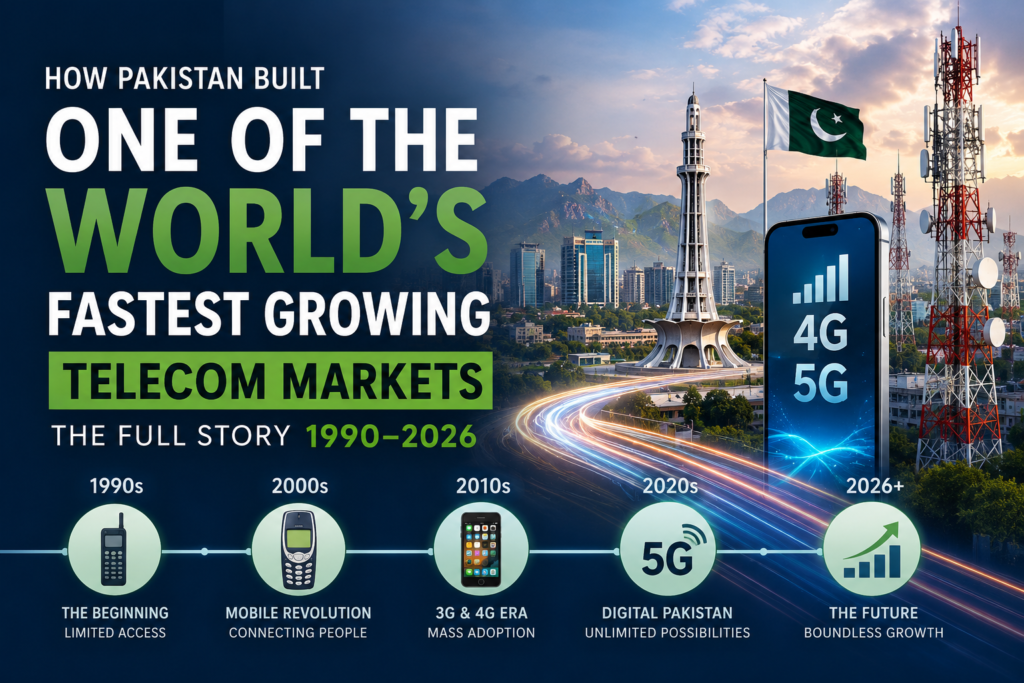
How Pakistan Built One of the World’s Fastest-Growing Telecom Markets: The Full Story (1990–2026)

Vivo X500 Pro
In 1990, Pakistan had roughly 900,000 landlines for a population of 110 million. By 2026 it had 230 million mobile subscribers, 5G commercial service in major cities, and a mobile payments ecosystem that financial analysts compare favourably with Kenya’s M-Pesa. This is the story of how that happened — the policy decisions, the corporate battles, the technology rollouts, and what they meant for ordinary Pakistanis.
Where It Began: The PTCL Era (1947–2003)
Pakistan’s telecommunications history begins with inheritance. When Pakistan gained independence in August 1947, the new country received a colonial telephone infrastructure built around administrative and military needs rather than mass connectivity. The system that had served a small British administrative class was simply re-signed to the Pakistan Telegraph and Telephone Department (T&T Department), which later became the Pakistan Telecommunication Corporation (PTC) in 1991 and was restructured into Pakistan Telecommunication Company Limited (PTCL) in 1996.
For nearly five decades, telecommunications in Pakistan was a government monopoly. PTCL controlled all fixed-line services, international calls, and long-distance connectivity. This monopoly was not merely administrative — it was structural. Building a telephone exchange required government approval. Making an international call required going through PTCL’s infrastructure. The company set its own rates, determined its own expansion priorities, and answered to government ministry rather than customer demand.
The results were predictable. By 1990, Pakistan had approximately 900,000 fixed lines — a teledensity (phones per 100 people) of less than one. The waiting list for a new landline connection ran into years in major cities. Bribes to PTCL officials for line prioritisation were an open secret. Rural Pakistan was almost entirely unconnected.
International calls from Pakistan in this era were prohibitively expensive. A three-minute call to the United Kingdom — the most common overseas destination, given Pakistan’s large diaspora — cost the equivalent of a day’s wages for a lower-middle-income earner. The PCO (Public Call Office) system described elsewhere in this series was the practical solution for those who needed to make calls they could not afford from a personal line.
The First Mobile Experiment: 1992–2000
Mobile telecommunications arrived in Pakistan earlier than is often remembered. Pakistan Mobile Communications Limited (PMCL), trading as Mobilink, launched in 1994, making Pakistan one of the first countries in the subcontinent with commercial mobile service. A second operator, Paktel, also launched in the early 1990s under various ownership structures.
But “launched” overstates the reality. These early services were expensive analogue systems aimed at business users and the wealthy. A mobile handset in 1995 cost more than many Pakistanis earned in three months. Per-minute call rates were entirely out of reach for ordinary households. Mobile telephony in this era was a status symbol in the most literal sense — a large brick phone on a restaurant table was a declaration of financial standing.
The significant point is structural. PTCL’s monopoly was on fixed-line and long-distance services. Mobile spectrum was licensed separately. This created, somewhat accidentally, a space in which private mobile operators could exist while PTCL retained control of the landline backbone. The consequences of this structural split would become significant after 2003.
The Monopoly Years — 1947 to 2003
Single state operator. No competition. Fixed-line only for most of the era. Mobile arrives in 1994 but serves only the wealthy. Rural Pakistan almost entirely unconnected. International calls expensive through PTCL controlled routing. Pakistan’s teledensity among the lowest in Asia.
The Watershed: Deregulation and the New Policy (2003–2005)
The Musharraf government’s 2003 Telecom Deregulation Policy is, without question, the single most consequential document in Pakistan’s telecommunications history. It dismantled PTCL’s monopoly, opened long-distance and international services to competition, created a framework for multiple mobile operators, and established the Pakistan Telecommunication Authority (PTA) as an independent regulator. The policy did not create Pakistan’s mobile revolution directly, but it created the conditions in which that revolution could occur.
The deregulation had several immediate effects. Fixed-line providers other than PTCL could now enter the market. Long-distance calls could be routed through competing networks. But most significantly for the story that followed, the government issued new mobile licenses. By 2005 Pakistan had five operating mobile networks, each competing for subscribers in a market that was about to experience explosive growth.
Mobilink (Jazz)
Founded 1994 — First Pakistani mobile operator
Originally owned by Motorola, then Orascom Telecom. Launched the Jazz brand for prepaid services. Became Pakistan’s largest mobile operator by subscriber count within a decade.
Ufone
Launched 2001 — PTCL subsidiary
Pakistan Telecom Mobile Limited, wholly owned subsidiary of PTCL. Leveraged PTCL’s infrastructure advantage. Ufone’s advertising — particularly its humour-based campaigns — became among the most celebrated in Pakistani commercial television.
Telenor Pakistan
Launched 2005 — Norwegian parent
Telenor ASA won a license in the 2004 auction and launched services in 2005. Brought significant capital investment and European operational standards. Grew rapidly, reaching 10 million subscribers by 2007.
Warid Telecom
Launched 2005 — Abu Dhabi Group
Backed by Abu Dhabi Group, a Pakistani-Emirati conglomerate. Positioned as a quality network. Warid grew to significant scale before eventually merging with Jazz in 2015–2016.
Paktel / Zong
Paktel 1990s — Acquired by China Mobile 2007, rebranded Zong 2008
Paktel struggled as an independent operator. China Mobile — the world’s largest telecom company by subscribers — acquired it in 2007, an investment that gave China a direct foothold in Pakistan’s communications infrastructure.
The Etisalat privatisation of PTCL deserves separate mention. In 2006, the Abu Dhabi-based Etisalat acquired a 26 percent controlling stake in PTCL from the Pakistani government for $2.6 billion — the largest foreign direct investment in Pakistan’s history at that time. The deal was contentious: Etisalat committed to a modernisation investment programme and employee terms that were disputed for years afterward. But it introduced significant capital and management expertise into what had been a sclerotic state bureaucracy. PTCL’s EVO wireless broadband service, launched in the mid-2000s, gave Pakistan its first practical broadband option in cities before mobile internet arrived.
Deregulation and Competition — 2003 to 2008
Five operators compete for subscribers. Price war drives per-minute rates from Rs. 5–8 to under Rs. 1. Mobile subscriber count grows from under 5 million to over 90 million by 2008. SMS becomes mass medium. Missed call culture peaks. PTCL privatised. International call costs collapse as competing long-distance providers enter. Mobile leapfrogs fixed line — Pakistan never achieves high fixed-line penetration, going directly to mobile as primary voice network.
The Price War and Mass Adoption (2005–2010)
The period from 2005 to 2010 was defined by one dynamic: operators competing on price with a ferocity that transformed mobile from luxury to necessity within five years. Pakistan went from under 5 million mobile subscribers in 2003 to over 100 million by 2011 — one of the fastest adoption curves of any large market globally.
The price war was brutal for operator margins but transformative for consumers. Per-minute call rates on prepaid services fell from Rs. 5–8 in 2003 to below Rs. 1 on many promotional packages by 2008. The recharge threshold fell from Rs. 100 minimum cards to Rs. 10 top-ups. Mobile phones themselves, driven by the Nokia 1100 and subsequent budget models, fell below Rs. 5,000 making first-time ownership possible for a much broader population.
| Year | Mobile Subscribers (M) | Approx. Peak Per-Minute Rate | Key Event |
|---|---|---|---|
| 2000 | 0.3 | Rs. 15–20 | Mobile a luxury item |
| 2003 | 2.4 | Rs. 5–8 | Deregulation policy |
| 2005 | 12.8 | Rs. 2–4 | Telenor and Warid launch |
| 2007 | 63.2 | Rs. 1–2 | Nokia mass-market handsets, China Mobile acquires Paktel |
| 2009 | 94.3 | Under Rs. 1 (bundles) | Easypaisa launches, SMS peak |
| 2011 | 108.9 | Bundle era (minutes packages) | Market near saturation on voice |
Ufone’s advertising during this period deserves specific mention. While all operators competed on price, Ufone differentiated on emotional connection. Its campaigns — featuring ordinary Pakistani characters navigating absurd situations, entirely in Urdu with natural Pakistani speech patterns rather than formal broadcast language — were breakthrough work. They normalised mobile use across class lines, portrayed it as an everyday tool rather than a business instrument, and built brand loyalty that survived the price wars.
Telenor introduced Easypaisa in 2009 in partnership with Tameer Microfinance Bank — a story told in full separately in this series. But the strategic significance here is that Telenor identified, correctly, that voice revenue was becoming commoditised. Value-added services, particularly financial services, would differentiate operators in the second decade. Easypaisa proved this thesis comprehensively.
The PTCL Broadband Period and WiMAX (2006–2012)
Pakistan’s internet history runs parallel to but separate from its mobile voice history. PTCL launched DSL broadband in 2007 under the brand PTCL Broadband. Coverage was limited to urban areas with working copper landline infrastructure, which excluded large portions of even major cities. Speeds were capped and pricing was high relative to the market.
PTCL’s EVO wireless broadband service, using CDMA 1x EVDO technology, gave urban areas a mobile data option before 3G licensing. The experience was variable — speeds fluctuated significantly with network load, and the USB dongle model was cumbersome — but it demonstrated demand for mobile internet before mobile operators offered it.
WiMAX licenses were issued in Pakistan in the late 2000s, and a small number of operators, particularly Qubee (owned by Augere) and Wi-Tribe, built out WiMAX networks in Karachi, Lahore, Islamabad, and a few other cities. WiMAX offered practical broadband speeds for fixed or semi-mobile use. Like PTCL’s EVO, it bridged the gap before true mobile broadband.
The fundamental problem with all of these intermediate technologies was coverage. Pakistan’s geography — dense urban cores, sprawling urban peripheries, and vast rural areas — made wired infrastructure expensive per connection. The mobile operators’ existing tower networks, built for voice, were the logical delivery mechanism for broadband. The industry waited for 3G spectrum allocation, which the government delayed for reasons that were primarily fiscal rather than technical.
The 3G/4G Auction: A Billion-Dollar Moment (2014)
Pakistan’s 3G and 4G spectrum auction in April 2014 was a pivotal moment — not just for telecommunications but for the economy. The auction raised $1.12 billion for the government, the largest single-day tax or fee collection in Pakistan’s history at that point. More significantly, it set in motion the mobile internet revolution that would reshape Pakistani daily life within three years.
The auction results reflected the operators’ strategic ambitions. Zong paid a premium for 4G spectrum, signalling China Mobile’s long-term commitment to the Pakistan market and its intention to compete not on legacy voice infrastructure but on next-generation data. Telenor also committed to 4G, consistent with its Easypaisa digital services strategy. Mobilink (the market leader on voice) acquired 3G spectrum but was initially slower to deploy 4G, a decision that cost it ground against Zong in the coming years.
The rollout was rapid by global standards. By late 2014, 3G services were live in major cities. By 2015, mobile internet users had crossed 20 million. By 2016, the figure was over 40 million. The pace of adoption reflected suppressed demand that had been waiting for affordable mobile data to become available.
Mobile Internet — 2014 to 2020
3G/4G transforms Pakistan from a voice-and-SMS market to a data market. WhatsApp replaces SMS. Facebook becomes the primary news and social platform for many Pakistanis. YouTube, blocked from 2012 to 2016 over content concerns, returns and becomes the dominant video platform. Easypaisa and JazzCash reach tens of millions of mobile wallet users. Low-cost Android phones below Rs. 10,000 drive smartphone penetration past 50 percent in urban areas by 2018.
The Consolidation Wave: Jazz, Telenor-PMCL, and the Five-Becomes-Three Story (2015–2020)
Pakistan’s mobile market, which had five competing operators from 2005 onward, began consolidating in the late 2010s as voice revenue matured and data infrastructure costs required scale.
The most significant consolidation was the Mobilink-Warid merger, announced in late 2015 and completed in 2016. Veon (the parent of Mobilink, formerly known as VimpelCom) acquired Warid Telecom from the Abu Dhabi Group and merged the two entities. The combined company was rebranded Jazz in 2017 — the first time in Pakistan that a telecom rebrand required retiring a name (Mobilink) that had been active for over twenty years. The merger created Pakistan’s largest mobile operator by subscriber count, with over 55 million subscribers at launch and a combined spectrum holding that was unmatched by any competitor.
Telenor Group explored various options for its Pakistan operations during this period, including a potential merger with Zong that was discussed publicly but never concluded. The market settled, broadly, into a three-network structure: Jazz (largest), Zong (fastest-growing on data), and Telenor (strong in rural coverage and financial services via Easypaisa), with Ufone as a smaller fourth player operating under PTCL/Etisalat ownership.
5G: The Long Approach and the March 2026 Launch
Pakistan’s 5G journey was slower than its mobile internet transition, for reasons that mixed the technical, financial, and political. 5G spectrum (particularly the 3.5 GHz band most commonly used for mid-band 5G globally) requires a denser tower network than 4G, higher capital expenditure, and a device ecosystem — smartphones capable of using 5G — at accessible price points. All three conditions needed to align.
Trials began in earnest in 2022, conducted jointly by operators and the PTA in controlled environments. The trials demonstrated that Pakistan’s existing tower infrastructure could support 5G upgrades in urban areas without a full greenfield build. The real question was spectrum allocation and pricing — the government, aware of the 2014 auction’s revenue success, sought similarly significant proceeds from 5G licensing. Operators, facing compressed margins from the data price wars, resisted valuations they considered unrealistic.
The 2026 commercial launch — announced in March 2026 with initial coverage in Karachi, Lahore, and Islamabad — resolved this standoff on terms broadly acceptable to both sides. Initial 5G services in Pakistan follow the Non-Standalone (NSA) architecture standard, meaning the 5G radio layer uses the existing 4G LTE core. This is the same path taken by most early 5G markets globally. Standalone 5G, with its lower-latency full-architecture benefits, is a subsequent phase.
5G and Digital Services — 2020 to Present
Mobile money reaches over 100 million registered users across Jazz Cash and Easypaisa combined. SadaPay and NayaPay launch as digital-native neobanks. COVID-19 accelerates digital adoption in education, payments, and commerce. 5G trials 2022–2024. Commercial 5G launch March 2026 in Karachi, Lahore, Islamabad. Pakistan’s 5G adoption will follow the urban concentration pattern of 3G/4G but with faster initial device penetration given the smartphone base already in place.
Regulatory Milestones: The PTA’s Role
The Pakistan Telecommunication Authority, established in 1996, has been the institutional framework within which all of this development occurred. Its quality and independence have varied significantly over three decades. In its early years it operated partly as a legacy regulator protecting PTCL’s interests rather than promoting competition. After deregulation in 2003 it became more genuinely market-oriented, though political interference in specific decisions — spectrum allocation, license renewals, interconnect rate-setting — remained a recurring concern.
PTA’s DIRBS (Device Identification, Registration and Blocking System) programme, launched in 2018–2019, represents one of its more ambitious interventions. DIRBS required all mobile handsets sold or imported into Pakistan to be registered by IMEI, with unregistered phones blocked from networks. The programme targeted the grey and counterfeit phone market, which had grown significantly as customs-duty-free smuggling via Afghanistan and other routes made unregistered handsets cheaper than legally imported ones. DIRBS’ implementation was controversial — legitimate owners of previously purchased phones had to register or face blocking — but it brought a significant portion of the grey market into the formal economy.
PTA’s content regulation powers have been a persistent source of controversy. Pakistan has one of the more active content-blocking regimes in Asia. YouTube was blocked from 2012 to 2016 over a specific content dispute. Twitter was blocked briefly in 2022. VPN usage in Pakistan is widespread precisely because the list of blocked sites and services has grown over time. The tension between content regulation and the open internet remains unresolved and is outside the scope of telecom infrastructure history, but it is inseparable from any accurate account of how Pakistanis use their connected devices.
The Financial Inclusion Revolution: Mobile Money (2009–2026)
Perhaps the most significant and least internationally celebrated achievement of Pakistan’s mobile revolution is financial inclusion. Pakistan in 2009 had approximately 10–15 percent formal banking penetration among adults — one of the lowest rates in Asia. The combination of geographic barriers, identity document requirements, bank fee structures, and cultural factors kept the majority of the population outside formal financial services.
Easypaisa’s 2009 launch, described in full in its own article in this series, demonstrated that mobile agents — small shopkeepers and general stores enrolled as cash-in/cash-out points — could bring basic financial services to populations with no practical access to bank branches. The model, similar to M-Pesa in Kenya, proved exceptionally well-suited to Pakistan’s urban and peri-urban geography. By 2015, Easypaisa had over 30 million accounts. JazzCash, launched by Mobilink in 2012, competed and grew. By 2026 the two services combined have well over 100 million registered mobile wallet users.
The State Bank of Pakistan’s fintech regulatory framework, particularly its Raast instant payment system launched in 2021, has further accelerated digital payments. Raast provides instant bank-to-bank transfers at zero cost, which has begun to shift even middle-class Pakistanis from cash to digital for everyday transactions. The trajectory is clear: Pakistan is building a digital financial infrastructure at a pace that was unimaginable in 2009 when Easypaisa launched from a single Karachi pilot.
What Pakistan’s Telecom Story Reveals
Pakistan’s telecommunications history from 1990 to 2026 is not a simple story of progress. It includes periods of deliberate state protection of a monopoly, of spectrum hoarding for fiscal reasons, of policy decisions that delayed broadband by years. The PTCL privatisation deal with Etisalat contained terms that were disputed in courts for a decade. The 3G auction was delayed repeatedly from its originally planned date of around 2007, costing Pakistan five or six years of mobile internet development during which India and Bangladesh advanced significantly.
And yet the overall trajectory is remarkable. A country that in 1990 had fewer landlines than Switzerland has 230 million mobile subscribers. A country where international calls required a government monopoly exchange now has cheap data calls over WhatsApp and YouTube available to daily-wage workers. A country where financial services required physical bank branches now has mobile wallets in rural markets and mountain villages.
The driver of this transformation was not primarily state strategy. It was competition, unlocked by the 2003 deregulation, combined with the cost curve of mobile hardware falling in ways that made the mass market accessible. Pakistan’s mobile operators — with all their flaws, their billing disputes, their interconnect rate arguments, and their content-blocking compliance — built an infrastructure that changed daily life more profoundly than most government programmes in the same period.
The 5G era that opened in March 2026 is the next chapter. The questions it raises are the same ones that characterised every previous transition: Will coverage reach beyond the three major cities quickly? Will the device ecosystem become affordable at mass market price points within two to three years? Will the regulatory framework enable innovation without imposing the kind of restrictions that delayed 3G by half a decade? Pakistan’s telecom history suggests reasons for both optimism and caution in equal measure.

Samsung Galaxy A35 5G

About Luqman
A passionate technology writer and digital researcher,Luqman specializes in simplifying complex tech trends into practical, user-focused insights. With a strong interest in smartphones, emerging gadgets, and digital ecosystems, Luqman delivers well-researched, unbiased content tailored for everyday users. From product deep-dives to buying guides, the goal is simple: help readers make smarter, more informed decisions in a fast-changing tech landscape.